Who is this choice relevant to?

Interviewers in a reverberant room

If you want to record the speaker clearly, consider the distance and position of the microphone. The East Midlands Oral History Archive at the University of Leicester recommends placing a table microphone as close as possible to the interviewee.

Interviewers recording two voices

If a shared microphone position doesn’t work well for both the speaker and interviewer, separate microphones and inputs can help you position each one individually. The International Association of Sound and Audiovisual Archives discusses achieving a balanced level between voices, while Zoom and Tascam document recorders with additional microphone inputs.

Creators of long-form archive interviews

If you’re recording long conversations and want to keep the original file, consider power, storage, recording format and file transfer when choosing. Sprekende Geschiedenis recommends keeping the original source file as the archive master.

What should you look for when choosing?

Compact recorder with built-in microphones

A good choice if: you can position the recorder close to the speaker and want a simple setup.

Bear in mind: a recorder placed in the middle of a large table may be further from the speaker than you’d like; 32-bit float mode won’t eliminate room reverberation.

Recorder with inputs for separate microphones

A good choice if: you want to position microphones closer to different speakers.

Bear in mind: check that the inputs and any power requirements are compatible with your microphones; cables and a test recording require extra preparation.

What to consider What to look for when buying Who is this important for?
Speaker clarity Can you position the microphone close to the speaker without picking up clothing rustle or handling noise? Make a test recording and listen back to it. If I want to record the speaker clearly in a reverberant room, I focus on the distance to the microphone. Around 33% of consumers prioritise clarity.
Recording two voices Decide whether one microphone can capture both voices clearly; if not, check the number of inputs and the type of microphone required. If one shared microphone position doesn’t work well for the speaker and interviewer, I want to be able to position them separately. Around 27% of consumers prioritise recording two voices.
Uninterrupted recording Check the power supply, available storage, recording settings and remaining recording time; this can vary by format. For a long interview, I want to avoid a flat battery or full storage interrupting the recording. Around 20% of consumers prioritise continuity.
Keeping the source file Check whether WAV/PCM is available, how much recording time remains with that setting, and how you can transfer the original file. If I want to keep the interview for later, I want to be able to transfer and find the original file. Around 20% of consumers prioritise having a usable source file.

Common pitfalls

  • Expecting 32-bit float to eliminate room reverberation

    A recording mode and the acoustics of a room are two different things. A recorder with this mode is no substitute for good microphone positioning.

    Test your setup in the room where the interview will take place, then listen back to the test recording.

    You may still need a microphone that can be positioned closer to the speaker, with a compatible connection.

  • Assuming the longest stated recording time applies to WAV

    The stated recording time can vary considerably depending on the file format and settings. Philips lists 11 hours for the VoiceTracer DVT4110 at PCM 48 kHz/16 bit; longer times apply to MP3 settings.

    Compare the remaining recording time for the format you actually want to use for the interview.

    A less compressed setting may require more storage space than an MP3 setting.

  • Buying two microphones without checking the inputs

    Two separate microphones require enough compatible recorder inputs; some microphones also need a specific connection or power supply.

    Decide in advance where both speakers will sit and check that the recorder and microphones will work together for that setup.

    Your setup may require extra microphones, cables and preparation.

Brands to compare

Zoom

The H1essential combines built-in X/Y microphones with a 3.5mm microphone input. The H4essential also has inputs 1 and 2 for a more extensive interview setup.

  • Zoom lists 32-bit float recording, headphone monitoring and lavalier microphone connection via the 3.5mm input for the H1essential.
  • The H4essential’s additional inputs are most useful if you’re actually using separate microphones; these features don’t mean that room reverberation will disappear.

Tascam

The DR-05XP has built-in omnidirectional microphones, while the DR-40XP offers two external XLR/TRS inputs with phantom power.

  • Tascam lists a 32-bit float mode for both models and describes the DR-40XP’s separate external inputs.
  • Choose connections to suit the microphones you want to use; a recording mode won’t solve room reverberation.

Sony

The ICD-UX570 is a compact voice recorder with linear PCM and MP3 recording, built-in memory and direct USB transfer.

  • Sony specifies 4 GB of built-in memory and file transfer via USB.
  • Sony’s claims about reducing background noise are manufacturer claims; in a reverberant room, good microphone positioning remains a separate consideration.

Philips VoiceTracer

The DVT4110 offers PCM/WAV recording and separate 3.5mm connections for a microphone and headphones.

  • According to Philips VoiceTracer’s technical specifications, recording time on the built-in memory is 11 hours at PCM 48 kHz/16 bit.
  • Longer stated recording times apply to MP3 settings, so check the recording time for the format you want to use.

Joybuy products

This selection includes an AI voice recorder for interviews and conversations in a room. Test the microphone positioning separately in your room to see how well it works.
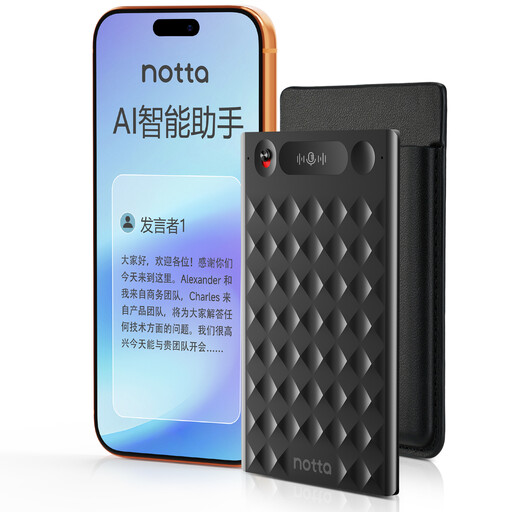
Notta 32GB AI Voice Recorder, Black

Notta 32GB AI Voice Recorder, Black

The product description mentions interviews and recording in a room; make a test recording to see whether the microphone setup suits the reverberation in your room.

The description lists a four-microphone array and 32 GB of storage.

The stated recording time is up to 30 hours; check the settings and available storage before your interview.

The Notta app is mentioned for cloud syncing and file management.

View at Joybuy

Frequently asked questions

Where should I place the microphone in a room without acoustic treatment?

Place the microphone as close to the speaker as the setup allows, without picking up noise from clothing, cables or handling. Make a test recording in the room and listen back to assess how the voices sound.

Should I choose MP3 or WAV for an archive interview?

If you want to keep the original interview as a source file, choose an available recording setting with as little compression as possible and keep the original. Sprekende Geschiedenis recommends keeping the source file as the archive master; also check how much recording time remains with that setting.

What extra equipment might I need for my interview setup?

It depends on the setup you choose: check whether you need a compatible microphone, cable, headphones, memory card or power solution. Make sure the connections and any microphone power requirements are compatible with the equipment you want to use.

Can I record an oral history interview and publish it later?

That depends on how the recording will be used and the circumstances. The Dutch Data Protection Authority explains that the GDPR exemption for purely personal or household use is limited to that context. If the GDPR applies, you must identify an appropriate legal basis before processing the data; consent is one possible basis, but it isn’t automatically the only one. These rules alone don’t provide a general answer to whether every interview can be recorded without consent.

What warranty rules apply to purchases in the Netherlands?

Consumer purchases in the Netherlands are covered by the statutory guarantee, but there is no fixed statutory guarantee period. The Dutch Government says that what you can expect from a product depends in part on the product and the circumstances. If a product is faulty, contact the seller.
