Who is this buying guide for?

A speaker with a quiet voice

If you’re recording someone whose voice is hard to hear over the background noise in a noisy or echoey room, focus on the microphone’s distance and position. The University of Leicester’s East Midlands Oral History Archive discusses using a lapel microphone to reduce echo.

An interviewer who needs to capture both voices

If you want to be able to hear both the questions and answers later, test the balance between the two voices or plan to use a microphone for each speaker. The International Association of Sound and Audiovisual Archives provides guidance on positioning a microphone near the person speaking.

Someone recording long life stories

If you’re recording a long conversation to work on or preserve later, check the power supply and available storage beforehand, and make a test recording. The Oral History Association also explains the importance of informed consent and agreeing how a recording may be made publicly available.

What should you look for?

Recorder with a lapel microphone

Choose this when: background noise or echo might drown out the speaker’s quiet voice, and they’re comfortable wearing a microphone.

Consider: this setup prioritises the speaker’s voice. Make sure you capture the interviewer too, and check that the microphone is compatible with the recorder’s connection.

Handheld recorder with built-in microphones

Choose this when: both speakers can sit comfortably near the recorder and a test recording confirms that their voices are clear.

Consider: a hard table can add reflections and handling noise. A low-cut filter is no substitute for good microphone placement.

Compact voice recorder with internal memory

Choose this when: ease of use, finding files or transferring recordings are important, and the recorder captures clear speech in the room.

Consider: internal memory may mean you don’t need a separate card, but the built-in microphone still needs to be positioned well.

What to considerWhat to look forWho is this important for?
Speech clarityTest the actual room using headphones; check that the recorder is compatible with your chosen external microphone.If I’m recording a quiet speaker in a noisy or echoey room, I want to be able to position the microphone nearby. Around 36% of consumers cite speech clarity as their main reason for buying.
Both voicesAsk both speakers to talk at their usual volume and listen back to the test recording before the conversation starts.If I want to be able to hear the questions later too, the setup needs to capture more than just the speaker clearly. Around 29% of consumers prioritise both people in the conversation.
Recording time and storageCheck the available storage, whether you need a memory card, and the power options for the model you’re considering.For a long interview, I want to avoid the recording being interrupted by a lack of storage or power. Around 21% of consumers put uninterrupted recording first.
Managing filesCheck how to transfer the recording, which file format you’ll use and how to keep the original file.If I want to find or work on the interview later, I want to be able to transfer and store the files easily. Around 14% of consumers make file management their top priority.

Common pitfalls

  • Assuming 32-bit float or noise reduction can make up for a microphone being too far away

    Recording features and filters won’t automatically solve the problem of a quiet voice being too far from the microphone in a noisy room.

    Choose your microphone setup first, then assess the recording features with a test recording in the room where you’ll be recording.

  • Placing a handheld recorder directly on a hard table between the speakers

    The speaker may be too far from the microphone, and the table can add reflections or handling noise to the recording.

    Try a stable position that’s softer or raised, then listen back to check that both voices are clear.

  • Forgetting that some recorders use a separate memory card

    The Zoom H1essential uses microSD; Sony lists 4 GB of internal memory for the Sony ICD-UX570.

    Check the storage medium for the exact model and test the device before the interview.

  • Not agreeing how the recording will be kept or whether it may be published

    A recording intended for your own use may later be used differently. The Dutch Data Protection Authority notes that an identifiable voice recording can be personal data.

    Discuss the purpose, who will have access and whether publication is planned with the speaker beforehand. The Oral History Association recommends informed consent and agreeing how a recording may be made publicly available.

Relevant brands to compare

Zoom

The H1essential is a compact handheld recorder that combines built-in X/Y microphones with the option to connect a compatible lapel microphone.

  • Zoom lists a 3.5 mm microphone input, headphone output and 32-bit float recording.
  • These features won’t eliminate background noise caused by poor microphone placement. The H1essential uses microSD, so check which card suits your recording needs.

Tascam

The DR-05XP has built-in microphones and an input for a compatible external microphone, so you can tailor the setup to the room and the speakers.

  • Tascam lists 32-bit float recording, a low-cut filter and a stereo mini-jack input with plug-in power.
  • The built-in omnidirectional microphones don’t necessarily let you place the recorder further away from a quiet speaker.

Sony

The ICD-UX570 is a compact voice recorder for anyone comparing internal storage with features for playback and searching.

  • Sony lists 4 GB of internal memory, linear PCM and MP3, plus a recording monitor.
  • These features alone won’t tell you whether both voices will be clear in a noisy room; test the positioning in the space.

Philips VoiceTracer

The DVT4115 combines internal memory with recording settings for tasks such as interviews.

  • Philips lists 8 GB of internal memory, a microSD slot and PCM/MP3.
  • The recording formats and storage listed don’t tell you how clearly a conversation will be captured in your flat; make a test recording.

OM SYSTEM

The WS-883 is a compact voice recorder for anyone comparing ease of use and file transfer.

  • OM SYSTEM lists 8 GB of internal memory and built-in USB transfer for the WS-883.
  • The Dutch product copy also mentions the WS-882 in its description, so check the exact model name when buying and don’t assume the features apply to both models.

Joybuy products for interviews and recording tasks

These products are aimed at recording interviews and offer features for working with recordings. Before choosing, check which microphone setup works in your room.
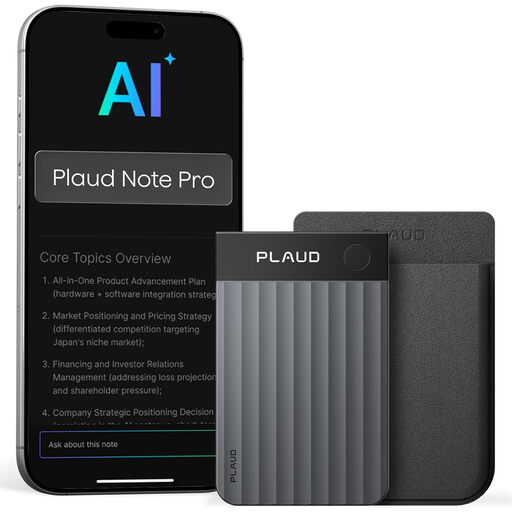
Plaud Note Pro AI voice recorder, black

Plaud Note Pro AI voice recorder with Notes & Summary (Black)

Suitable for anyone looking for an interview recorder with note-taking and summarising features.

View product on Joybuy
Digital voice recorder with transcription, 64 GB

Digital voice recorder with transcription, 64 GB

Suitable for anyone who wants to record interviews and is looking for a transcription feature.

The product title specifies 64 GB of storage.

View product on Joybuy
Mini AI dictation device with transcription and summaries in 118 languages, 64 GB

Mini AI dictation device, 64 GB, transcription and summaries in 118 languages

Suitable for anyone looking for a compact interview recorder and comparing transcription and summarising features.

The product title specifies 64 GB and features for 118 languages.

View product on Joybuy
notta AI voice recorder, 32 GB, black

notta AI voice recorder, 32 GB, 2000h storage and 30h battery (Black)

Suitable for anyone looking for an interview recorder with transcription and summarising features.

The product title specifies 32 GB, 30h of battery life and a claimed recording capacity of 2000h. Check how this capacity is defined before comparing it with your own recording time.

View product on Joybuy

Frequently asked questions

How do you make a test recording in a noisy flat?

Choose the quietest spot available and position the microphone close to the speaker. Ask both speakers to talk at their usual volume, then listen back through headphones to check for clear speech, rustling clothes and table noise before the interview starts.

What should you check before a long interview?

Check the power supply, available storage, recording device and whether a connected microphone works, then make a short test recording. The Zoom H1essential uses microSD, so check that you have the required card for this model.

Does the speaker need to consent to being recorded or to publication?

Discuss what you’re recording, how you’ll store it and whether you plan to publish it beforehand. The Oral History Association recommends informed consent and agreeing how a recording may be made publicly available. The Dutch Data Protection Authority notes that an identifiable voice recording can be personal data. According to the Dutch Data Protection Authority, the exception for personal or household use applies only when the recording is used exclusively for private purposes, not on behalf of a business, and for your own personal or household use. If the GDPR applies to the processing, you need a lawful basis, and consent is one option.

What are your rights if a recorder bought online turns out to be faulty?

When you buy from a business seller, the product must meet what you could reasonably expect from it under normal use. The seller is responsible for putting right, free of charge, a fault covered by the statutory guarantee, according to ACM ConsuWijzer. In many cases, distance purchases also come with a 14-day cooling-off period, subject to exceptions, according to the Dutch government. This cooling-off period is separate from your rights if a product is faulty.
