What should you look for when choosing?
Simple voice recorder
Best suited to: recording short passages and getting started with playback quickly.
Bear in mind: the OM SYSTEM VN-541PC records in mono using WMA; its described noise-cancellation feature works during playback.
Voice recorder with more recording options
Best suited to: practising at different distances and comparing microphone modes; according to its specifications, the Philips VoiceTracer DVT4110 has one directional and two omnidirectional microphones.
Bear in mind: results can vary depending on the position and settings, so test the setup you plan to use.
Versatile portable audio recorder
Best suited to: assessing the sound of the room or connecting a compatible external microphone; the Zoom H1essential and Tascam DR-05XP offer different recording and connection options for this.
Bear in mind: placement and storage need consideration; 32-bit float recording won’t automatically make a soft voice recorded from far away clear.
First decide whether ease of use or flexibility in your recording setup matters more for your practice sessions. Then make a test recording from the distance at which you plan to practise the script.
| What to consider |
What to look for |
Who this matters to |
| Hearing soft words clearly on playback |
Test from the distance you plan to speak at, and check the microphone direction and whether there’s an input for an external microphone. |
If I speak softly, I also want to be able to make out words at the end of a sentence; around 36% of consumers give top priority to making soft speech clear. |
| Recording and listening back quickly |
Check the start and stop controls, built-in playback options and whether the file format is compatible with the device you’ll use to listen back. |
If I repeat the same paragraph often, I want to be able to record and listen without fiddly settings; around 29% of consumers prioritise being able to repeat a recording quickly. |
| Practising in different places |
Make short test recordings in the relevant locations and check that your chosen external microphone fits the input. |
If I practise in different parts of a museum, I want to compare how much of my voice and the room sound each setup captures; around 21% of consumers prioritise varying acoustics. |
| Storage and power for longer sessions |
Check the recording medium, chosen format and power supply for the exact model. |
If I practise longer sections back to back, I want to be able to plan storage and power in advance; around 14% of consumers put session length first. |
Joybuy products
These Joybuy picks are related to recording and listening back to a spoken museum script. Compare the listed features with the way you work, and test how clear the recording is in the place where you plan to practise.
 No image available
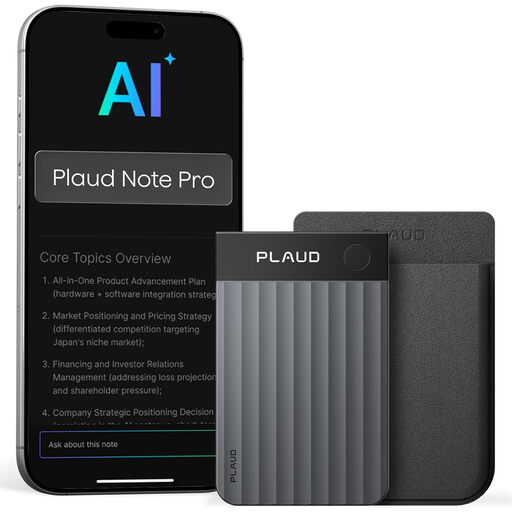
Plaud Note Pro AI voice recorder for notes and summaries (black)
May suit you if you want to record a spoken practice session and also need transcription or summaries.
The product name mentions AI recording, notes and summaries; check that these features fit the way you work.
View at Joybuy
 No image available
64 GB digital voice recorder with transcription function
May suit you if you want to record a spoken script and need transcription; check the recording itself from the distance at which you practise.
The product name lists 64 GB of storage and a transcription function.
View at Joybuy
 No image available
64 GB AI dictation device, mini voice recorder with transcription and summaries in 118 languages
May suit you if you want to record a spoken practice session and use transcription or summaries.
The product name lists 64 GB, transcription and summaries in 118 languages; check that the features work with the software you use.
View at Joybuy
 No image available
Rexsun L357 digital voice recorder, 128 GB
May suit you if you want to record short passages and listen back to them repeatedly.
The product name lists 128 GB of storage.
View at Joybuy
 No image available
Rexsun L810 digital voice recorder, 64 GB
May suit you if you want to record a practice session and listen back straight away.
The product name lists 64 GB of storage.
View at Joybuy
Frequently asked questions
Which recorder is handy if you keep recording the same paragraph?
Start by looking at the controls and playback, rather than just the stated recording time. OM SYSTEM lists a recording slider on the VN-541PC; Zoom Corporation lists adjustable playback speed on the H1essential. A short test recording can help you decide which controls suit you.
How do you prepare a recorder for a practice session?
Check the recording medium and power supply, then make a short test recording from the distance you plan to speak at. Zoom Corporation describes microSD as the recording medium for the H1essential, so check in advance that you have a suitable card.
Do you need to pay for extra cover if the recorder breaks?
No, you don’t need paid add-on cover to exercise your statutory rights if a product is faulty. According to the Dutch Government, a product bought by a consumer in the Netherlands must work properly, and the seller must resolve problems with faulty goods; there is no fixed statutory guarantee period in the Netherlands. If you’re considering paid cover, check what additional rights it actually gives you.
Can you record in a Dutch museum if visitors or colleagues can be heard?
It depends on the specific recording and the circumstances; a recording of your own voice alone is not the same as one in which other people can be identified. The Dutch Data Protection Authority describes an exception for purely personal or household use; outside that exception, processing personal data may require an applicable legal basis under the GDPR. Check the museum’s rules too: these conditions don’t amount to general permission to record in every museum.


