Who is an audio recorder for voice-overs at home suitable for?

Home presenter recording a single voice

You want to record a clear presentation with minimal equipment, and you’re happy to position the recorder carefully and listen back to the recording. Zoom warns that reflections from a table can affect recordings made with the H1essential.

Presenter who edits on a computer

You want to know whether the recorder works as a USB microphone or audio interface while you record, or whether it only transfers files. Zoom, Tascam and Sony describe different features for this.

Creator with an external microphone

You already have an external microphone or want to add one later. Check the connection, whether phantom power is needed and how the specific model works via USB.

What should you look for in a recorder for presentation voice-overs?

Compact recorder with built-in microphones

Choose this option if: you want to record a single voice independently and edit the file on your computer later.

Bear in mind: positioning and room noise still matter; built-in microphones are no substitute for an XLR input.

Recorder with XLR/TRS inputs

Choose this option if: you want to use an external microphone or need extra inputs.

Bear in mind: check that the microphone, cable, power supply and computer support are all compatible.

Simple voice recorder with internal memory

Choose this option if: your priorities are recording quickly, listening back and transferring files.

Bear in mind: being able to transfer files via USB doesn’t automatically mean you can record live via USB.

What to consider What should you look for? Who is this important for?
Clarity in the room Test the recorder where you plan to use it, then listen back to check your voice, echo and background noise. Place it securely and don’t simply put it straight on a table without considering the effect. If I want my presentation to sound clear in my room, I want to hear what the location does to my voice first; around 36% of consumers put clarity first.
Computer workflow Check whether the exact model works live as a USB microphone or audio interface, and whether your computer and recording software are compatible. If I want to record directly into my recording software, I’ll check the USB function before choosing; around 29% of consumers say their main concern is the computer workflow.
External microphone Check that the microphone connection is compatible with the recorder, and whether the microphone needs phantom power. If I already have an XLR microphone or want to connect one, the input and power supply need to be compatible; around 21% of consumers want to use an external microphone.
Recording independently Check which storage medium the model uses, how you can listen back to recordings, and what you need for power and file transfers. If I want to get started without a complex studio set-up, I’ll look at recording, saving and listening back; around 14% of consumers prioritise this simple, independent workflow.

Common mistakes when buying an audio recorder

  • Thinking 32-bit float will fix every bad recording

    Zoom lists 32-bit float recording for the models mentioned, but also warns that reflections from a table can affect recordings. A recording format won’t automatically solve problems with your room or positioning.

    Start with a short test recording where you plan to speak, then listen back. After that, decide which features you need.

    An unsuitable location could mean spending extra time re-recording or adjusting your recording space.

  • Confusing a USB connection with a USB microphone

    Recording live via USB and transferring files are different functions. Zoom and Tascam, for example, describe USB microphone or interface functions for specific models, while Sony lists direct file transfer for the ICD-UX570.

    If you want to record live in software, look for ‘USB microphone’ or ‘USB audio interface’ in the details for the exact model.

  • Leaving storage and positioning checks until your first recording

    The H1essential uses microSD storage, while Sony and OM SYSTEM list internal memory for the voice recorders mentioned. Positioning a recorder on a table can also cause reflections.

    Check the storage medium and power supply in advance, and make a test recording. If necessary, use a tripod or a compatible memory card.

    If you don’t yet have the required card or a tripod, you’ll need to add one to your recording set-up first.

Brands to consider for voice-over recorders

Zoom

The H1essential is designed for compact recording with built-in microphones; the H4essential has two XLR/TRS inputs.

  • Zoom lists 32-bit float recording for both models. According to Zoom, the H1essential can also work as a USB microphone.
  • A recording format won’t solve positioning or room problems. Also check the microSD storage required for the H1essential.

Tascam

The DR-07XP has adjustable built-in microphones and a USB interface; the DR-40XP is designed for a set-up with external XLR/TRS microphones.

  • Tascam lists different connections and recording features for the two models.
  • Tascam’s claims about clear or distortion-free recordings are manufacturer claims, not independent tests in a home studio. Check the connections and power requirements for each model.

Sony

The ICD-UX570 is designed for voice recording, with internal memory and direct USB file transfer.

  • Sony lists 4 GB of internal memory and linear PCM and MP3 recording.
  • Transferring files via USB is different from recording live as a USB microphone. Check which workflow you need.

OM SYSTEM

The LS-P5 is designed for independent recording, with internal memory and expandable storage.

  • OM SYSTEM lists 16 GB of internal memory, microSD expansion and remote operation.
  • Check that the storage and control features suit your recording and editing workflow.

Joybuy products for voice recording and voice-overs

This selection includes digital voice recorders. Some product listings mention transcription and summaries, while others focus on recording, storage and file transfer.
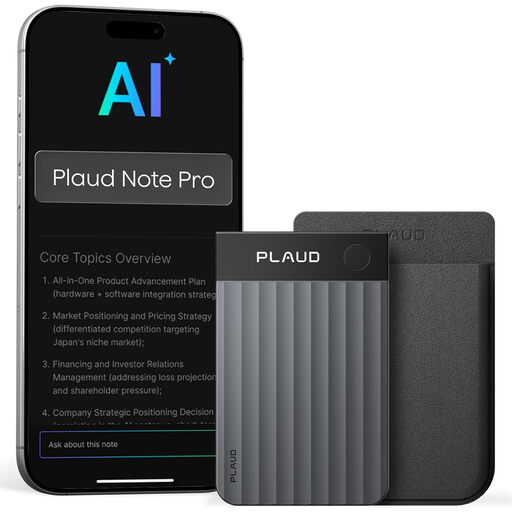
Plaud Note Pro AI Voice Recorder for Notes and Summary, Black

Plaud Note Pro AI Voice Recorder, Black

The product description mentions one-touch recording, transcription and summaries, for anyone who also wants to work with text after recording.

View at Joybuy

Digital Voice Recorder 64 GB with Transcription Function

Digital Voice Recorder, 64 GB

The product description mentions audio recording, transcription and automatic summaries, for anyone who wants to turn spoken content into text afterwards.

The product title lists 64 GB of storage.

View at Joybuy

AI Dictation Device, 64 GB, Mini Voice Recorder

AI Dictation Device, 64 GB

The product description mentions audio recording and converting it into text; the title also lists transcription and summaries.

The product title lists 64 GB of storage, plus transcription and summaries in 118 languages. Check that the languages listed suit your needs.

View at Joybuy

Rexsun 128GB Portable Digital Voice Recorder, L357

Rexsun L357 Digital Voice Recorder, 128 GB

The product description mentions one-touch recording and headphone playback, for independent recording and listening back.

The product title lists 128 GB. The product description mentions USB-C file transfer and WAV and MP3 recording.

View at Joybuy

Rexsun 64GB Digital Voice Recorder, L810

Rexsun L810 Digital Voice Recorder, 64 GB

The product description mentions one-touch recording and headphone playback, for anyone who wants to record a voice-over and listen back straight away.

The product description lists 64 GB of internal memory, WAV recording at 48 kHz and file transfer to Windows, Mac and Android.

View at Joybuy

Frequently asked questions about audio recorders for voice-overs

Can I use any USB connection to record directly into my presentation software?

No. A USB connection doesn’t automatically mean a recorder will work as a microphone. Zoom describes the H1essential as a USB microphone and Tascam describes the DR-07XP as a USB audio interface; Sony describes direct file transfer for the ICD-UX570. Check the exact model’s function and whether your software supports it.

How should I position and check a recorder for a voice-over?

Make a short test recording where you plan to speak, then listen back. Zoom recommends using a tripod with the H1essential if placing it on a table causes reflections; also check the storage and power supply in advance.

What can I do if a recorder I bought online doesn’t suit the way I work?

For distance purchases made by Dutch consumers from a business, the Dutch government says that in many cases there is a 14-day cooling-off period. Check the seller’s information and the applicable terms and conditions; according to the Dutch government, purchases from private individuals are not covered by the same distance-selling rules.

Can I use other people’s music or material in a presentation voice-over?

According to the Dutch government, you need the creator’s permission to distribute copyrighted music, photos or text. A private copy for your own use must not be distributed or made public; an audio recorder does not grant you the rights to use material.

What should I bear in mind if my presentation includes someone else’s recognisable voice or personal information?

The Dutch Data Protection Authority says that organisations need a GDPR legal basis to publish personal data; in many cases, this means obtaining consent. What applies depends on what you publish and who it is for. This is not a general requirement when recording only your own voice.
