
Anyone recording in a noisy home
If you record your own short study cards, conversations, appliances and echo can all affect how clear they sound. Shure explains how microphone distance and reflections influence the recording of direct speech.


For clear speech, start by placing the microphone close to your mouth and making a test recording in your own space. Shure explains how distance and reflections affect what the microphone picks up. Then choose a voice recorder if you mainly want to listen back and repeat recordings on the device, or a handheld recorder if you want to use an external microphone or additional connections. A noise-reduction feature or 32-bit float recording is no substitute for positioning the microphone well.
If you record your own short study cards, conversations, appliances and echo can all affect how clear they sound. Shure explains how microphone distance and reflections influence the recording of direct speech.
For short clips that you want to find, repeat or listen to at a custom speed on the device, playback and search features matter. Sony and OM SYSTEM describe these features for the ICD-UX570 and WS-883 respectively.
If you want to transfer audio files to a computer before using them in your own flashcard workflow, check both the transfer method and your app’s file requirements. Philips Dictation describes file transfer for the VoiceTracer DVT2050.
A good fit if: you listen back to lots of short cards directly on the device. The Sony ICD-UX570 and OM SYSTEM WS-883 are examples of models with relevant playback or search features.
Bear in mind: check how to make individual recordings and transfer them to your learning app. A feature with ‘noise’ in its name is not necessarily a recording filter.
A good fit if: you want to transfer MP3 or PCM files to a computer and may want to connect an external microphone. The Philips VoiceTracer DVT2050 is one example.
Bear in mind: built-in microphones won’t automatically separate your voice from other people at home. Test the positioning and check the connection for any external microphone you plan to use.
A good fit if: you want to position a compatible lavalier microphone close to your mouth or use the recorder as a USB microphone. Zoom says the H1essential offers both options.
Bear in mind: 32-bit float recording helps with recording levels, but it won’t separate speech from background noise on its own. Also check microphone compatibility, storage and power requirements.
First decide how you’ll record and listen back. Then check that the files will work with your learning workflow and find out which accessories you’ll need.
| What to consider | What should you check? | Who is this important for? |
|---|---|---|
| Clear recording of your own voice | Check the microphone input on the exact model and make a test recording with the background noise in your home. | If I’m recording in a noisy room, I want to hear my voice clearly when I listen back. Around 36% of consumers put clear playback of their own voice first. |
| Repeating short cards | Check the repeat feature, search system and whether you can find individual recordings easily. | If I practise lots of short clips on the device, I want to find and repeat them quickly. Around 29% of consumers prioritise this ease of use. |
| Transferring files to a learning app | Check the recording format, transfer method and whether your app accepts a test file. | If I use my recordings in my own flashcard app, I want to transfer files easily. Around 21% of consumers put this workflow at the top of their list. |
| Getting started easily | Check what storage and power the exact model uses and what’s included with that version. | If I want to start making short cards without extra setup, I want to know what I’ll need straight away. Around 14% of consumers say ease of getting started is their main reason for buying. |
On the Zoom H1essential, 32-bit float recording relates to recording levels. It won’t automatically fix an unfavourable balance between your voice and the sounds in the room.
First, position the recorder close to your mouth and listen to a test recording in the room where you plan to record your cards.
If the built-in microphone isn’t good enough in that position, you may need a different microphone or setup.
Sony lists ‘Clear Voice’ under playback, while OM SYSTEM describes noise cancellation during playback. This doesn’t prove that conversations are filtered out during recording.
Check when the feature works on each model, rather than relying on its name alone.
According to their specifications, the Sony ICD-UX570 and OM SYSTEM WS-883 have internal memory. The Zoom H1essential’s manual describes using a microSD card.
Check the storage and power requirements for the exact version and what’s included.
The ICD-UX570 is a compact voice recorder to consider if listening back, A-B repeat and internal memory are important to you.
OM SYSTEM says the WS-883 is also designed for notes and language study, and has built-in USB transfer.
The VoiceTracer DVT2050 is an option if you want to transfer MP3 or PCM files and have the option of connecting an external microphone.
The H1essential is a handheld recorder to consider if you also want to use a lavalier microphone or the USB microphone function.
This selection from Joybuy includes devices for voice recording and, depending on the model, transcription, repeat playback or file transfer. Check that the files will work with your flashcard app, and make a test recording to see how clearly the device performs in your own space.
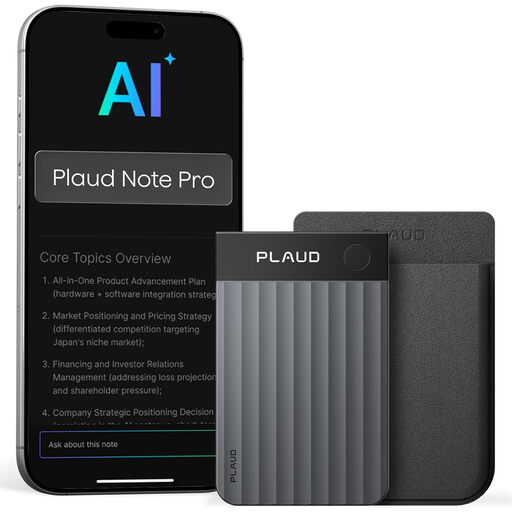 No image available
An option if you want to record speech and use the transcription features mentioned in the product listing as part of your workflow.
The product information mentions one-touch recording, transcription and access to notes across different devices. Check that the output will work with your flashcard app.
 No image available
An option if you want to record speech and include transcription in the process of creating your study cards.
The product name lists 64 GB and a transcription function. Check that the device produces files in a format you can use.
 No image available
An option if you also want to use the text features mentioned to process voice recordings for your learning workflow.
The product name lists 64 GB, transcription and summaries in 118 languages. Check that the output and features suit the way you make flashcards.
 No image available
An option if you want to repeat short passages on the device, then transfer and find your recordings.
The product information lists 128GB, MP3/WAV, A-B repeat, USB-C file transfer and timestamp-based organisation. Test a sample file to check that your learning app accepts the format.
 No image available
An option if you want to record short spoken cards, listen back straight away and transfer files.
The product information lists 64GB, WAV recording and one-touch operation. Check that the transfer method and file format work with your device and learning app.
Don’t assume it can. First, move the microphone closer to your mouth and listen to a test recording in your own space. Also check whether the feature on your chosen model works during recording or playback.
Start by making one short test card. Listen back and transfer the file before recording a whole set. The Philips VoiceTracer DVT2050 manual describes listening back, repeating and transferring files. Also check that your learning app accepts the file.
In the Netherlands, if a product is faulty, you can contact the seller under your statutory guarantee. The Dutch government explains that the seller must provide a solution. For online purchases, ACM ConsuWijzer generally states that you have a 14-day cooling-off period after delivery, subject to applicable exceptions. This cooling-off period is separate from your rights if a product is faulty.
For your own study cards, it’s best to record only your own voice and keep the files private. The Dutch Data Protection Authority describes an exemption under the GDPR for processing that is solely personal or domestic, but this isn’t general permission to record or share other people’s conversations.