
Speaker with an expressive delivery
You deliberately switch between quieter and more powerful passages, and want to be able to listen back to your recording and edit it if needed.


For a course introduction with changes in vocal intensity, a handheld recorder with 32-bit float recording is worth considering. For a short solo recording, a simple voice recorder may be enough. Choose based on where you’ll be speaking, whether you can listen back to test recordings, and how you want to store and edit your files. Shure emphasises that microphone placement and room acoustics affect intelligibility, so a recording mode won’t eliminate room echo.
You deliberately switch between quieter and more powerful passages, and want to be able to listen back to your recording and edit it if needed.
For example, you record at a desk and want to check whether the recorder’s position captures your voice clearly.
You want to record a short piece of speech with one speaker, listen back to it and transfer it to a computer without a complicated set-up.
Start with your vocal dynamics and the room. Then choose between a simple workflow and extra recording features, and check the storage and file-transfer options.
| What to consider | What should you check? | Who is it for? |
|---|---|---|
| Changes in vocal intensity | Compare the recording mode, monitoring options and file compatibility with your editing software. Listen back to both quieter and louder passages. | If you alternate between quieter and more powerful passages in one introduction, you’ll want to assess how those differences sound in the recording. Around 36% of consumers give changes in vocal intensity top priority. |
| Clarity in the room | Decide where you can place the recorder or a suitable external microphone, and make a test recording from that position. | If you’re recording in a room with echo, you’ll want to check whether your voice comes through clearly enough. Around 29% of consumers put clarity in the recording space first. |
| Recording and transferring files | Check the controls, playback options, recording formats and connection to your computer or phone for the exact model version. | For a short introduction with one speaker, you’ll want to check and transfer your recording without unnecessary steps. Around 21% of consumers choose a simple recording workflow as their main consideration. |
| Power and storage | Check the built-in memory, supported cards, power supply and what’s included in the box for each model version. | If you want to record independently and know exactly what you’ll need for memory and power, check what you need before recording. Around 14% of consumers give independent recording, power and storage top priority. |
A recording mode and room acoustics are two different things. Shure points out that a microphone can’t improve the acoustics of the room it’s in.
Make a test recording where you plan to record your course introduction before letting extra recording features determine your choice.
An unsuitable set-up could mean having to record again or spend extra time adjusting the microphone’s position.
The models mentioned vary in their built-in memory and use of removable storage. Depending on the model version, you may therefore need to prepare your recording set-up differently.
Check the full model version, supported storage media, power supply and box contents before recording.
If your recording depends on a suitable card or power supply, you may need to arrange these separately in advance.
Philips VoiceTracer documentation lists app support for specific model codes, not automatically for every version.
If app control matters to you, compare the full model code with the documentation.
The H1essential is a handheld recorder for anyone looking for 32-bit float recording, built-in microphones and the option to use it as a USB microphone.
According to Tascam, the DR-05XP combines a 32-bit float mode with a USB-C audio interface.
The LS-P5 is worth considering if you want to record independently and built-in memory or remote control is important to you.
The ICD-UX570 series is an option if you’re looking for a compact voice recorder with built-in memory and playback features.
The DVT4110 series is worth considering if built-in memory, recording settings and control via a supported app matter to you.
These Joybuy products are suited to recording a spoken course introduction and include digital voice recorders and a wireless microphone. For each model, check that the storage, file-transfer options and connections suit your recording and editing workflow.
 Image unavailable
Could be a good fit if you’re looking for the AI notes and summaries mentioned in the product name as well as recording; check that this workflow suits your course introduction.
 Image unavailable
The product name mentions 64 GB and a transcription function; check how you’ll use the recorded files in your preferred editing workflow.
 Image unavailable
A digital voice recorder to consider if you want to record a short introduction; check how you’ll listen back to and transfer your recordings as part of your workflow.
The product name lists 128GB.
 Image unavailable
Could be a good fit if you’re looking for a simple way to record an introduction; the product name mentions one-touch operation and 64GB.
Check in advance how you plan to listen back to and transfer your recording.
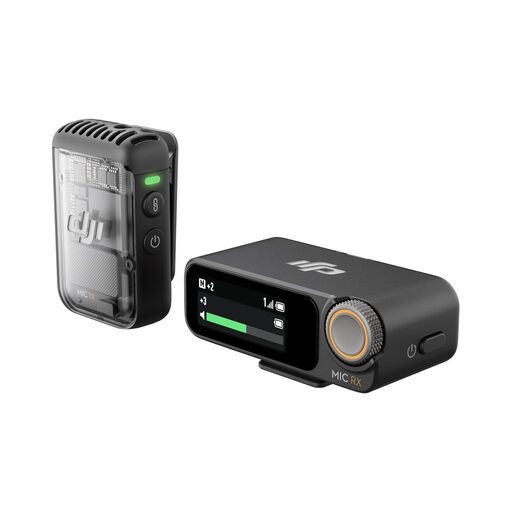 Image unavailable
A wireless microphone to consider if you want to position the microphone close to the speaker; the product name mentions internal 32-bit float recording.
Check that the connections and recording workflow suit the device you plan to use to record your course introduction.
It’s a relevant recording mode for this kind of delivery: Zoom and Tascam offer it on the models mentioned. Do listen back to a test recording, though; 32-bit float doesn’t remove room echo or guarantee that every audible distortion can be fixed.
First, make a test recording where you plan to speak, then assess both your voice and any echo. Shure points out that a microphone can’t improve the acoustics of a room with echo, and that placing it too far away can affect intelligibility.
It depends on the model and version. OM SYSTEM lists built-in memory for the LS-P5, as does Sony for the ICD-UX570; Zoom’s manual describes preparing to record with a microSD card. Check what’s included in the box and which cards are supported before recording.
When you buy as a consumer in the Netherlands, the product must be of satisfactory quality. The Dutch government advises you to contact the seller if there’s a problem; the Netherlands doesn’t have one fixed statutory warranty period that applies to every product.
This isn’t automatically covered by the basic scenario of recording your own voice alone. According to the Dutch Data Protection Authority, a sound recording in which someone is recognisable may be personal data; an organisation needs an appropriate GDPR legal basis to process it, and consent is one possible basis. Auteursrecht.nl explains that the educational exception for copyright-protected material is limited to teaching on behalf of the government or by a non-profit legal entity. So check whether these conditions apply to your course.