If you’re mainly recording one narrator, choose a recorder that’s easy to use and makes it simple to play back or transfer files. If speaking volumes vary or you plan to edit the recording, recording formats and microphone connections matter more. Neither feature can replace a test recording from the intended position. If other people will be identifiable in the recording, decide in advance how to record and share it in line with your school’s policies.
Who is this choice relevant to?
Student recording their own commentary
Wants to record a single voice, listen back and submit the file without much preparation. Ease of use and file transfer matter more than extensive recording settings; OM SYSTEM and Philips VoiceTracer describe models with built-in storage.
Creator editing the commentary
Wants to be able to edit the recording and account for varying speaking volumes or use an external microphone. Zoom and Tascam list recording formats and microphone connections for the H1essential and DR-05XP that may be useful for this type of workflow.
Teacher recording contributions from the class
May want to record several identifiable voices. As well as recording quality, consider the purpose, how the file will be managed and whether it will be shared. The Dutch Data Protection Authority notes that identifiable audio recordings may constitute personal data.
What should you look for when choosing?
Compact voice recorder with built-in storage
Choose this option: if you’re mainly recording one narrator and want to play back or transfer the file easily. OM SYSTEM lists built-in storage and direct USB transfer for the WS-883; Philips VoiceTracer lists built-in storage and MP3 and WAV recording for the DVT4110.
Trade-off: a built-in microphone is convenient, but that doesn’t prove it will capture a speaker clearly from a distance in a noisy classroom.
Portable recorder for editing
Choose this option: if speaking volumes vary or you want to edit the commentary later. Zoom lists 32-bit float WAV and a microphone/line input for the H1essential; Tascam lists MP3 and WAV recording modes and an external microphone input for the DR-05XP, among other features.
Trade-off: more recording and editing options also mean paying attention to storage, power and file handling. 32-bit float won’t restore a voice that was recorded poorly because of distance or background noise.
| What to consider |
What should you check? |
Who is this important for? |
| Clarity |
Make a test recording from the planned speaking position and listen back. If you’re using an external microphone, check that the recorder has a suitable input. |
If I want to know whether the narrator will be easy to hear from the chosen position, I’ll record a few sentences first and listen back. Around 33% of consumers say clarity of the narrator is their top priority. |
| Easy recording and file transfer |
Check whether you can record without an additional card, how files can be transferred to the school device and whether you can play them back on the recorder. |
For a short assignment, I want to be able to record, check and submit the file independently, without unnecessary steps. Around 25% of consumers prioritise ease of use and file transfer. |
| File for editing |
Ask which format the assignment or editing software accepts, and check the recording mode and storage required for the exact model. |
If I want to edit the commentary later or expect speaking volumes to vary, I’ll check that the recording suits my workflow. Around 25% of consumers say recording formats and editing are their top priority. |
| Identifiable voices from the class |
Decide who will be audible, what the file is for, who will receive it and which school policies apply. If necessary, position the recorder to capture only the narrator. |
If classmates will be identifiable in the recording, I want to be clear in advance about who will receive it and how it will be used. Around 17% of consumers say careful handling of identifiable voices is their top priority. |
Common buying mistakes
-
Assuming 32-bit float removes classroom noise
Zoom and Tascam describe recording features for handling levels, but that doesn’t mean a voice recorded at a distance will rise above classroom noise.
Make a test recording from the planned position first, and adjust the microphone placement if needed.
-
Assuming the maximum recording time applies to every sound quality setting
Philips specifies different recording times for MP3 and PCM settings on the VoiceTracer DVT4110.
Compare the capacity for the mode you’ll actually use, and check how much space is available before the lesson.
A different file format or a higher-quality setting may require more storage.
-
Choosing a 32-bit float recorder without checking storage
Zoom says the H1essential uses microSD cards, while the voice recorders reviewed have built-in storage.
Check what’s included with the exact offer, and make sure you have the required storage and power ready before recording day.
Some setups may require a compatible memory card or other equipment.
Brands to consider
OM SYSTEM
The WS voice recorders are worth considering if you mainly want to record spoken commentary easily.
- According to OM SYSTEM, the WS-883 has 8 GB of built-in storage, MP3 and mono PCM recording, a microSD slot, direct USB transfer and a simple mode.
- The WS-883 product specifications don’t mention a zoom microphone, so they don’t indicate that this model is designed to capture sound clearly from a great distance.
Philips VoiceTracer
The VoiceTracer DVT4110 may suit classroom recording if you want built-in storage and the choice of MP3 or WAV.
- The DVT4110 specifications list 8 GB of built-in storage, a microphone input and several recording scenes.
- The stated battery life of up to 36 hours applies to MP3 at 8 kbps, not to every recording mode.
Zoom
The H1essential is worth considering if you want to record spoken material as 32-bit float WAV and edit it later.
- Zoom’s manual lists a built-in XY microphone, microSD card use and a microphone/line input for the H1essential.
- These features don’t prove that they will remove background noise from a classroom recording.
Tascam
The DR-05XP is worth considering if you’re looking for a portable recorder with MP3 and WAV recording modes and an external microphone input.
- Tascam lists built-in stereo microphones, an external microphone input and power from two AA batteries.
- The stated maximum operating time of 17½ hours is a manufacturer figure based on its test conditions, not a guarantee for every setting.
Products at Joybuy
Joybuy product picks for recording spoken commentary, including models whose product names also mention features for notes, summaries or file transfer.
 No image available
Plaud Note Pro AI voice recorder (silver)
May suit you if, alongside a voice recording, you’re also looking for the note-taking and summarising features mentioned in the product name.
The product name describes an AI voice recorder with note-taking and summary features.
View at Joybuy
 No image available
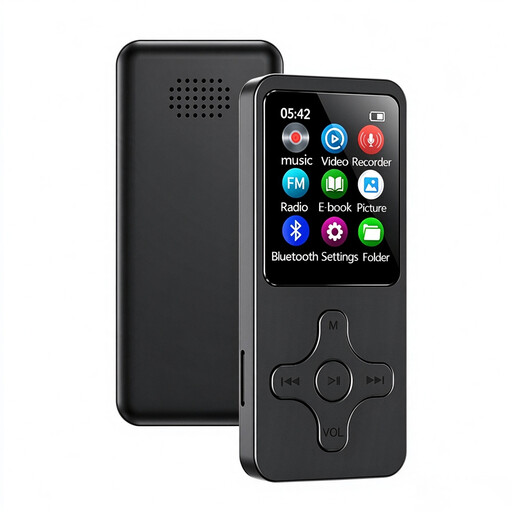
Digital audio player with 1.8-inch display and voice recording
May suit you if you’re looking for a device whose product name lists both voice recording and MP3 player features.
The product name lists a 1.8-inch display, Bluetooth, voice recording, an MP3 player, an e-book reader and an alarm function.
View at Joybuy
 No image available
AI dictation device, 64 GB, mini voice recorder
May suit you if, alongside a voice recording, you’d also like to explore the transcription and summary features mentioned in the product name.
The product name lists 64 GB, transcription, summaries in 118 languages and a typing function.
View at Joybuy
 No image available
Rexsun L357, 128 GB portable digital voice recorder
May suit you if you’re looking for a portable digital recorder and want to weigh up the storage capacity listed in the product name against your assignment needs.
The product name lists 128 GB, an LCD screen and an ABS and aluminium alloy body.
View at Joybuy
 No image available
Rexsun L810, 64 GB digital voice recorder
May suit you if you want to record a spoken contribution and compare the controls listed in the product name with your workflow.
The product name lists 64 GB and one-touch recording.
View at Joybuy
Frequently asked questions
Is a simple voice recorder enough for a single recorded museum commentary?
A compact voice recorder may be suitable if you’re recording one narrator and mainly want to play back or submit the file. Make a test recording to check that the voice is clear from the planned position; built-in storage and USB transfer can make the process easier.
What should you check before recording the class?
Check the power supply, available storage and the file format your teacher or editing software requires. Record a few sentences from the intended position and listen back to make sure the narrator is easy to hear. Zoom’s manual explains how to insert and format a microSD card for the H1essential.
What if a recorder breaks sooner than expected during normal use?
According to ACM ConsuWijzer, the seller is responsible for providing a solution if a product breaks during normal use sooner than you could reasonably expect. The appropriate solution depends on the circumstances.
Can I record identifiable voices of classmates and share the recording?
There’s no general yes or no without knowing the purpose, who is involved and how the recording will be shared. The Dutch Data Protection Authority notes that identifiable audio recordings may constitute personal data, and that schools must inform pupils and parents about the processing of personal data. Discuss your school’s policies in advance and limit recording and sharing to what’s necessary for the assignment; consent isn’t automatically the only possible legal basis under the GDPR.


