
Diary writer dealing with background noise
Wants speech to be clear, even when housemates, traffic or ventilation can be heard. Microphone placement and a suitable external input may be important when choosing a recorder.


For clear audio when keeping a diary in a noisy flat, microphone placement matters just as much as the type of recorder. A microphone close to your mouth will generally pick up less room noise than a recorder placed further away. Shure explains how distance and reflections affect a recording, while RØDE recommends positioning the microphone closer to the speaker. Choose a compact voice recorder if quick recording and playback are your priorities, or a handheld recorder with a compatible external microphone input if you want to position the microphone closer to you. Also check the connection, power supply and storage.
Wants speech to be clear, even when housemates, traffic or ventilation can be heard. Microphone placement and a suitable external input may be important when choosing a recorder.
Wants to capture a thought without adjusting lots of settings, then easily find or listen to clips later. Sony describes search and playback functions for the ICD-UX570.
Records regularly and wants to think ahead about how files will be stored and transferred, and how the device will be powered. Sony lists internal memory and USB charging for the ICD-UX570.
Start with the distance between your mouth and the microphone. Then consider how the recorder’s controls, readiness to record and file management fit your routine.
| What to consider | What to look for | Who is this important for? |
|---|---|---|
| Clear speech | Compare the position of the built-in microphone with that of a suitable external microphone, and make a test recording in your own room. | If I want to hear my voice clearly despite housemates or traffic, I’ll focus on the microphone’s distance and position. Around 36% of consumers put speech clarity first. |
| Quick recording and playback | Check the controls, playback options and search functions on the exact model. | If I want to record a thought straight away and find it later, easy operation and playback matter more to me than extra settings. Around 29% of consumers prioritise being able to record immediately. |
| Power and storage | Check the power supply and storage used by the version you’re considering, and how you can transfer files. | If I want to record regularly, I want to know in advance whether the recorder is ready to use and where my files will be stored. Around 21% of consumers put readiness to record first. |
| Managing private files | Check how files are stored, transferred and deleted, and think about who can access your recordings. | If my diary contains personal content, I want to know how to store and manage my files privately. Around 14% of consumers prioritise keeping their files private. |
Recording settings or filters won’t automatically counteract the effects of microphone distance and echo.
First, find a practical position for recording and listen back to a test. Don’t treat a claim about reducing noise as an independent real-world test.
An external microphone will only work if its connection and any power requirements are compatible with both the recorder and the microphone.
Before ordering, check the input, microphone power, storage and power supply, and find out which accessories are included with the version you’ve chosen.
A suitable external microphone, storage media or batteries may be part of the set-up.
The exception for personal or household use is limited in scope and does not provide a general ruling on publishing recordings of other people.
Keep your diary private, and check the applicable privacy rules again before sharing or publishing identifiable recordings.
These models illustrate different recording set-ups; descriptions of brands are not a verdict on every product they make.
The ICD-UX570 is a compact voice recorder for capturing speech and listening back later.
The H1essential is a handheld recorder with built-in stereo microphones and an input for an external microphone.
The DR-05XP has built-in microphones and an input for an external microphone.
This selection includes devices described in their product titles as voice recorders, dictation devices or recording devices for spoken notes.
 No image available
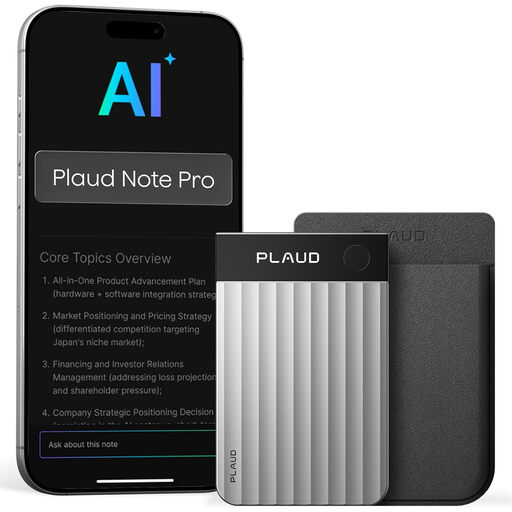
The product title positions this device for AI note-taking and summaries of spoken content.
Colour: Silver.
 No image available
The product title describes a digital voice recorder with a transcription function for spoken recordings.
Storage listed in the product title: 64 GB.
 No image available
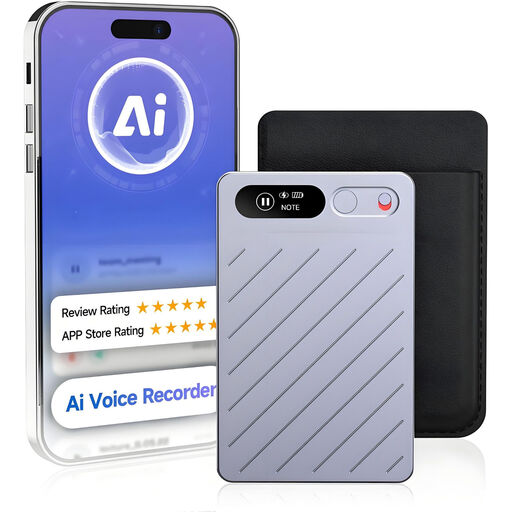
The product title describes a mini dictation device for spoken notes.
The title lists 64 GB and transcription and summary features in 118 languages.
 No image available
The product title describes a portable digital voice recorder. Check that its controls and connections suit your recording set-up.
The title lists 128GB, an LCD screen and the claim of intelligent noise reduction. This claim does not prove that speech can be isolated in a noisy flat.
 No image available
The product title describes a digital voice recorder with one-touch operation.
The title lists 64GB and a casing made from ABS and aluminium alloy.
No, 32-bit float recording is no substitute for good microphone placement. First, make a test recording with the microphone closer to your mouth, and listen out for breathing sounds and echo too.
No, check that the connection and any power requirements are compatible with both the recorder and the microphone. Zoom lists a 3.5mm microphone/line input for the H1essential; Tascam lists a 3.5mm input with plug-in power for the DR-05XP.
Make a short test recording in your usual spot and listen back to it. Also check the power supply, available storage and how to transfer files. Make your own backup if you want to keep your recordings.
According to the Dutch government, if a product is faulty, the seller must provide a solution; the Netherlands does not have a fixed statutory guarantee period for all products. When you buy from a business at a distance, you usually have 14 days to change your mind, with some exceptions.
According to the Dutch Data Protection Authority, a recording processed solely for personal or household use does not fall under the GDPR. This is not a general ruling on recording or publishing identifiable people; check the rules for your specific situation before sharing such recordings.