
Cooking for a large neighbourhood gathering
You’re making more dip than will fit in a small blending beaker and want to purée it in a suitable bowl or in several batches.


A standard hand blender is all you need to purée roasted aubergine dip. Choose one with multiple speed settings if you’d like more control over the texture as you blend. If you’re making a larger quantity, check whether you can use it in a suitable bowl or whether you’ll need to purée the dip in batches. A chopper is useful mainly if you also want to chop herbs, onion or nuts separately. When buying, check which accessories are included and whether the specific product carries the CE mark.
You’re making more dip than will fit in a small blending beaker and want to purée it in a suitable bowl or in several batches.
You want to be able to stop blending as soon as the aubergine reaches your preferred texture, which may still be a little chunky.
You also use your hand blender for other dishes and want to chop ingredients such as herbs or nuts with a chopper.
First, decide how much dip you want to purée at a time and how much control you need over the texture. Then consider whether extra attachments would be useful for other recipes.
| What to consider | What should you look for? | Who is this important for? |
|---|---|---|
| Portions for a neighbourhood gathering | Check the usable capacity and whether the blending foot fits in your own bowl. The Consumers’ Association describes puréeing with the blending foot; you can work in batches if needed. | If I’m cooking for a larger group, I want to know whether I can purée the dip in my own bowl or need to make several batches. Around 36% of consumers prioritise workable batch sizes. |
| Control over the texture | Check which speed settings or controls the model has; speed settings alone don’t prove that a blender will purée more effectively. | If I’d rather not make the dip completely smooth, I want to be able to adjust the texture as I blend. Around 29% of consumers say control over texture is their main consideration. |
| Extra chopper | Check which accessories are included for the exact model and whether the chopper is suitable for the quantities you want to process. | If I want to chop herbs, onion or nuts separately as well as the aubergine, a chopper could be handy. Around 21% of consumers prioritise versatility. |
| Cleaning and storage | Check whether the blending foot is detachable and which removable parts the model-specific manual says are dishwasher-safe. | If I want to clean or store as few separate parts as possible after supper, I check what’s included in the set and the cleaning instructions. Around 14% of consumers prioritise easy clear-up. |
The blending foot is designed for puréeing; a chopper is a separate attachment for chopping ingredients.
First decide whether you also want to chop ingredients such as herbs, onion or nuts separately from the aubergine.
Extra attachments also take up storage space and need to be cleaned.
For the Tefal Quickchef+ HB67MB30, the stated accessory capacities are total capacities; they don’t confirm how much dip you can safely process at a time.
Check the manual for the usable capacity and plan to make several batches if needed.
Braun lists both 1000 W in the description and 750 W in the technical specifications for the MultiQuick 5 MQ50236M.
Ask for confirmation of the exact model and specification; don’t base your choice on the highest wattage listed alone.
The ErgoMixx MSM66110 is a basic model with a detachable metal blending foot and two speeds.
Braun describes the MultiQuick 5 MQ50236M as a set with a blending foot, measuring beaker, whisk and 500 ml chopper.
The Quickchef+ HB67MB30 is described as including a whisk, a measuring beaker with a total capacity of 800 ml and a 1-litre chopper-blender with a total capacity of 1 litre.
The Dutch bamix channel describes hand blenders with interchangeable attachments and recommends using them in tall, narrow beakers or pans.
These hand blenders are designed for puréeing cooked aubergine. Models vary in their speed controls and included accessories, among other features. Before buying, check that the specific product carries the required CE mark.
 No image available
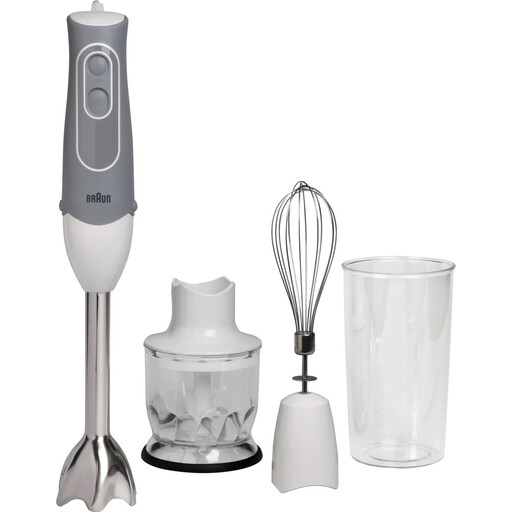
The blending shaft is described as suitable for puréeing; two speeds and a turbo button offer different ways to control it.
The set described also includes a whisk and a 350 ml chopper.
 No image available
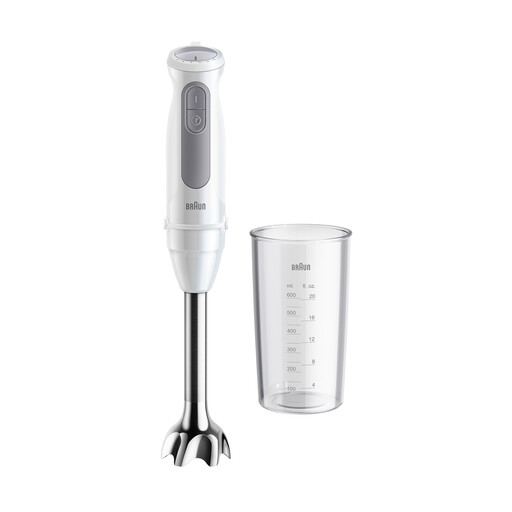
The blending foot and the 25 speed settings listed give you options for puréeing and adjusting the texture of the dip.
The description lists a chopper with settings for fine, medium and coarse textures.
 No image available
The description lists dips as one use and 21 adjustable speeds so you can change the setting as you blend.
The measuring beaker supplied is designed for small portions; make several batches if needed for a larger quantity.
 No image available
The description lists puréeing and two speed settings for blending.
The title lists a 500 ml chopper bowl and an 800 ml measuring beaker; these are total capacities, not confirmed usable quantities of dip.
The set also includes a whisk.
 No image available
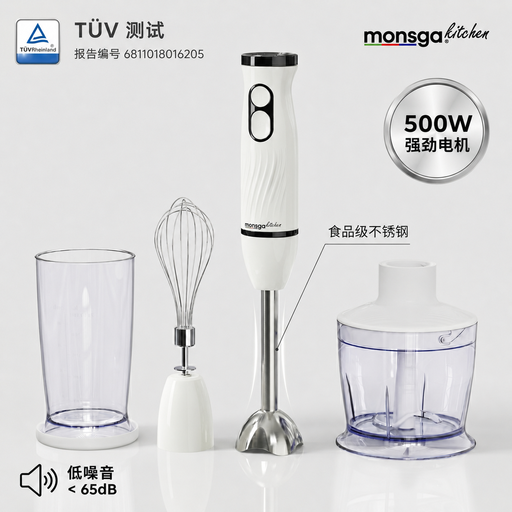
The blending foot described is designed for use in deep pans or tall containers; the product description gives a reach of 36.5 cm.
The title lists a 500 ml chopper, a 500 ml measuring beaker and a 1.5 m cord. The controls include NORMAL and TURBO buttons.
No. The blending foot is designed for puréeing cooked aubergine. A chopper is an extra option if you also want to chop ingredients such as herbs, onion or nuts separately.
The Consumers’ Association recommends placing the blending foot on the bottom of the bowl or pan before switching on the hand blender. Unplug it after use and detach the attachments; check the manual before putting any removable parts in the dishwasher.
The Netherlands Nutrition Centre advises covering cooked leftovers, allowing them to cool and putting them in the fridge within 2 hours. Set your fridge to 4 °C and eat leftovers within 2 days. This is food storage advice, not a hand blender product specification.
When you buy a product as a consumer, it must meet the standard you’re entitled to expect. The Dutch government explains that there’s no fixed statutory warranty period in the Netherlands and that you should contact the seller if a product is faulty; any manufacturer’s warranty is separate.
Yes. According to the Netherlands Food and Consumer Product Safety Authority, CE marking is compulsory for electrical products covered by the relevant rules. This general requirement doesn’t confirm that a specific product on sale actually carries the mark, so check the product itself.