
Apron wearers with limited storage space
You need somewhere to dry your aprons and want to be able to put the airer away afterwards. Compare its dimensions both in use and when folded.


First, measure how much space the airer takes up when it is open, as well as how much storage space you have when it is folded away. Also check that your aprons can hang freely. A heated airer is worth considering if you expect to use the heat regularly, while a compact unheated airer does not use electricity for heating. Good ventilation is important when drying clothes indoors, and if you choose an electric model, check the instructions and the relevant product information.
You need somewhere to dry your aprons and want to be able to put the airer away afterwards. Compare its dimensions both in use and when folded.
You often dry aprons indoors and are considering a heated airer. Remember to allow for a suitable location and adequate ventilation too.
You want to weigh up what electric heating offers compared with an unheated airer, for example if you do not dry clothes often.
Choose this if: you want to hang your aprons spread out and put the airer away after use.
Bear in mind: how wide the airer is when open and the clearance needed around the model.
Choose this if: you want to consider a tower model with several hanging levels instead of a wide winged airer.
Bear in mind: the space between the levels, room for the cover, and the floor space and storage space required by the model you choose.
Choose this if: you mainly need a space-saving option and electric heating is not essential.
Bear in mind: this type does not provide electric heat; moisture still needs to be removed when drying indoors.
| What to consider | What should you check? | Who is this important for? |
|---|---|---|
| Storage and drying space | Compare the dimensions when open and folded, the available hanging height and the clearance required around the model. | If the drying area is narrow and the airer needs to fit in a cupboard or alcove after use, I want to check both sets of dimensions and the hanging space. Around 33% of consumers prioritise storage space. |
| Regular indoor drying | Check the usable hanging space and the guidance on positioning and ventilation. | If you often dry your aprons indoors, you’ll want enough hanging space and somewhere you can ventilate. Around 27% of consumers give regular indoor drying top priority. |
| Electricity use | Check the stated wattage of the exact model and factor in how long you expect to use it. | If you mainly want to know what heating adds to your use, compare a heated airer with an unheated alternative. Around 20% of consumers prioritise electricity use. |
| Fabric care and safe use | Read the care label on your apron and the instructions for the specific airer. | If you have aprons made from different materials or long aprons, check what works for the fabric and the available hanging space. Around 20% of consumers prioritise fabric care and safe use. |
An airer may be compact to store but need more room when in use. Some models also need to be kept away from walls.
Measure both the storage space and the area where you plan to use the airer. Allow for the clearance specified in the instructions for the exact model.
The wattage tells you how much electricity the appliance uses when it is switched on; on its own, it does not tell you how long your aprons will take to dry.
Check the wattage of the exact model and keep track of how long you use it. Do not estimate drying time based on wattage alone.
Using the airer for longer can increase electricity consumption.
Moisture is still released when you dry laundry indoors, even if you use a heated airer.
Choose a spot where you can ventilate. Milieu Centraal describes ventilation as bringing in fresh air and removing stale air.
Silvergear offers heated airers with covers, including a clothes airer and a drying tower.
Brabantia describes a range of unheated airers, including folding models and drying towers.
Leifheit describes unheated airers in various sizes, including Pegasus models with features for hanging clothes on hangers.
A Dutch comparison website lists a folding heated airer from Dirt Devil as a compact option.
This selection from Joybuy includes a folding heated winged airer and a wall-mounted airer. Decide whether you want electric heating and whether wall mounting is suitable for your home.
 No image available
The fold-out side wings may suit you if you want to hang your aprons spread out and fold the airer away after use.
Joybuy states that this model has a recommended maximum load of 10 kg. Check the instructions for guidance on positioning, ventilation and the required clearance from walls.
 No image available
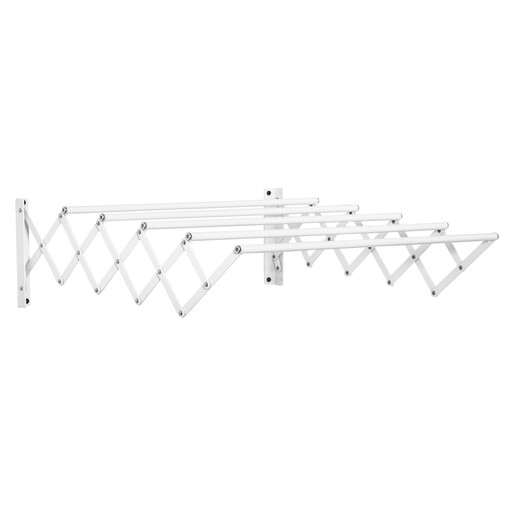
A wall-mounted airer may suit you if you want a permanent drying spot and would rather not have a freestanding airer.
This model needs to be mounted on a wall. Check the available wall space and whether the rails are long enough for your aprons.
Yes, you should still ventilate the room. Milieu Centraal describes ventilation as bringing in fresh air and removing stale air; a heated airer does not remove moisture from the air.
It depends on the fabric and the specific airer. Check the care label on your apron and follow the manufacturer's instructions. A symbol indicating that an item should not be tumble dried does not, on its own, tell you which other drying methods are suitable.
For a simple estimate, multiply the stated power in kilowatts by the number of hours the airer is switched on. This estimates electricity consumption, not drying time; actual consumption may vary if the heating switches on and off during use.
Check the dimensions both in use and when folded, and make sure your aprons can hang freely. For an electric model, also allow for the required clearance and follow any other guidance in the instructions.
The Netherlands Food and Consumer Product Safety Authority explains that CE marking is mandatory for electrical products where this requirement applies. Electrical equipment with a rated AC voltage between 50 V and 1000 V is subject to the requirements of the Low Voltage Directive. CE marking is not a separate EU approval certificate; check the product information and declaration of conformity for the specific model.