
If you scan one letter now and then
You want a legible digital copy without a large, permanent scanner setup. Epson describes the WorkForce ES-50 as a compact scanner for single documents.


If you only need to scan one appointment letter now and then, a compact single-sheet scanner is a sensible choice. For regular batches or double-sided letters, an ADF with duplex scanning is a better fit for your workflow. Epson powers the ES-50 via USB, while Brother and Canon each specify a 20-sheet ADF and duplex scanning for the ADS-1300 and imageFORMULA R10. Choose a flatbed if you don’t want to feed a fragile sheet through a mechanism, and check the OCR software and storage location separately.
You want a legible digital copy without a large, permanent scanner setup. Epson describes the WorkForce ES-50 as a compact scanner for single documents.
You want to spend less time feeding pages individually, including when they’re printed on both sides. Brother and Canon specify an ADF and duplex scanning for the ADS-1300 and imageFORMULA R10.
If paper is damaged or fragile, you want to consider whether a flatbed would be more suitable than a document feeder. Canon describes the LiDE 400 as a flatbed scanner. VeiligInternetten and the Dutch Data Protection Authority also provide information about storing and processing data.
A good fit if: you mainly scan one ordinary letter now and then and want to save desk space. Epson powers the ES-50 via USB.
Bear in mind: you feed pages in yourself; check separately how to scan double-sided letters.
A good fit if: you regularly process several letters or double-sided pages in a row. Brother and Canon each specify a 20-sheet ADF and duplex scanning for the ADS-1300 and R10.
Bear in mind: check the condition of the paper and your computer’s connection. Stated scan speeds don’t tell you how long the complete scanning and archiving process will take.
A good fit if: you’d rather place a fragile or damaged letter flat on the glass than feed it through a mechanism. Canon describes the CanoScan LiDE 400 as an A4 flatbed scanner.
Bear in mind: you place each page on the scanner individually, so a flatbed is less convenient than an ADF for batches.
| Key consideration | What to check before buying | Who is this important to? |
|---|---|---|
| Individual letters | Check the paper size, connection, output formats and whether you need to scan both sides of a letter separately. | If you mainly want to keep one tidy letter now and then and don’t want a large, permanent scanner setup, a single-sheet scanner may be enough. This is the top priority for around 36% of consumers. |
| Batches and duplex scanning | Look for a stated ADF capacity in sheets and a separately listed duplex function; check the connection too. | If you regularly process several letters or double-sided pages, automatic feeding can save you time and effort. Batch processing and duplex scanning are the top priorities for around 27% of consumers. |
| Finding and storing documents | Check whether the software creates searchable PDFs. Decide where files will be stored and how you’ll back them up and protect them. | If you want to search the text in appointment letters later and store personal information carefully, check both the OCR and your storage options. Easy retrieval and secure storage are the top priorities for around 19% of consumers. |
| Fragile paper | Assess the condition and size of the letter; if you’re considering a flatbed, check that the scanning surface is large enough. | If a letter is fragile or damaged and you don’t want to feed it through a mechanism, a flatbed may be a better fit. Preserving fragile paper is the top priority for around 18% of consumers. |
A stated scan mode doesn’t necessarily mean the device can feed a stack of paper. Brother explicitly specifies a 20-sheet ADF capacity for the ADS-1300.
If you scan batches, look for a stated ADF capacity in sheets and check duplex scanning separately.
If you scan regularly, feeding pages manually can take extra time.
PDF as an output format doesn’t necessarily mean you’ll get an indexed PDF that lets you search the text. Epson lists PDF as an output format for the ES-50; IRIS lists indexed PDFs for the Express 4 with Readiris.
Check whether text recognition and searchable PDFs are included for the exact model and software package.
Without suitable text recognition, it can take longer to find letters later.
A scanner that feeds paper works differently from a flatbed, where you place the sheet on the glass, so the condition of the letter may be a deciding factor.
Assess fragile or damaged letters individually and check that the flatbed’s scanning surface is suitable.
According to the Dutch Government, there’s no fixed time limit for the statutory guarantee in the Netherlands: the product must do what you can reasonably expect it to do.
If you’re considering an additional warranty package, check what extra terms it offers. If there’s a fault, contact the seller.
Epson offers models for single documents, as well as compact scanners with Wi-Fi and different paper paths.
The ADS-1300 is a compact ADF option if you process several ordinary letters or double-sided pages.
Canon offers the portable imageFORMULA R10 ADF scanner and the CanoScan LiDE 400 as a flatbed alternative.
The IRIScan Express 4 is designed for single sheets and text recognition with Readiris software.
The ScanJet Pro 2000 s2 is designed for larger document projects than the occasional scanning of appointment letters.
These Joybuy models suit different ways of scanning appointment letters: feeding sheets individually, using an ADF with duplex scanning, or choosing a combination of flatbed and document feeder.
 Image unavailable
The combination of a flatbed and ADF suits anyone who wants to process both individual originals and batches.
The product name lists a flatbed, ADF, A4 size and 600 × 600 DPI.
 Image unavailable
This model suits anyone who wants to process several letters or double-sided pages; Canon specifies a 20-sheet ADF and duplex scanning.
The product name lists A4 and 600 × 600 DPI. The product description mentions USB cable power.
 Image unavailable
Wi-Fi may be useful if you don’t want to place the scanner next to your computer; Epson lists Wi-Fi and different paper paths for the ES-C320W.
The product name lists A4 and 600 × 600 DPI.
 Image unavailable
A handheld scanner may suit anyone who scans individual A4 letters and wants a compact setup.
The product name lists A4 and 600 × 600 DPI.
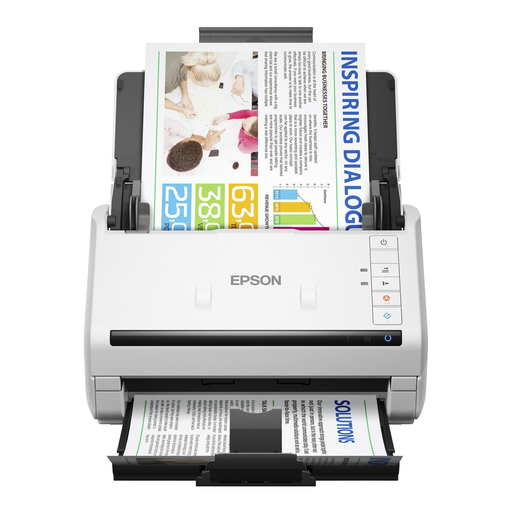 Image unavailable
This model is worth comparing if you’re looking for an A4 document scanner with a paper feeder.
The product name lists 600 × 600 DPI and the black and white colour option.
These are two different functions. Epson lists PDF as an output format for the ES-50; for the Express 4 with Readiris, IRIS specifically lists indexed PDFs. Check that text recognition is included for the exact model, and try a sample letter before discarding paper originals.
Check the connection and software requirements of your chosen model for your computer. Then make a test scan and check that both the front and back are legible.
Back up your files regularly. VeiligInternetten recommends checking where your data is stored if you use cloud storage, what charges and terms apply, and what security options are available.
According to the Dutch Data Protection Authority, processing carried out purely for personal or household purposes doesn’t fall under the GDPR. This doesn’t necessarily apply if you process documents for an organisation or another non-household purpose. In any case, protect confidential copies appropriately.
The Dutch Government says that you’ll often have 14 days to change your mind when buying at a distance, but there are exceptions. Before buying, check the seller’s information about your order and the returns policy.