For the occasional appointment letter, a flatbed or basic portable scanner is usually the best option: choose a glass platen for delicate paper, or a sheet feeder if compact storage matters more. A scanner with an automatic duplex feeder is particularly useful if you regularly scan several pages or double-sided documents. Before you choose, also check the connection, computer compatibility and storage settings.
Which scanner is right for you?
Student with limited storage space
You want to digitise appointment letters and put the scanner away afterwards. A portable scanner or a flatbed that can stand upright could suit your needs. Epson Netherlands says the Perfection V39II can be used flat or on its side; Brother describes the DS-640 as a portable scanner for limited workspace.
Student with delicate post
You have folded or creased letters and would rather not feed the paper through a scanner. A flatbed is one alternative; for the Brother DS-640, Brother also offers a separate carrier sheet for delicate or creased documents.
Student with regular paperwork
You regularly scan several pages or documents with text on both sides. For these tasks, an automatic duplex feeder can be more convenient than turning sheets over one at a time. The Dutch ScanSnap product page lists a duplex ADF for 20 sheets of 80 g/m² A4 paper for the iX1300.
What should you look for when choosing?
Flatbed scanner
Best for: individual letters that you want to place flat on the glass, especially if the paper is delicate or creased.
Bear in mind: you place pages on the glass one at a time; also check how much space the scanner needs when in use.
Portable scanner with sheet feeder
Best for: anyone who wants to put their scanner away or take it with them after use, and usually scans individual A4 sheets.
Bear in mind: with single-sided feeding, you’ll need to scan the reverse in a separate pass; also check which connection you need.
Scanner with automatic duplex feeder
Best for: anyone who regularly scans several pages or double-sided documents together.
Bear in mind: the extra feeding features may not be necessary for a single letter; check the capacity for the type of paper you use.
| What to consider |
What should you check? |
Who is this important for? |
| Storage in a small room |
Compare how much space the scanner takes up in use and when stored, and check where the cable and paper will go. |
If I have little cupboard space, I want to be able to put the scanner away easily after use. Around 31% of consumers give storage space their highest priority. |
| Scanning individual letters |
Think about how often you scan and whether you really need automatic feeding. |
For a few individual letters, I want a simple way to scan, without features for stacks of paper that I don’t use. Around 25% of consumers prioritise simple scanning for occasional use. |
| Storing sensitive information |
Check where the software saves scans by default and whether you can choose the storage location yourself. |
If appointment letters contain personal information, I want to decide where my digital copies are stored. Around 19% of consumers make this their top priority. |
| Delicate or creased paper |
Check the condition of the letter and whether a suitable carrier sheet is needed and included. |
For a delicate letter, I want to put as little strain on the original as possible and choose a suitable scanning method. Around 13% of consumers prioritise the condition of the paper. |
| Several or double-sided pages |
Check whether double-sided scanning is automatic and how many sheets the feeder can handle. |
If I regularly scan several sheets or double-sided post, I don’t want to turn them over by hand every time. Around 12% of consumers make this feeding convenience their top priority. |
Common pitfalls when choosing
-
Assuming single-sided feeding means automatic double-sided scanning
According to Brother, the Brother DS-640 scans single-sided documents; you need to feed the sheet through again to scan the reverse. The ScanSnap iX1300 has a duplex feeder, according to the Dutch product page.
For letters with text on both sides, check specifically whether double-sided scanning is automatic, rather than looking only at the stated scanning speed.
-
Feeding a delicate letter through without checking first
Folded, creased or delicate paper calls for careful consideration of the scanning method. For the DS-640, among other models, Brother offers a separate carrier sheet for delicate or creased documents.
Check the condition of the original and the guidance for your chosen model. Consider a flatbed or check which carrier sheet is suitable.
Brother sells the carrier sheet separately, so check whether it’s included with the scanner if you need one.
-
Assuming a cloud feature means you have to save scans to the cloud
Wi-Fi or cloud features don’t, in themselves, determine where your scans are stored. Appointment letters may contain personal or health information.
Choose a storage location carefully and check the settings before scanning or sharing sensitive letters.
Scanner brands to consider
Canon
CanoScan LiDE flatbeds are an option for individual A4 letters that you’d rather not feed through a scanner.
- Canon Netherlands lists USB power and a maximum A4/Letter scan area for the LiDE 300.
- This flatbed model can’t scan a stack using an automatic document feeder. Check that the model is compatible with your operating system.
Epson
The Perfection V39II is a flatbed with a stand; the WorkForce ES-50 and ES-60W are sheet-fed models.
- Epson says the V39II can be used flat or on its side. The ES-60W has a battery and Wi-Fi, according to Epson.
- The ES-50 is powered by a USB cable connected to a computer. These features vary by model and don’t apply to every Epson scanner.
Brother
The portable DS-640 is designed for individual A4 sheets and can be put away after use.
- Brother lists single-sided scanning and power via USB 3.0 from a PC or laptop.
- Brother offers a separate compatible carrier sheet for delicate paper; check whether you need one.
Ricoh ScanSnap
The iX1300 is a compact desktop option for regularly scanning several pages or double-sided documents.
- The Dutch ScanSnap product page lists a duplex ADF for 20 sheets of 80 g/m² A4 paper, as well as Wi-Fi.
- Automatic feeding may not be a deciding factor if you only scan one individual letter now and then.
Joybuy scanners for appointment letters
This Joybuy selection ranges from portable A4 sheet-fed scanners to models with a flatbed and automatic document feeder.
 No image available
Canon imageFORMULA P-215II
Suitable if you’re looking for a compact scanner for several or double-sided A4 pages.
Sheet-fed; 600 x 600 DPI; A4.
View at Joybuy
 No image available
Canon imageFORMULA DR-F120
Suitable if you want to combine a glass platen for delicate letters with a feeder for multiple pages.
Flatbed and ADF; 600x600DPI; A4.
View at Joybuy
 No image available
Epson DS-C330
Suitable if you’re looking for an A4 sheet-fed scanner for documents in a limited space.
ADF and sheet-fed; 600 x 600 DPI; A4.
View at Joybuy
 No image available
Epson DS-C490
Suitable if you want to scan double-sided pages using an automatic feeder.
ADF and sheet-fed; 600 x 600 DPI; A4.
View at Joybuy
 No image available
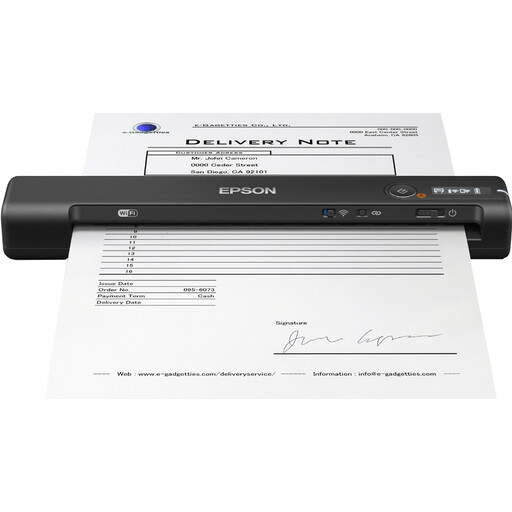
Epson WorkForce ES-60W
Suitable if you want a portable A4 scanner that you can put away and use wirelessly.
600 x 600 DPI; A4. Epson Netherlands lists Wi-Fi and a battery for this model.
View at Joybuy
Frequently asked questions
Do I need an automatic document feeder for one appointment letter?
No, it isn’t a general requirement. For individual pages, you could consider a flatbed or single-sided portable scanner; an automatic duplex feeder is particularly useful if you regularly scan several sheets or double-sided documents.
Can I feed a creased letter through a portable scanner?
First check the condition of the letter and the guidance for your chosen model. For the Brother DS-640, Brother offers a separate carrier sheet for delicate or creased documents; a flatbed avoids feeding the sheet through.
Can I scan my own appointment letter privately under the GDPR?
According to the Dutch Data Protection Authority, the GDPR doesn’t apply to the processing of personal data for personal or household use. This isn’t a general exemption for professional use or publication. If a letter contains health information, treat it as sensitive and check where the digital copy is stored.
What about returns and warranties on a scanner bought online?
For an online purchase from a business, ACM ConsuWijzer says you generally have a statutory cooling-off period of up to 14 days after delivery, with some exceptions. Your statutory rights are separate from any manufacturer’s warranty: if a product used normally doesn’t meet what you could reasonably expect, the seller is responsible for putting things right.


