
Baking just a few apple turnovers
You want to bake one small batch and are mainly concerned with the usable space on the tray or in the basket, and settings that suit your recipe.


Choose based on the usable space on the tray or in the basket: this tells you how many folded apple turnovers will fit with room between them. A mini oven offers conventional top and bottom heat, a larger fan oven may provide more tray space, and an air fryer is an option for small batches. Compare the internal dimensions and settings with your recipe, and check the safety information for the specific appliance before buying.
You want to bake one small batch and are mainly concerned with the usable space on the tray or in the basket, and settings that suit your recipe.
You sometimes bake more than one batch and want a choice of oven settings and more baking surface.
You’re looking for a compact appliance and want to consider where it will go, how easy it is to clean and how much electricity it uses.
Best for: a small baking tray and usually a limited number of turnovers per batch.
The trade-off: limited baking space may mean you need to bake extra batches. Rommelsbacher recommends preheating the BG 950.
Best for: anyone looking for more tray space or a choice between fan-assisted cooking and conventional top and bottom heat. Inventum lists both settings for the OV207B.
The trade-off: check the external dimensions and the space needed around the appliance. A larger capacity doesn’t necessarily mean it will fit on your worktop.
Best for: anyone who wants to make small batches and use a basket for other types of cooking, too. Philips lists baking as one of the ways to use the NA229/00.
The trade-off: check the usable basket space. If you use a suitable baking tin, Philips recommends leaving space around it to allow air to circulate.
| What to consider | What to look for when buying | Who is this important for? |
|---|---|---|
| Baking space per batch | Compare the size of your folded turnovers with the usable tray or basket space, leaving room between them. | I want to know whether my turnovers will fit side by side, so my planned small batch doesn’t end up taking several batches unnecessarily. Around 36% of consumers prioritise the space available per batch. |
| Setting for puff pastry | Check whether the appliance offers conventional top and bottom heat, fan-assisted cooking or a suitable temperature control. Follow the instructions for your chosen type of appliance. | When baking puff pastry, I want to follow the settings in my recipe without assuming that oven and air-fryer settings are interchangeable. Around 29% of consumers mainly choose an appliance based on suitable baking settings. |
| Positioning and cleaning | Measure the available space and check the positioning instructions, the included baking tray and the cleaning options. | I want to check in advance that the appliance will fit on my worktop and be practical to clean after baking. Around 21% of consumers prioritise where the appliance goes and how to maintain it. |
| Running costs and aftercare | Where possible, compare the electricity used per batch for a similar quantity, and check the warranty and service terms. | I want to weigh up the running costs and know who to contact if something goes wrong. Around 14% of consumers focus most on running costs and aftercare. |
The capacity in litres doesn’t tell you how many folded turnovers will fit on the tray or in the basket with space between them.
Measure one turnover and compare its size with the usable baking space and the supplied tray or basket.
A recipe for a conventional oven, a fan oven and an air fryer may call for different settings.
Choose a recipe designed for your type of appliance and check the turnovers as they bake.
The stated wattage on its own doesn’t tell you how much electricity is used per batch. Milieu Centraal recommends comparing ovens by their energy use per use or per year.
Where this information is available, compare energy use for a similar cooking task and factor in any extra batches you might need.
An additional manufacturer’s warranty doesn’t replace your statutory rights against the seller.
First check what the seller is required to do if the appliance is faulty, then see what an additional warranty offers.
An additional warranty service may cost extra; consider whether its cover adds anything to your existing rights.
According to Inventum, the OV207B is a 20-litre freestanding fan oven with a choice of fan-assisted cooking and conventional top and bottom heat.
The OV-3610 is a 10-litre mini oven with conventional top and bottom heat.
The BG 950 is a 10-litre mini oven with conventional top and bottom heat.
The NA229/00 is a 4.2-litre basket air fryer. Philips lists baking as one of its cooking options.
The Joybuy products below focus on freestanding ovens and cookers with different heating settings for baking. When choosing between an oven and an air fryer, the usable space per batch is still what matters.
 No image available
A freestanding oven with fan-assisted cooking and a larger capacity may suit you if you want extra oven space as well as the option to bake small batches.
The product description lists a 45-litre capacity, 2000 W, convection and conventional top and bottom heat. Compare the internal dimensions with your baking tray and recipe.
 No image available
This oven may suit you if you want to use conventional top and bottom heat for oven recipes and are looking for an appliance that includes a baking tray.
The product description lists a 35-litre capacity, temperature control up to 250 °C, a timer and four shelf positions. Check which temperature your recipe calls for.
 No image available
A compact oven with several heating settings may suit you if you want to switch between conventional top and bottom heat and fan-assisted cooking for different recipes.
The product description lists a 22-litre capacity, five heating settings, a temperature of up to 230 °C, an enamelled baking tray and space for baking tins up to 25 cm in diameter.
 No image available
This mini oven may suit a small batch if the baking tray is the right size for your turnovers.
The product description lists a 10-litre capacity, conventional top and bottom heat and a temperature range of 80–230 °C. Baking tins up to 20 cm are listed; Rommelsbacher recommends preheating.
 No image available
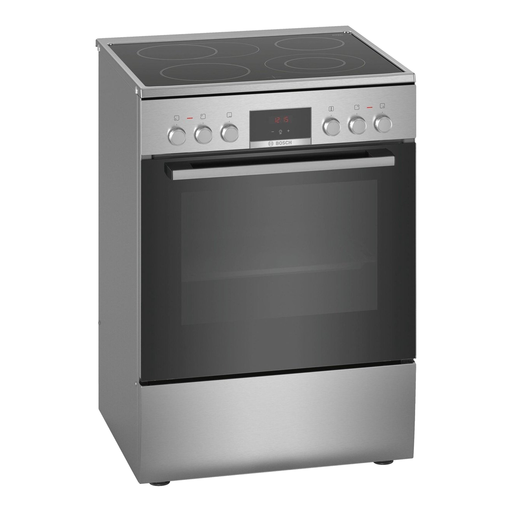
This freestanding cooker may suit you if you’re looking for an electric hob as well as an oven.
The product description lists a 66-litre oven capacity, 3D fan cooking, multi-level baking, a ceramic hob and telescopic rails. Check that it will fit in the available space.
Not without checking first. Use a recipe designed for your type of appliance and check the turnovers as they bake; oven and air-fryer settings aren’t automatically interchangeable.
Follow the instructions for your model. Rommelsbacher recommends preheating the BG 950, as otherwise food may be exposed to too much radiant heat during the initial heating phase.
Where the information is available, compare the electricity used per cooking session for a similar quantity, and factor in any extra batches. For oven comparisons, Milieu Centraal recommends looking at energy use per use or per year; wattage or capacity alone won’t tell you the cost per apple turnover.
No. According to the Dutch government, there is no fixed statutory guarantee period in the Netherlands: you’re entitled to a product that works properly for as long as you could reasonably expect it to. The seller is your point of contact if there’s a problem; a manufacturer’s guarantee may offer additional cover.
According to the Netherlands Food and Consumer Product Safety Authority, CE marking is compulsory for electrical products where this requirement applies. It doesn’t prove that a specific item for sale has been inspected; check the markings and product information for the appliance you’re considering.