
Cook with limited cupboard space
You want to make apple toasties without leaving the appliance permanently on the worktop. That makes its storage position and the dimensions of your cupboard important considerations.


Start by checking how the appliance is stored and measuring the space available in your cupboard; ‘compact’ on its own doesn’t tell you whether it will fit. A standard sandwich plate may be enough for thin apple slices, while deeper plates leave more room for extra fillings. Removable plates can make cleaning easier, but you’ll also need somewhere to store the spare sets.
You want to make apple toasties without leaving the appliance permanently on the worktop. That makes its storage position and the dimensions of your cupboard important considerations.
You want room for apple and perhaps other fillings. Tristar describes the deep plates on the SA-3060 as suitable for larger, generously filled toasties; also check that the appliance will fit in your cupboard.
You want to make other snacks as well as toasties, or remove the plates for cleaning. Bear in mind how much space the spare plate sets will take up.
First, measure your cupboard and check how the appliance is stored. Then choose a type of plate that suits the amount of filling you want and how you prefer to clean it.
| What to consider | What should you check? | Who is this important for? |
|---|---|---|
| Will the appliance fit in your cupboard? | Measure the available height, width and depth, then compare them with the appliance dimensions in its intended storage position. | I want to put the appliance away after use and have little spare shelf space. Around 36% of consumers prioritise having enough cupboard space. |
| Is there enough room for the filling? | Compare the shape and depth of the plates with the size of your bread and the amount of apple or other filling you want to use. | If I want to add extra filling between the slices of bread, I check how much space there is. Around 29% of consumers prioritise room for fillings. |
| How do you clean the plates? | Check whether the plates are removable and whether the manufacturer states that they are dishwasher-safe for the exact model. | I want to clean the plates separately rather than clean food residue from the appliance itself. Around 21% of consumers prioritise ease of cleaning. |
| Would you like to make other snacks too? | Check which plates are included and whether you have space to store the spare sets. | If I want to make different snacks with one appliance, the included plates and the space needed to store them both matter. Around 14% of consumers prioritise versatility. |
An upright storage position doesn’t tell you whether your cupboard has enough clearance, width or space at the opening.
Measure the available space and compare it with the full external dimensions of the exact model in the storage position you plan to use.
Appliances with interchangeable plates also need somewhere to store the sets you’re not using.
Check which plate sets are included and allow space for them when assessing your cupboard capacity.
The Tefal XA800212 is an accessory for compatible Tefal Snack Collection appliances, including model SW852, and is not a standalone appliance.
Check whether the product description is for a complete electrical appliance or just an accessory.
The models reviewed have different types of plates: the SA-3060 has deep, fixed plates, while the SA-3070 has interchangeable plates.
According to Tefal, the UltraCompact 3in1 SW383D10 combines sandwich, waffle and panini plates in one appliance.
According to Philips, the 5000 Series HD2350/80 comes with plates for toasties, waffles and paninis.
This selection includes sandwich makers for apple toasties, from models with fixed or deep plates to options with interchangeable plates. If cupboard space is limited, remember to factor in the external dimensions and the space needed to store spare sets.
 No image available
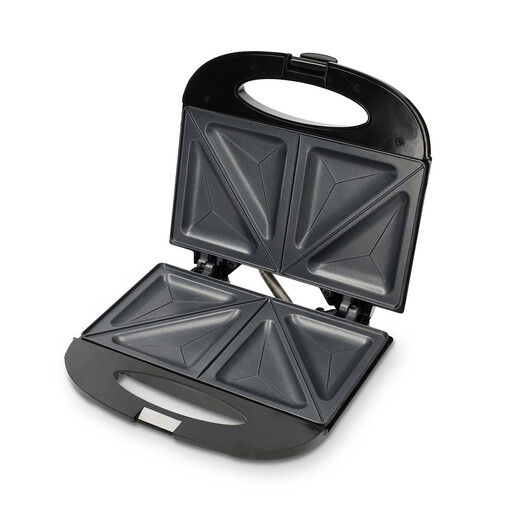
Worth considering if you’re looking for a sandwich maker that, according to the product description, can be stored horizontally or vertically. Check that its dimensions suit your cupboard.
750 W; non-stick sandwich plates; automatic temperature control.
 No image available
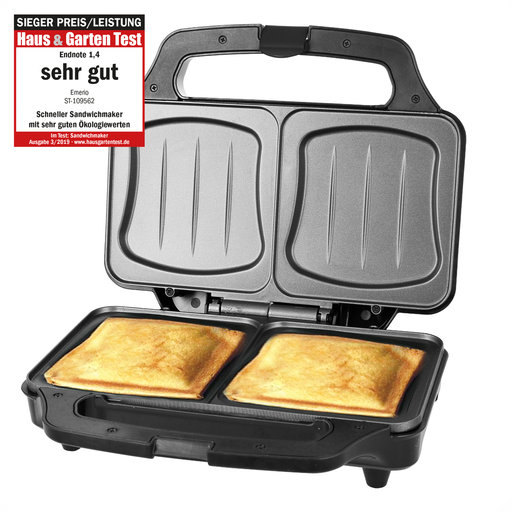
According to the product description, the deep shell-shaped plates are designed for generously filled sandwiches. Check that the appliance will fit in your available storage space.
900 W; capacity for 2 sandwiches; XXL non-stick shell-shaped plates.
 No image available
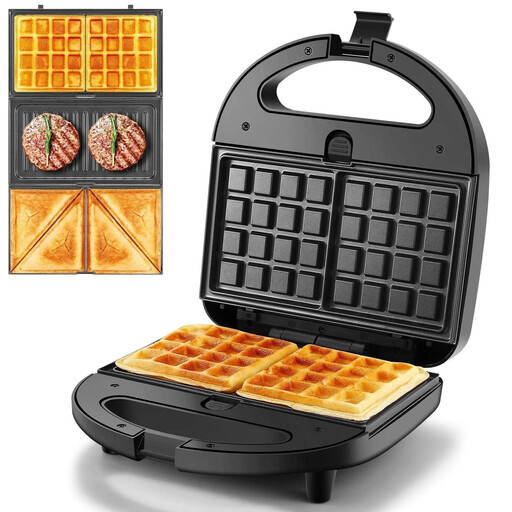
According to the product description, this model can be stored upright and includes cord storage; allow space for the three spare plate sets too.
760 W; three interchangeable sets for sandwiches, waffles and contact grilling; plates are dishwasher-safe.
 No image available
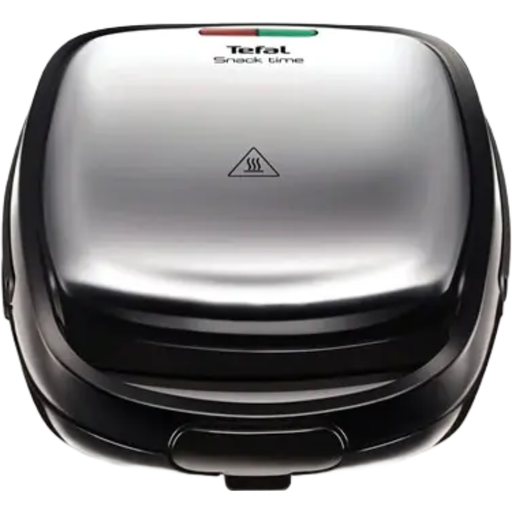
Worth considering if you want interchangeable plates for sandwiches and waffles; bear in mind the extra space needed to store them.
700 W; removable, interchangeable non-stick plates; according to the product description, the plates are dishwasher-safe.
 No image available
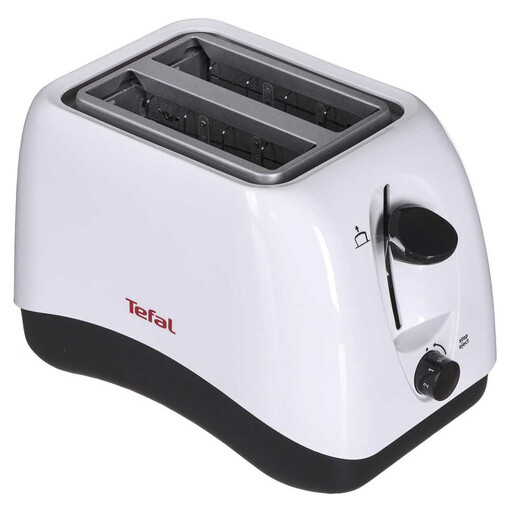
This model is worth considering if you’re looking for a compact sandwich toaster; compare its external dimensions with the space where you plan to store it.
850 W; capacity for 2 slices; non-stick plates.
No, not necessarily. The Netherlands Nutrition Centre’s apple toastie recipe uses thin slices of apple and lists a sandwich maker, frying pan or grill as suitable cooking equipment. Deeper plates are an option if you want to add more filling; the recipe doesn’t compare cooking results between appliances.
No, check the instructions for the exact model. Tefal says the plates for the SW383D10 are dishwasher-safe; the plates on the Tristar SA-3060 are not removable.
Report the fault to the retailer. According to the Dutch Government, the retailer must resolve problems with a faulty product and cannot simply refer you to the manufacturer.
When you buy a new, similar appliance, the shop must take your old one back free of charge. The Dutch Government also says you can take it to a collection point or your local council’s recycling centre.
Not necessarily: the Netherlands Food and Consumer Product Safety Authority (NVWA) does not check every food-contact material individually before it goes on sale. The NVWA says that manufacturers and importers are responsible for ensuring that food-contact materials placed on the market are safe.