
Baking a pie for a group
You want to know whether your springform tin will fit and whether you can bake the number of pies you need in time. The Consumentenbond recommends checking the usable internal dimensions of the oven.


Start by checking the external dimensions of your springform tin, the usable internal dimensions of the oven and the setting specified in your recipe. A built-in oven is suited to a suitable housing unit, while a freestanding oven needs a safe place on your worktop. A combination microwave is worth considering if you also need a microwave. Capacity in litres and extra features alone won’t guarantee that your tin will fit or your pie will bake well.
You want to know whether your springform tin will fit and whether you can bake the number of pies you need in time. The Consumentenbond recommends checking the usable internal dimensions of the oven.
You’re looking for an oven that can be placed somewhere suitable and lets you follow the setting specified in your apple pie recipe. Check the placement instructions and features of the exact model.
You’re considering one appliance for both reheating and baking. If so, check separately that the oven setting and the space for your springform tin are suitable.
Start with the size of your tin and the setting specified in your recipe. Then decide which oven suits the space available and how many pies you want to bake.
| What to consider | What should you check? | Who should give this more weight? |
|---|---|---|
| Will your springform tin fit? | Measure the external dimensions and height of your tin, then compare them with the usable internal dimensions and shelf position. The Consumentenbond recommends checking the internal dimensions. | If I’m baking for a group, I want to know in advance whether my springform tin will fit and have enough room. Around 31% of consumers make this their top priority. |
| Is the oven setting right for your recipe? | Compare the oven setting listed with the instructions in your recipe. Don’t assume the temperature and baking time from another recipe will be suitable. | If I’m following a specific apple pie recipe, I want to be able to select the setting it recommends. Around 25% of consumers prioritise this match. |
| Will the oven fit in your kitchen? | For a built-in model, check the housing unit and connection. For a freestanding model, check its external dimensions and placement instructions. | If the available housing unit, connection or worktop space determines my choice, I check the placement first. Around 19% of consumers make this their top priority. |
| How many pies can you plan to bake? | Check the usable shelf positions, the height of your tin and the model instructions for baking more than one item at a time. Otherwise, plan to bake in batches. | If I’m baking for several people, I want to know how many batches I’ll need and when I can get started. Around 13% of consumers start with this planning. |
| How important is energy consumption? | For applicable models, compare the stated consumption in kWh per cycle with the oven capacity. Standard cycle figures don’t measure how much energy your apple pie will use. | If I use the oven regularly, I want to weigh up the space it offers against its energy consumption. Around 12% of consumers make this their top priority. |
The stated capacity doesn’t tell you whether your tin will fit on the shelf or have enough room. Measure the tin and compare its external dimensions with the usable internal dimensions and shelf position.
Also check the placement instructions for the specific model before assuming your tin will fit.
A recipe may specify a particular setting, and a fan or combination programme won’t automatically be the same. Compare the oven functions of the exact model with the instructions in your recipe.
Also check the shelf positions and the space available for your springform tin.
The label on its own doesn’t tell you how the size and stated consumption per cycle compare. Milieu Centraal points out that a smaller oven with a lower rating doesn’t necessarily use more energy than a larger oven with a higher rating.
Where possible, compare the stated consumption per cycle with the oven capacity. The European Commission lists consumption per cycle for conventional and fan settings; these figures don’t measure the energy used to bake your apple pie.
For the HBA534BS3 built-in oven, Bosch lists settings including conventional top and bottom heat, bottom heat and 3D Hotair.
Inventum offers a freestanding oven, the OV607B, and a built-in combination microwave, the IMC6044GK. They are different types of appliance.
The ETNA OM316MZ is a built-in oven. ETNA lists a capacity of 77 litres and five shelf positions for this model.
For the OS6PB52WAB built-in oven, AEG lists a capacity of 71 litres, conventional top and bottom heat, and bottom heat.
The Panasonic NN-DF37PWEPG is an example of a combination microwave with top and bottom heating.
These products suit different baking needs: a worktop oven, a freestanding model and combination microwaves with an oven function. Check for each model whether your springform tin will fit and whether the oven setting is right for your recipe.
 Image unavailable
For anyone looking for a worktop oven with fan cooking and several rack positions.
The product name lists a capacity of 35 L, a four-level baking rack, an LED display and a thermometer.
 Image unavailable
For anyone looking to combine microwave and grill functions with convection baking.
This model has a capacity of 25 litres. The stated internal dimensions are 340 × 220 × 344 mm and the turntable has a diameter of 270 mm, so measure your springform tin.
 Image unavailable
A freestanding model to consider if you don’t have a suitable built-in space and have somewhere appropriate to put it.
The product name lists a capacity of 65 litres and a power rating of 2000 W.
 Image unavailable
For anyone looking to combine microwave and grill functions with convection baking.
The product name lists a capacity of 20 litres. This model has a glass turntable; check that the available space is suitable for your tin.
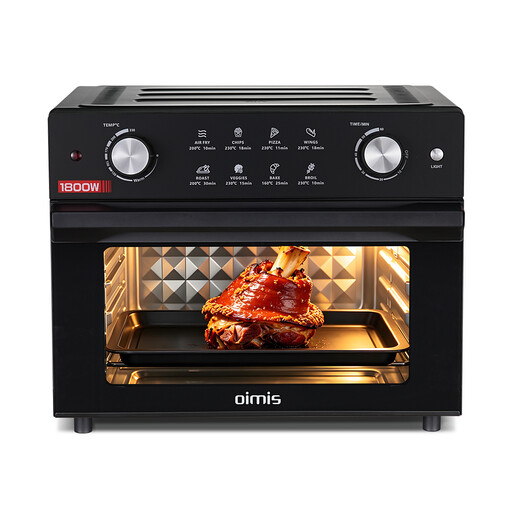 Image unavailable
For anyone looking for a worktop appliance that combines air fryer, toaster and oven functions.
The product name lists a power rating of 1800 W. Check the usable space and oven settings for your springform tin and recipe.
Follow the temperature and oven setting in your recipe. For its apple pie mix, Koopmans recommends 180 °C for conventional electric baking or 165 °C for fan baking, with a baking time of 60–75 minutes. These instructions apply to that recipe and aren’t universal settings.
You can’t tell from the capacity in litres alone. Measure the external dimensions and height of your springform tin, then check the usable internal dimensions, shelf and placement instructions for the exact model.
Follow the model’s instructions for placement, connection and cleaning. For a built-in oven, check that the housing unit and connection are suitable. Don’t connect an appliance based only on its plug or capacity in litres.
The requirements that apply depend on how the event is organised and who is offering the food. The NVWA outlines rules for selling at markets and events, including for private individuals. Businesses and organisations have obligations around allergen information for non-prepacked food. Check which rules apply to the specific coffee morning.
Voedingscentrum recommends storing apple pie in the fridge and gives it a refrigerated shelf life of three days. When planning, also allow time for it to cool before transporting and serving.