
Mirrorless camera photographers
You want to start by choosing a lens that fits your camera mount, then compare magnification and handling. Canon, Nikon, Sony and Sigma use different mounts for the models covered here.


First, choose a lens with the right mount, then decide whether you want to photograph the whole brooch or focus on small engravings and settings. Compare the maximum magnification and the working distance in front of the lens when focusing close up. For shiny metal against a dark background, diffused light and, where needed, focus stacking are also important parts of your set-up.
You want to start by choosing a lens that fits your camera mount, then compare magnification and handling. Canon, Nikon, Sony and Sigma use different mounts for the models covered here.
You may want to photograph engravings, settings or a clasp separately. To do this, compare the maximum magnification of the exact model; Canon, Nikon, Sony and Laowa quote different figures.
You’re photographing against a dark background and want to control reflections, harsh highlights and shadows cast by your equipment. Diffused light and the position of your light sources are therefore also part of your choice.
| What to consider | What to look for | Who it’s for |
|---|---|---|
| Mount and camera compatibility | Check the mount on the exact version. The models discussed include Canon RF, Nikon Z, Sony E and Sigma versions for Sony E or L-Mount; Canon, Nikon, Sony and Sigma provide this model and mount information. | I want a lens that fits my existing camera before comparing magnification. Around 33% of consumers say compatibility is their main buying concern. |
| Magnification for details | Compare the maximum magnification of the exact model: Canon quotes 1.4× for the RF 100mm, Nikon and Sony quote 1:1 for the 105mm and 90mm models discussed, and Laowa quotes 2:1 for its manual-focus 90mm. These are published model specifications, not the result of a direct image-quality test. | If I want to show a small engraving or setting in close-up, detail magnification matters most to me. Around 27% of consumers say small details are their main buying concern. |
| Room for lighting | Check the clearance in front of the lens for the framing you want. Nikon states that when focusing close up, there is around 5 cm between the front of the Z MC 50mm lens and the subject. Nikon recommends a light tent for softer lighting when photographing jewellery; also check whether you can position your diffuser and lights without creating unwanted shadows. | I want to control reflections on metal and stones while leaving enough room to position my lights. Around 20% of consumers prioritise controlling the lighting. |
| Sharpness across the whole brooch | Check the depth of field in test shots and see whether your camera supports focus bracketing. Canon Europe describes focus stacking as combining shots taken at different focus distances; this requires extra shots and post-processing. | If I want the clasp, stone and edge to appear sharp in one final image, sharpness across the whole brooch matters more than extreme magnification. Around 20% of consumers say this is their main buying concern. |
Maximum magnification varies by model. Canon quotes a maximum of 0.5× for the RF 85mm and 1.4× for the RF 100mm; these figures aren’t equivalent when photographing very small details.
Compare the maximum reproduction ratio of the exact version with the framing you want.
A tight working space may mean you need to adjust your lighting set-up more.
Shiny metal and stones can reflect light sources and create harsh highlights. A dark background won’t prevent this on its own; Nikon highlights reflections as something to consider when photographing jewellery.
Take test shots using diffused light and check the metal and stones separately for distracting reflections.
Adjusting the lighting, subject and shooting angle can take extra time.
Stabilisation doesn’t replace depth of field. Parts of a three-dimensional brooch may sit at different distances; focus stacking combines shots taken at different focus distances.
Check whether your camera supports focus bracketing. If you use focus stacking, allow for extra shots and post-processing.
Focus stacking requires extra shots and suitable editing.
For a compatible EOS R camera, Canon lists the RF 100mm F2.8L Macro IS USM and the RF 85mm F2 Macro IS STM, among other options.
For cameras with a Nikon Z mount, the Z MC 105mm f/2.8 VR S and Z MC 50mm f/2.8 are models worth comparing.
The FE 90mm F2.8 Macro G OSS is a macro lens for a compatible Sony E camera.
The 105mm F2.8 DG DN MACRO | Art is available in separate versions for Sony E and L-Mount.
The 90mm f/2.8 2x Ultra Macro APO is a manual-focus model for capturing very small details.
The selection below includes two Sony E lenses listed as options for close-up photography. They’re not an obvious substitute for a macro lens if you want to photograph very small engravings in close-up.
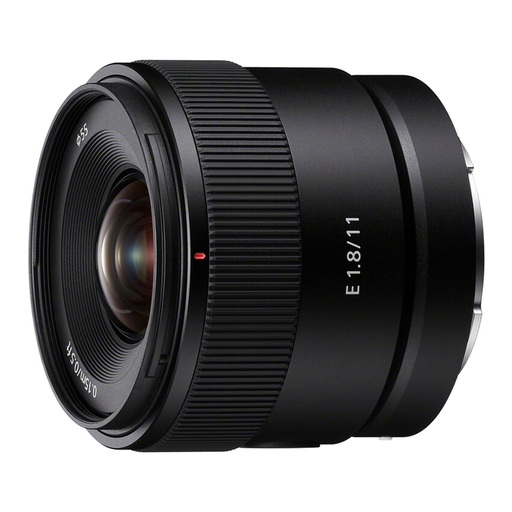 No image available
According to its product name, this is a Sony E wide-angle lens, not a macro lens. Its stated magnification is limited for very small engravings: 0.13× with AF and 0.20× with MF.
 No image available
This Sony E prime lens is listed for close-up and product photography, but it isn’t a macro lens. Its stated magnification of 0.16× is limited if you want to show very small engravings or settings in close-up.
No, not if you mainly want to photograph the whole brooch. Choose the maximum magnification to suit the framing you want: the models discussed range from 0.5× to 2:1, with higher maximum magnification mainly useful for smaller details.
Take test shots to assess reflections and harsh highlights on the metal and stones. Try diffused, movable lighting; Nikon’s jewellery guide describes using a light tent to soften the light. This is a photography technique, not a guarantee that a particular lens will eliminate reflections.
If a single shot doesn’t provide enough depth of field, you can combine photos taken at different focus distances using focus stacking, as long as the brooch is stationary. Check whether your camera supports focus bracketing; otherwise, you’ll need to take manual shots and use suitable editing software.
For an online product purchase, there is generally a statutory cooling-off period that ends 14 days after delivery, according to ACM ConsuWijzer; check which exceptions apply. The statutory guarantee is separate from any manufacturer’s guarantee: the seller is responsible for ensuring the product does what you can reasonably expect it to do.