Choose aniseed sprinkles for your gym bag mainly as a small topping for a snack you’ve prepared in advance, rather than as a snack in their own right around your workout. Whole sprinkles add a crunchy texture, while crushed sprinkles are easier to spread evenly. Pack your chosen amount in a sealed container, and check the nutritional information and allergen details on the packaging.
Who are aniseed sprinkles suitable for as a topping?
People who take a topping with them to the gym
If you want to sprinkle aniseed sprinkles over a pot of yoghurt or quark you’ve prepared in advance, you can pack a small amount separately at home. PLUS suggests using crushed sprinkles with yoghurt. Bear in mind that loose sprinkles may spill when you open the pot on the go.
People comparing pack sizes and portions
If you only use aniseed sprinkles now and then, consider not just the size of the pack but also how much you want to sprinkle on each time. The De Ruijter packs we looked at contain either 270 g of crushed sprinkles or 330 g of blue and white sprinkles, so the product form varies too.
People who check nutritional information
If you keep an eye on sugar, protein or allergens, it’s worth checking the variant you choose. For De Ruijter blue and white sprinkles, Jumbo lists 79 g of sugar and 2 g of protein per 100 g. Check the ingredients and allergen information on the packaging each time you buy them, too.
What should you consider when choosing?
First, decide whether you want aniseed sprinkles as a topping or are looking for a snack in their own right. Then choose the form that suits what you’re taking with you and how much you plan to use.
| What to consider |
What to look for |
Who it matters to |
| Easy to take with you |
Choose whole or crushed sprinkles based on the topping you want to make. Use a well-sealed container and keep the sprinkles dry. |
If I add sprinkles to my snack on the go, I want to take a portion with me without getting loose sprinkles in my bag. For around 40% of consumers, convenience when carrying a product is the top priority. |
| Nutritional information |
Check the sugar and protein content per 100 g, and consider how much you’ll use. For the blue and white variant, Jumbo lists 79 g of sugar and 2 g of protein per 100 g. |
If you’re looking for a snack in its own right around your workout, you’ll want to know what the sprinkles add to it. Around 30% of consumers put this nutritional consideration first. |
| Pack size and portion |
Compare the pack sizes and decide how much you’ll sprinkle each time; bear in mind the difference between whole and crushed sprinkles. |
I only use small amounts of sprinkles and want to choose a pack that suits how I use them. Portion control comes first for around 30% of consumers. |
Common mistakes
-
Thinking of sprinkles as a complete pre- or post-workout snack
Per 100 g, the blue and white sprinkles for which Jumbo lists nutritional values contain 92 g of carbohydrates, including 79 g of sugar, and 2 g of protein. This product information means that sprinkles on their own are not a substitute for a complete meal.
Decide whether you need a topping or a snack in its own right. If you want to take sprinkles with you, measure out a portion to sprinkle over yoghurt, quark, bread or rusks, for example.
-
Skipping the allergen information
The product information for the selected blue and white De Ruijter sprinkles lists wheat and gluten. Don’t assume that another form or variant has the same ingredients.
Read the ingredients and allergen information on the packaging you’re actually buying.
A relevant brand to consider
De Ruijter
De Ruijter offers, among other products, 330 g packs of whole blue and white sprinkles and 270 g packs of crushed sprinkles. These are different forms of sweet bread topping and sprinkles, so choose according to how you plan to use them and the information on the specific pack.
- PLUS describes the blue and white variant as aniseed with a crunchy sugar coating, and suggests using crushed sprinkles with yoghurt.
- For the blue and white variant, Jumbo lists 79 g of sugar and 2 g of protein per 100 g. So consider sprinkles as part of the snack you put together, not as a high-protein snack on their own.
Aniseed sprinkles for a prepared snack
These blue and white sprinkles are a good fit for a measured topping on yoghurt, quark, bread or rusks, for example. If you’re looking for crushed sprinkles, check the product form too: the option below is for whole sprinkles.
 No image available
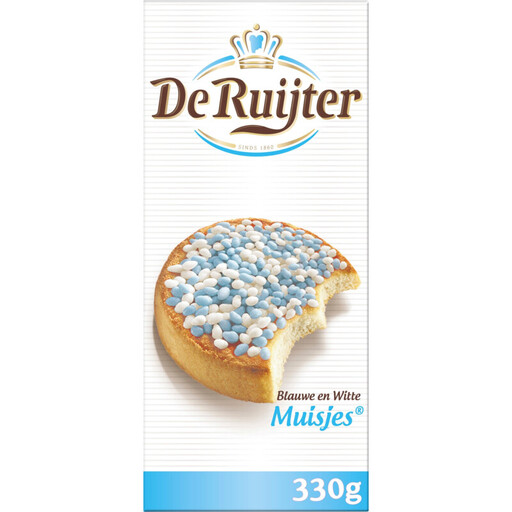
De Ruijter blue and white aniseed sprinkles 330 g
For anyone who wants to use whole sprinkles as a topping on a snack prepared in advance.
330 g pack. For this blue and white variant, Jumbo lists 79 g of sugar and 2 g of protein per 100 g. The product information lists wheat and gluten; check the current packaging and store the sprinkles in a dry place.
View at Joybuy
Frequently asked questions
Are aniseed sprinkles a good post-workout snack on their own?
Aniseed sprinkles are best used as a sweet topping, rather than as a complete snack in their own right. For De Ruijter blue and white sprinkles, Jumbo lists 92 g of carbohydrates per 100 g, including 79 g of sugar, and 2 g of protein. Consider the whole snack when deciding what to eat around your workout.
Should I take whole or crushed sprinkles with me?
Choose whole sprinkles if you want a crunchy topping; crushed sprinkles are easier to spread evenly over bread, rusks or yoghurt. Pack a portion in a sealed container and keep the sprinkles dry.
What should I check if I want to check for allergens?
Read the allergen information for the variant you’re buying. The product information for the selected blue and white De Ruijter sprinkles lists wheat and gluten; check the packaging again if you choose a different variant.
Do aniseed sprinkles need to be kept in the fridge or freezer?
For the De Ruijter crushed sprinkles we looked at, Jumbo’s storage instruction is ‘store in a dry place’. Follow the storage instructions on your pack, and use a well-sealed container for a portion in your gym bag.


