
Families sharing aniseed sprinkles
If you’re planning several breakfasts or rusk breaks on holiday, you’ll want a pack everyone can help themselves to. Check the pack size and storage instructions if you’re taking it with you.


For shared breakfasts or rusks, a 330 g pack of whole aniseed sprinkles is one option. If you’d prefer a smaller pack with a finer texture, consider a 270 g pack of crushed aniseed sprinkles. Need individual portions for lunchboxes? Check explicitly that the pack contains separate sachets: a standard pack isn’t automatically a multipack.
If you’re planning several breakfasts or rusk breaks on holiday, you’ll want a pack everyone can help themselves to. Check the pack size and storage instructions if you’re taking it with you.
If individual portions matter, the pack’s weight isn’t the only thing to consider. Check whether it actually contains separate sachets of aniseed sprinkles.
If you have questions about wheat, gluten or the amount of sugar per portion, check the ingredients, allergen information and nutritional values on the current pack.
First decide whether you want to share one pack of aniseed sprinkles or need individual portions. Then compare the pack sizes and the label on the product you’re considering.
| What to consider | What to check before buying | Who it matters to |
|---|---|---|
| Pack size for sharing | Compare the net weight and choose between 330 g of whole aniseed sprinkles and 270 g of crushed aniseed sprinkles. | If several people will be sharing a pack on holiday, I want enough for the planned occasions without having lots left over; around 40% of consumers prioritise sharing. |
| Individual lunchbox portions | Look for an explicit mention of separate sachets of aniseed sprinkles on the product page and the pack. | For lunchboxes, I want to take portions with me without having to decant the sprinkles myself; convenience is the top priority for around 40% of consumers. |
| Label and storage instructions | Read the ingredients, allergen information, nutritional values and storage instructions on the current pack. | If wheat, gluten or sugar content affects my choice, I want to see the details for this exact pack; around 20% of consumers give label information top priority. |
A 270 g or 330 g pack of aniseed sprinkles doesn’t, by itself, tell you whether it contains individual portions. For lunchboxes, you may need to portion them out yourself.
Check that the pack explicitly says it contains separate sachets of aniseed sprinkles. Portion packs of chocolate sprinkles are a different product.
The De Ruijter Feestmuisjes and Gestampte Muisjes listed by Jumbo contain wheat and gluten-containing cereals. Pack size tells you nothing about the ingredients or nutritional values.
Read the label on the specific pack before use, especially if allergens or sugar content are important to your choice.
The storage instructions for the aniseed sprinkles listed by Jumbo say to keep them dry. This is important when you’re taking the pack to your holiday accommodation, too.
Seal the pack securely after use and follow the storage instructions on the packaging.
Jumbo lists De Ruijter aniseed sprinkles as whole sprinkles in 330 g packs and crushed sprinkles in a 270 g pack.
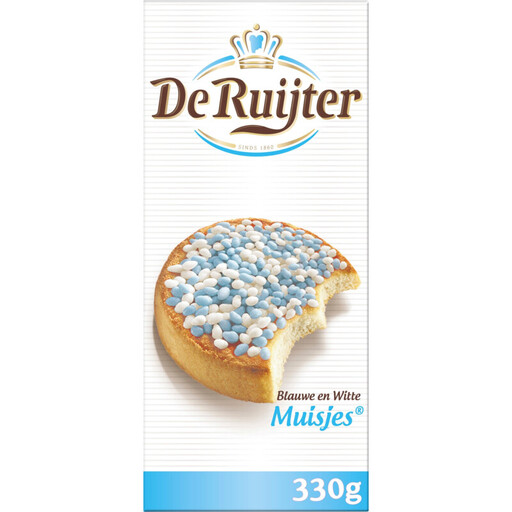
This 330 g pack is suitable for breakfasts or rusk breaks when you want to use aniseed sprinkles from one pack. Looking for individual lunchbox portions? Check the packaging format first.
 No image available
An option for shared breakfasts or rusk breaks, with you choosing how much of the sprinkles to use.
Not necessarily: the weight doesn’t confirm that the pack contains separate sachets. Check the current packaging to see whether the sprinkles are individually portioned. De Ruijter Kleintjes in individual portions are chocolate sprinkles, not aniseed sprinkles.
Follow the storage instructions on the pack and keep the sprinkles dry and securely sealed. Also check the best-before date on the packaging.
The De Ruijter Feestmuisjes and Gestampte Muisjes listed by Jumbo contain wheat and gluten-containing cereals, so read the label on the specific pack. According to the Netherlands Food and Consumer Product Safety Authority, allergen information for prepacked products is shown on the label.