If you want to pack aniseed sprinkles for school, use them as a small, sweet extra rather than as the regular topping for everyday lunches. The Netherlands Nutrition Centre recommends choosing mainly foods from the Wheel of Five for a primary school lunch. Measure out the sprinkles yourself, and check the label on the pack you buy if your child has any allergies.
Who is this choice for?
Parents putting together everyday lunches
You want to know whether a slice of bread with aniseed sprinkles fits alongside the foods you usually pack. The Netherlands Nutrition Centre recommends wholemeal bread and toppings that fit the Wheel of Five for a primary school lunch.
Parents who occasionally pack a sweet topping
Your child enjoys a sweet sandwich, but you want to use aniseed sprinkles as a little extra rather than as an everyday topping by default.
Parents who want to pack one lunch-sized portion
You’re looking for a small amount to put in a lunchbox. Jumbo lists aniseed sprinkle varieties in 270 g and 330 g boxes, so you can measure out a portion at home for one lunch.
What should you look for when choosing?
First decide whether the sandwich is part of an everyday school lunch or an occasional treat. Then consider how many sprinkles you want to pack and whether the ingredients are suitable for your child.
| What to consider | What to check before buying | Who it matters to |
|---|
| Everyday lunch |
Consider the whole lunch and read the nutritional information for the topping. |
If I’m making lunch for every school day, I don’t want sweet toppings to become the main part of the meal. For around 50% of these consumers, the make-up of an everyday lunch comes first. |
| A taste of something sweet |
Check whether your child likes the aniseed flavour and decide how many sprinkles to add to the sandwich. |
An occasional sweet sandwich is only worthwhile if my child enjoys it. Taste or a treat for a special occasion comes first for around 30% of these consumers. |
| A portion to take with you |
Compare the pack sizes and consider whether you can measure out a small portion at home. |
I don’t want to pack a whole box for one lunchbox, so I’m looking for a practical way to pack a few sprinkles. Around 20% of these consumers give portioning and ease of packing top priority. |
For comparison, the Netherlands Nutrition Centre gives an average of 11.9 g of sugars per 15 g of aniseed sprinkles. The nutritional values on the pack you buy may differ.
Common mistakes
-
Using aniseed sprinkles as the standard topping for every lunch
The Netherlands Nutrition Centre recommends choosing mainly foods from the Wheel of Five for a primary school lunch. According to the average nutritional values, a 15 g portion of aniseed sprinkles contains 11.9 g of sugars.
If you like, use the sprinkles as a small topping, and choose bread and toppings that follow the Netherlands Nutrition Centre’s guidance for everyday lunches.
-
Expecting a single-portion pack of Muisjes
The Muisjes varieties listed in Jumbo’s category come in 270 g or 330 g boxes. A box is not the same as a pre-portioned serving for lunch.
Check the type of packaging, and measure out a small amount at home if you only want to pack one portion.
-
Relying on a previous purchase when your child has allergies
Albert Heijn and PLUS list wheat starch among the ingredients of De Ruijter Feestmuisjes. Ingredients can vary between varieties or change over time.
Check the current label of the variety you choose each time you buy it, especially if you need to avoid wheat or gluten.
Brands and retailers to explore
The retailers listed provide information about specific Muisjes varieties; their inclusion here does not mean every store stocks them.
De Ruijter
The brand behind the Feestmuisjes and other Muisjes varieties featured here.
- You can choose from Feestmuisjes, crushed and coloured varieties, among others, as shown by Jumbo.
- Albert Heijn lists sugar as the first ingredient in De Ruijter Feestmuisjes and also mentions wheat starch; check the ingredients for each variety.
Albert Heijn
A retailer with product information for 330 g De Ruijter Feestmuisjes.
- The product page lists ingredients and nutritional information for this variety.
- When you buy it, check the label on the pack for the latest ingredient and allergen information.
Jumbo
A retailer whose category includes Feestmuisjes, pink and white, blue and white, and crushed Muisjes.
- The 270 g and 330 g boxes listed make it easy to compare pack sizes.
- You’ll need to measure out the sprinkles yourself if you only want to pack a small portion for lunch.
PLUS
A retailer with product information for 330 g De Ruijter Feestmuisjes.
- The product page lists the ingredients, allergens, nutritional values and storage advice for this box.
- Check the pack you choose if the ingredients or allergens are important to your purchase.
Aniseed sprinkles to portion yourself
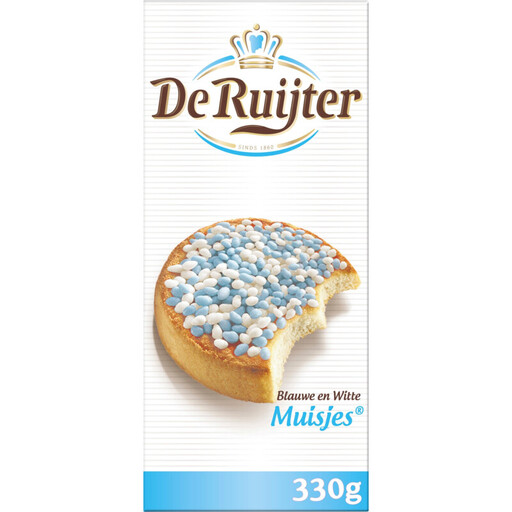
These blue and white aniseed sprinkles come in a 330 g box. If you want to pack a small amount for one school lunch, you can measure out a portion at home.
 No image available
De Ruijter blue and white aniseed sprinkles, 330 g
You can measure out a small amount from this box to sprinkle on a sandwich.
Pack size: 330 g. Before use, check the ingredients and allergens on the current label. To carry a separate portion, use a clean, dry, tightly sealed container.
View at Joybuy
Frequently asked questions
Are aniseed sprinkles suitable as the regular topping for an everyday school lunch?
It’s best to use aniseed sprinkles as a small extra rather than as the regular main topping. The Netherlands Nutrition Centre recommends choosing mainly foods from the Wheel of Five for a primary school lunch and gives an average of 11.9 g of sugars per 15 g of aniseed sprinkles.
How can I pack a small portion of aniseed sprinkles?
Sprinkle a little onto the sandwich at home, or measure out a portion into a clean, dry, tightly sealed container. Jumbo lists Muisjes boxes of 270 g and 330 g; check the packaging if you’re looking for a pre-portioned serving.
What should I look for if my child needs to avoid wheat or gluten?
Check the label of the exact variety before packing it. Albert Heijn and PLUS list wheat starch among the ingredients of De Ruijter Feestmuisjes; don’t assume the information is the same for every variety.
What should I check on the pack of aniseed sprinkles?
Always check the ingredients, allergens, nutritional information, quantity and storage instructions for the variety you buy. The Netherlands Food and Consumer Product Safety Authority stresses that information about the contents of prepacked food must be clearly legible on the label.


