Choose pink-and-white or blue-and-white aniseed sprinkles for the colour you want on your rusk, or crushed sprinkles if you prefer a finer topping. The boxes described contain 330 g and 270 g respectively; even the smaller box is not a single serving. If you’ll only use a small amount, check the net weight, and always read the label on your chosen variety if you have allergies.
Who is this choice for?
If you’re making just a few rusks
If you’re buying aniseed sprinkles for yourself or a small group, the main thing to consider is how much will be left over. The De Ruijter boxes described by Albert Heijn contain 270 g of crushed aniseed sprinkles or 330 g of a coloured variety.
If you’re choosing a colour for visiting a new baby
For a traditional topping on rusks, you can choose between pink-and-white and blue-and-white aniseed sprinkles. Albert Heijn lists both De Ruijter varieties in 330 g boxes.
If you’re comparing ingredients and portions
Wheat/gluten is a point to note in the De Ruijter varieties described here. If you also want to compare the sugar content per serving, check the nutritional information on your chosen box: Voedingscentrum gives an average of 11.9 g of sugars per 15 g for aniseed sprinkles, not a figure that applies to every variety or serving size.
What should you look for when buying?
If you’re making just one or a few rusks, start by checking how much is in the box. Then choose your preferred colour or texture, and read the label if the ingredients matter to you.
| What to consider |
What to check before buying |
Who should consider this? |
| Quantity and leftovers |
Compare the net weight and serving size. Albert Heijn lists 270 g for De Ruijter crushed aniseed sprinkles and 330 g for both coloured varieties. |
If I’m making just a few rusks, I want to know how much will be left over. Packaging size is the top priority for around 45% of consumers. |
| Colour and presentation |
Check whether you’re choosing the pink-and-white or blue-and-white variety, and read the ingredients if the colouring matters to you. |
For a visit to a new baby, I want to choose a colour that suits the presentation I have in mind. Around 33% of consumers prioritise this choice of colour. |
| Ingredients and serving size |
Read the allergen and nutritional information per serving on the pack you’ve chosen. The De Ruijter varieties described by Albert Heijn list wheat/gluten. |
If I’m keeping an eye on ingredients or sugar content, I want to be able to compare this information by variety. Ingredients and serving sizes are the first consideration for around 22% of consumers. |
Common mistakes
-
Assuming a smaller box is a single serving
Albert Heijn lists De Ruijter crushed aniseed sprinkles as 270 g, with 45 servings of 6 g. That’s less than the 330 g boxes described, but it isn’t individually portioned.
Check the net weight, and only choose portion packs if they’re clearly labelled as such.
-
Assuming aniseed sprinkles are gluten-free
The pink-and-white, blue-and-white and crushed De Ruijter varieties described here list wheat/gluten. The words ‘sugar’ and ‘aniseed’ in the name don’t tell you everything about the ingredients.
If you have an allergy or intolerance, read the current label on the exact variety you intend to use.
-
Assuming a difference in colour means a nutritional difference
For the coloured varieties described by Albert Heijn, pink-and-white or blue-and-white is mainly a presentation choice. The listed colourings differ: carmine for pink-and-white and indigotine for blue-and-white.
Compare the nutritional information and ingredients separately if they matter to your choice.
-
Relying only on an online product description
When it comes to ingredients, allergens and shelf life, the pack you actually receive is what determines whether you can use the product and how you should store it.
Check the label on the box you receive before use, even if you’ve already read the product information online.
A useful brand to consider
De Ruijter
For rusks topped with aniseed sprinkles, Albert Heijn describes a pink-and-white, a blue-and-white and a crushed variety from De Ruijter.
- The coloured varieties give you a choice of presentation, while the crushed variety has a finer texture.
- The boxes described contain 270 g or 330 g and list wheat/gluten. Check the details on the current packaging.
Aniseed sprinkles for rusks at Joybuy
These two boxes are a good option if you’re looking for blue-and-white or pink-and-white sprinkles for rusks. Both contain 330 g, so if you’re making just a few rusks, the quantity in the box is an important consideration.
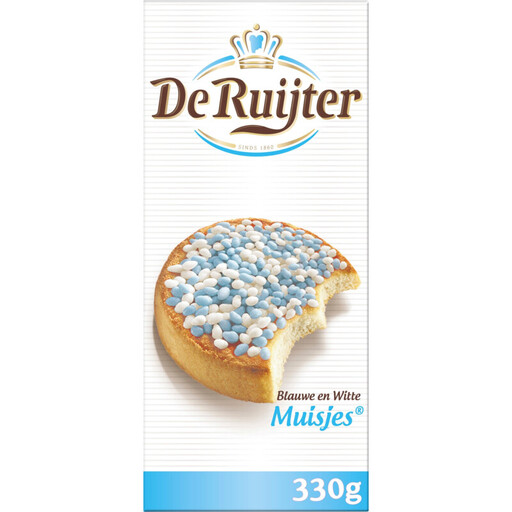 Image unavailable
De Ruijter blue-and-white aniseed sprinkles 330 g
For serving rusks topped with blue-and-white aniseed sprinkles. This box contains 330 g; if you’ll only use a small amount, consider how much you need and check the label for wheat/gluten.
View at Joybuy
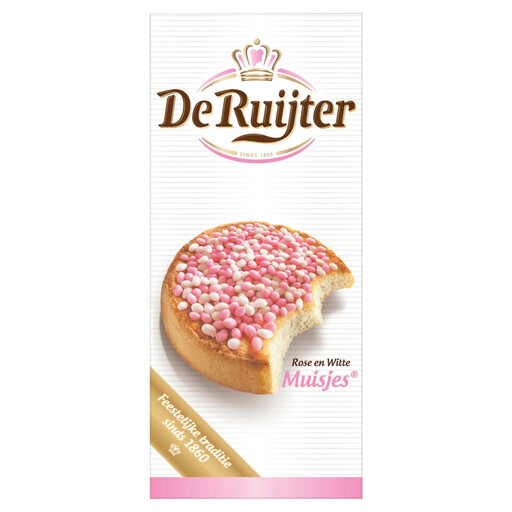 Image unavailable
De Ruijter pink-and-white aniseed sprinkles 330 g
For serving rusks topped with pink-and-white aniseed sprinkles. This box also contains 330 g; if you’re making just a few rusks, bear in mind how much will be left over, and read the label if you have questions about wheat/gluten.
View at Joybuy
Frequently asked questions
Is a box of crushed aniseed sprinkles suitable for one rusk?
You can use them to top one rusk, but the box described isn’t an individual portion pack. Albert Heijn lists De Ruijter crushed aniseed sprinkles as 270 g, with 45 servings of 6 g; check the net weight if you want to avoid having much left over.
Should I choose pink-and-white or blue-and-white sprinkles for traditional rusks?
Choose the colour that suits your presentation. Albert Heijn describes both De Ruijter varieties as sugar-coated aniseed seeds in a 330 g box; read the label if the colouring or other ingredients also matter to you.
What should I check if I avoid wheat or gluten?
Check the label on the exact variety of aniseed sprinkles before using it. The pink-and-white, blue-and-white and crushed De Ruijter varieties described here list wheat/gluten, so don’t treat them as gluten-free.
How should I store aniseed sprinkles after opening?
Follow the storage instructions and use-by information on the packaging you’ve bought. The De Ruijter varieties described by Albert Heijn say to store in a dry place.


