
For a small Mother’s Day breakfast
You want to decorate one rusk or a few cupcakes, and would rather sprinkle on a small amount yourself than use a whole portion.


For a small Mother’s Day treat, you can sprinkle a little crushed aniseed sprinkles yourself, or choose whole pink-and-white sprinkles if you want them to stand out as decoration. The 270 g and 330 g packs listed by Albert Heijn for these products are not individually wrapped mini portions. Aniseed hail is an alternative only if you don’t need traditional muisjes; check the ingredients and allergens on the packaging whichever option you choose.
You want to decorate one rusk or a few cupcakes, and would rather sprinkle on a small amount yourself than use a whole portion.
You’re looking for a familiar aniseed-sprinkle decoration for rusks, cupcakes or cakes, and are choosing the grain mainly for its appearance.
You’re buying for yourself or someone else and want to check the ingredients, allergens and nutritional information on the packaging before use.
First decide whether you need individually wrapped portions or want to sprinkle from a standard pack. Then choose the type of grain and check the label.
| What to consider | What to check when buying | Who it matters to |
|---|---|---|
| Sprinkling your own | Compare the net weight with the stated serving size; a serving-size indication doesn’t mean the portions are individually wrapped. | For one breakfast, I want to sprinkle on a little without expecting a separate sachet containing a small portion. Around 50% of consumers prioritise being able to sprinkle their own amount. |
| Decoration | Decide whether you want whole, clearly visible sprinkles or a finer topping. | I want the pink-and-white sprinkles to show on my Mother’s Day cake. For around 30% of consumers, appearance is the top priority. |
| Ingredients and nutritional information | Read the current ingredients and allergen information, and compare sugars per 100 g if that matters to your choice. | If I’m decorating something for someone else, I want to know what ingredients and allergens it contains first. Around 20% of consumers make this their top priority. |
Albert Heijn lists a 6 g serving for De Ruijter Gestampte muisjes and a 15 g serving for De Ruijter Roze en witte muisjes. These serving sizes are for 270 g and 330 g packs respectively, not individually wrapped portions.
If you only want to use the sprinkles once, check both the net weight and the type of packaging.
According to Albert Heijn’s product description, De Ruijter Anijshagel is sugar strands with an aniseed flavour. It’s a different type of product from muisjes, so the topping will look different.
Choose anijshagel only if a fine sprinkle matters more to you than the recognisable look of muisjes.
The muisjes varieties and anijshagel discussed here list wheat or gluten. This matters if you’re buying for someone who needs to avoid certain ingredients or allergens.
Check the current allergen information on the packaging every time you buy.
The size of the grains tells you nothing about the sugar content per 100 g. Joybuy lists 91 g of sugars per 100 g for De Ruijter Anijsstrooisels, 300 g; Albert Heijn lists 79 g per 100 g for De Ruijter Roze en witte muisjes.
Compare the nutritional information per 100 g and decide separately how much you want to sprinkle on.
The product range discussed includes whole muisjes, crushed muisjes and anijshagel.
The product information lets you compare De Ruijter Roze en witte muisjes with Gestampte muisjes.
The muisjes category includes 330 g packs of whole varieties and 270 g packs of crushed muisjes.
The product pages list 330 g packs of De Ruijter Roze en witte muisjes and 270 g packs of Gestampte muisjes.
These whole pink muisjes are designed to stand out as a topping on, for example, a Mother’s Day rusk or cupcake. You sprinkle them from a 330 g pack; they’re not individually wrapped portions.
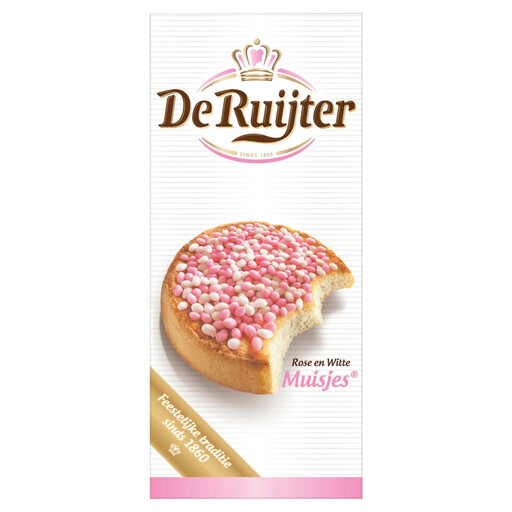 Image unavailable
For a colourful topping on rusks or cupcakes; you decide how much to sprinkle from the 330 g pack. Check the ingredients and allergens on the packaging before use.
The muisjes discussed here are listed by Albert Heijn and Jumbo in standard 270 g or 330 g packs, not as individual mini portions. If you need separate portions, check the type of packaging explicitly before you buy.
Crushed muisjes are an option if you want to sprinkle a small amount finely. Albert Heijn lists a 6 g serving for De Ruijter Gestampte muisjes, but the product comes in a 270 g pack.
The pink-and-white and crushed muisjes discussed here list wheat or gluten; the same applies to the anijshagel discussed here. Always check the current allergen information on the packaging of the product you buy.
Keep the pack tightly closed in a cool, dry place, as Joybuy advises for the Pink Muisjes discussed here. Also check the storage instructions and date on your own pack.