
Shoppers prioritising a sugar-free option
You’re looking for a product labelled sugar-free and are happy to consider a soft sweet as an alternative to crunchy anise sprinkles. Also compare the polyols and ingredients listed on the packaging.


Choose Joris Sugar-free Muisjes if you’re looking for a soft sweet, not if you expect crunchy anise sprinkles for bread: bol.com lists 0.1 g of sugars per 100 g, and Snoepman lists food-grade gelatine as an ingredient. For rusks topped with traditional anise sprinkles, De Ruijter is the right product type, but Joybuy lists 79 g of sugars per 100 g for the Blue & White variety, so it isn’t suitable if you need a sugar-free option. Check the ingredients, allergens and nutritional information on the packaging of the variety you buy.
You’re looking for a product labelled sugar-free and are happy to consider a soft sweet as an alternative to crunchy anise sprinkles. Also compare the polyols and ingredients listed on the packaging.
You want crunchy anise seeds for rusks, bread or a celebratory occasion. In that case, the traditional product type matters more to your choice than a sugar-free claim.
You want to know before buying whether a product contains gelatine, wheat or a sweetener you wish to avoid. Snoepman lists food-grade gelatine in the Joris sweet mice; Joybuy’s product information lists wheat in De Ruijter Blue & White.
First decide whether sugar-free is a must-have or whether you mainly want crunchy anise sprinkles. Then compare the nutritional information per 100 g and read the ingredients for the variety you’ve chosen.
| What to consider | What to check | Who it matters to |
|---|---|---|
| Sugar-free option | Compare sugars per 100 g and check the claim on the packaging. | I want to choose something sugar-free for breakfast, even if that means a soft sweet instead of anise sprinkles for bread. For around 43% of shoppers, this sugar-free requirement is the top priority. |
| Crunchy anise sprinkles | Check whether the product is anise seeds with a sugar coating or soft jelly sweets. | For rusks at a celebration, I want to serve the familiar, crunchy anise sprinkles. Around 29% of shoppers prioritise this traditional product type. |
| Ingredients and allergens | Read the ingredients and allergen information, and check for any warnings about polyols. | If I want to avoid gelatine, wheat or a particular sweetener, the ingredients list should determine my choice. For around 28% of shoppers, this is their top priority. |
Joris is sold as a soft jelly sweet, whereas PLUS describes traditional anise sprinkles as anise seeds with a sugar coating. You’ll notice the difference when you want crunchy sprinkles for your rusks.
Decide which product type you want to serve before comparing the sugar content.
A sugar-free claim alone tells you nothing about the amount of polyols or whether the product contains animal-derived ingredients. The Joris listing on bol.com states 78.4 g of polyols per 100 g; Snoepman lists food-grade gelatine.
As well as checking sugars per 100 g, read the full ingredients list and nutritional information on the packaging.
In the Joris listing we reviewed, a vegan label conflicts with the food-grade gelatine listed in the ingredients. This makes a difference if you avoid gelatine.
Check the current ingredients list on the packaging and, if the information conflicts, ask for confirmation before buying.
The Joris product listing states 78.4 g of polyols per 100 g as well as 0.1 g of sugars. The sugar figure alone therefore doesn’t give you the full nutritional picture.
Also check the polyols and any warnings on the packaging, and consider how much of the product you’ll use.
The Joris Sugar-free Muisjes we reviewed are soft sweets shaped like mice, not crunchy anise sprinkles for rusks.
The traditional sprinkles we reviewed are for anyone looking for sugar-coated anise seeds. PLUS describes Roze & Witte as having this composition.
This product is a good fit if you’re looking for classic anise sprinkles for rusks or as a topping. If you want soft, sugar-free sweets shaped like mice, you’ll need a different product type.
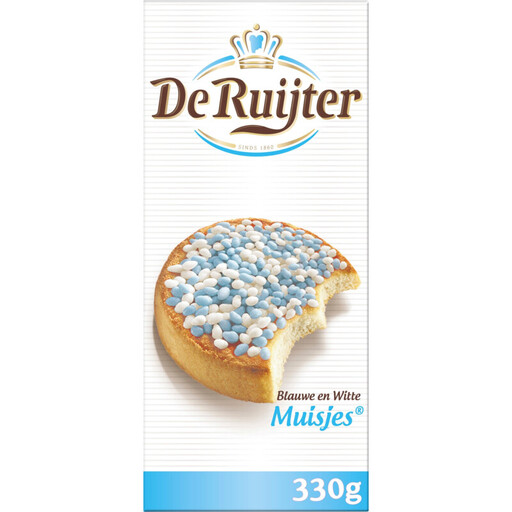 Image unavailable
For anyone who wants traditional anise sprinkles on rusks and doesn’t need a sugar-free option.
330 g pack. Joybuy’s product information lists 79 g of sugars per 100 g and includes wheat in the ingredients; if you have an allergy, check the current packaging.
No. The Joris variety we reviewed is a soft jelly sweet made with maltitol syrup, whereas PLUS describes traditional De Ruijter sprinkles as anise seeds with a sugar coating. Choose based on the product type you want, not just the word ‘muisjes’ in the name.
Compare the nutritional information per 100 g so that different packs and portions are measured on the same basis. The Netherlands Nutrition Centre recommends this approach when comparing labels; also check the ingredients for the specific variety.
As well as sugars, check the polyols information and any warnings on the packaging. The Joris listing we reviewed on bol.com states 78.4 g of polyols per 100 g; consider how much of the product you’ll use when making your choice.
No. A sugar-free claim doesn’t confirm either of these properties. Snoepman lists food-grade gelatine in Joris Sugar-free Muisjes, while Joybuy’s product information lists wheat in De Ruijter Blue & White. Check the ingredients and allergen information on the packaging of the product you choose.