
Vandaag of morgen in huis

Kwaliteit gegarandeerd

Welkomstaanbiedingen ontgrendelen: GRATIS bezorging | Tot 80% korting | Gratis 30 dagen JoyPlus-proefperiode
Download de app
A car interior with coloured lighting can be a subtle upgrade for everyday use, or a striking feature of a tuning and car-audio project. However, many kits look alike. A long LED strip, millions of colours and music synchronisation may sound appealing, but they do not automatically indicate ease of installation, even light distribution or suitability for your vehicle.
As a Joybuy Product Recommendation Officer, I therefore focus primarily on verifiable specifications. With ambient LED lighting for cars, three pitfalls are particularly important: the wrong supply voltage, an installation that does not suit the interior and an app that offers fewer functions than expected.
Many RGB interior lighting kits for cars advertise millions of colours. This mainly indicates how many colour combinations the controller can display. It says nothing about brightness, even distribution or visibility during the day.
An acrylic strip and fibre optic car lighting also work differently. With an acrylic strip, the light is distributed along the strip according to the product description. With a traditional optical fibre, the light comes from one or more LED sources into the fibre. The positioning of the LEDs and the length of the fibre therefore have more influence on the result.
Universal car interior lighting may be suitable for cars, SUVs, vans and pick-ups, but every interior has different gaps, panels and available space. A strip that fits neatly into a dashboard seam will not automatically be suitable for a door panel or footwell.
Also pay attention to the electrical system. The sets mentioned are designed for 12V. A vehicle with a 24V system, such as certain commercial vehicles or buses, presents a different connection challenge without a suitable voltage converter.
Music-controlled LED car lighting generally uses a microphone in the controller. According to the product descriptions, these systems respond to sound picked up by the microphone. This could be music, but also speech or ambient noise. The synchronisation therefore does not necessarily follow the audio signal directly from the car stereo.
If you mainly want a calm colour while driving, choose a kit with fixed colour modes, brightness control and a memory function. For a show car or car-audio installation, chase, bounce and sound-sensing modes may be more appealing.
Check the following before buying:
A kit with a main controller and sub-controllers can operate different zones at the same time. Check that the variant you want actually includes door lighting, door-pocket lighting or car footwell lighting. The names “6 in 1”, “14 in 1” or “22 in 1” do not always refer to the same number of components.
A long strip is not automatically practical. The Dreamcolor variants in this selection, for example, use multiple strips of approximately 29.5 inches, 43.3 inches and 14 inches. This allows you to distribute them across the dashboard and interior, but you should measure beforehand.
Fibre optic kits sometimes include a fibre line of approximately 6 metres. According to the product information, this can be cut into several sections. With acrylic strips, you should only cut at the indicated cutting points. Bending an acrylic strip or fibre optic strip too sharply, or folding it double, can damage the light transmission.
Before installation, plan the following:
First test the lighting while it is connected, before pressing the adhesive tape down permanently. Clean the mounting surfaces and check that the strip is not near any moving or hot components.
A car LED strip with app control generally works via Bluetooth. Check which app is compatible with the selected controller, as the product information mentions Lotus Lantern, LotusLamp X, LED LAMP and Magic Lantern. The functions may vary between variants.
Pay attention to the following points:
Bluetooth car lighting with dual-zone control is useful when, for example, you want the dashboard lighting and footwell to have different colours. For simple DIY car LED lighting, a single zone may be easier to manage.
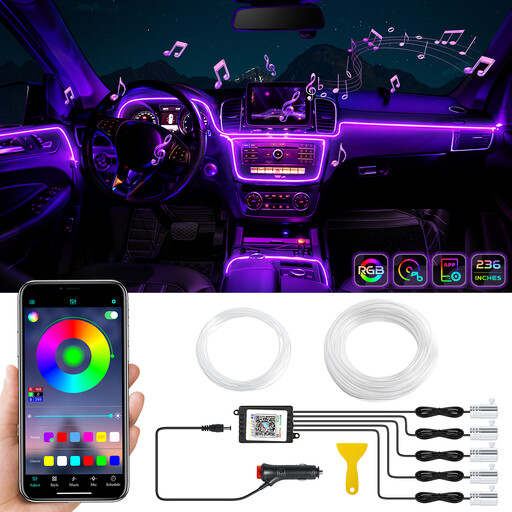
Why it suits this profile: This kit offers a relatively simple starting point, with an approximately 6-metre fibre optic line, five LED sources and Bluetooth app control.
The product information specifies an operating voltage of 10–16V, a transparent tube included in the box and installation instructions. This makes measuring and testing beforehand easier.
29 preset modes according to the product description, Bluetooth control, a music sensor and a mounting tool included in the box.

Why it suits this profile: The acrylic strips are designed to create an even line of light along the dashboard and interior gaps, with additional lights for the footwell and door handles.
According to the product description, the set includes six strips, four footwell lamps, four door-handle lamps and multiple controllers. However, check beforehand that the supplied lengths suit your interior.
12V connection, RGB Smart IC, static and dynamic modes, app control and a specified range of 0–10 metres.
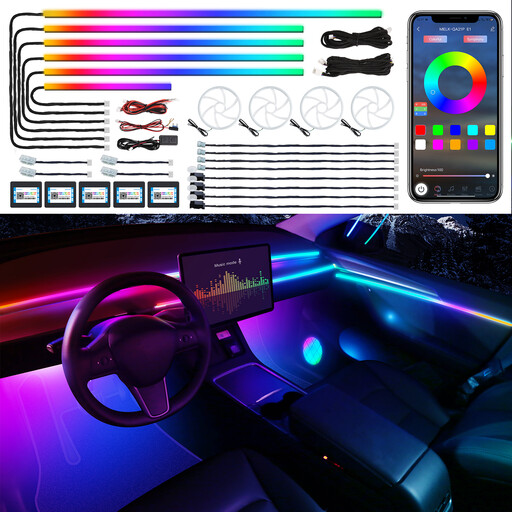
Why it suits this profile: This version is aimed at users who want to combine the dashboard, doors, door pockets, door corners and footwell in a single project.
The separate controllers and zones allow you to route the cables for each part of the interior. Test all components first and keep the controller’s microphone opening unobstructed.
According to the product information: six acrylic strips, four footwell lamps, four door-handle lamps, four door-pocket lamps and four door-corner lamps, plus Dreamcolor effects and a music sensor.
We have put together a complete, up-to-date list of products that fully meet these strict selection criteria and the applicable European safety regulations.
Start with a temporary setup. Position the strips in the desired gaps, connect the controller and test fixed colours, dynamic effects and music synchronisation. Only then should you conceal the cables and secure the components in place.
Pay attention to the following points:
Service life depends on usage, heat, moisture, installation quality and the electrical connection. A manufacturer may list protective features such as short-circuit protection or low heat generation; treat these as product specifications from the brand and always check the manual.
The lighting must not obstruct your view or interfere with operating the car. Use interior lighting in a way that does not distract you and does not shine outside in a manner that could confuse other road users. If in doubt, check the current traffic rules and inspection requirements for your vehicle.
You can with many kits, provided you measure carefully, use the correct 12V connection and route the cables safely. Connecting via the fuse box or interior wiring requires more knowledge than using a 12V plug. If you are unsure, have it installed by someone with relevant vehicle electrical experience.
Consumption varies depending on the number of LEDs, lamps, brightness and duration of use. Check the electrical specifications of the selected kit and do not leave the lighting switched on unnecessarily when the engine is off. A memory function is useful for saving settings, but it does not mean that the kit uses no power at all.
