
Anyone looking to manage their portion size
You want to weigh out your own portion during a study break and work out the energy per serving. The Netherlands Nutrition Centre gives an average of 158 kcal per handful (25 g) of unsalted almonds.


If you want to enjoy almonds mindfully while studying, weigh your portion and check the nutritional information for the exact variety. The Netherlands Nutrition Centre gives an average of 158 kcal per 25 g of unsalted almonds; a smaller portion does not make almonds a low-calorie food. According to the European Commission, the ‘low calorie’ claim for solid foods is only permitted if they contain no more than 40 kcal (170 kJ) per 100 g.
You want to weigh out your own portion during a study break and work out the energy per serving. The Netherlands Nutrition Centre gives an average of 158 kcal per handful (25 g) of unsalted almonds.
You might be looking for an unsalted variety and want to check whether oil or flavourings have been added. Compare the ingredients list and, if you have a relevant allergy, check the allergen information too.
You want to portion out snacks in advance or take them with you, and store the rest properly. Check the net weight, the number of portions and whether the packaging can be resealed; Albert Heijn and ALDI provide this information for specific varieties.
First decide how much you want to eat during one study break, then compare the ingredients and preparation method of the exact variety.
The breakdown below relates to consumers considering almonds as a snack during a study break while preparing for exams. It focuses on each consumer’s main buying priority.
| What to consider | What should you check? | Who is this important to? |
|---|---|---|
| Energy per portion | Compare the kcal per 100 g and work out the energy for the amount you weigh out. | If I want to eat a measured amount during a study break, I use the value on my pack to work it out. Around 36% of consumers put energy per portion first. |
| Ingredients and allergens | Read the ingredients list and allergen information; ‘unsalted’ does not mean a variety is unroasted or made without oil. | If the ingredients matter to me, I check whether the product contains oil, salt or flavourings as well as almonds. Around 29% of consumers focus mainly on the ingredients. |
| Portioning and storage | Check the net weight, any portion information, the closure and the storage instructions. | I want to portion out snacks in advance and keep the rest properly sealed, so I look for portion information and suitable packaging. Around 21% of consumers prioritise preparation and storage. |
| Pack size | Compare the net weight with the number of portions and how much you want to set aside for your study breaks. | If I don’t want to buy more than I need for my planned snack breaks, I check the pack size and number of portions. Around 14% of consumers put the quantity they are buying first. |
A description of how a product is prepared does not, on its own, tell you how much energy it contains. Duyvis describes Almonds Original as oven-roasted without added oil or fat; this does not prove that the variety is low in calories.
Check the nutrition table for the exact variety and work out the energy in the portion you have weighed.
A resealable closure helps you keep the remaining contents covered, but it doesn’t determine how much you eat in one sitting. ALDI describes the packaging for the TRADER JOE'S Unroasted Almonds reviewed here as resealable.
Weigh out your portion in advance and reseal the rest according to the instructions on the pack.
Unsalted almonds still contain almonds. Roasting does not reliably make the allergen harmless.
Check the ingredients list and any allergen warnings. If you have an almond allergy, ‘unsalted’ does not mean the snack is suitable for you.
AH Terra Unroasted Almonds have been reviewed in 200 g and 500 g packs.
The 200 g pack of PLUS Unroasted and Unsalted Almonds is worth a look if you’re after a simple ingredients list.
Jumbo Unsalted Almonds, 140 g, are a specific example of a roasted, unsalted variety.
Duyvis Almonds Original, 125 g, is worth considering if you’re looking for a savoury, seasoned variety.
ALDI is where you can find the 200 g pack of TRADER JOE'S Unroasted Almonds reviewed here.
Lidl lists an unsalted almond variety on its Dutch website for in-store purchase.
These Joybuy products may suit you if you’re looking for almonds to portion out for a study break. Always compare the nutritional information and ingredients of the variety you choose.
 Image unavailable
The product information describes almond kernels that are ready to eat as a snack.
The ingredients list states 100% almond kernels, and the stated energy is 622 kcal per 100 g.
Contains almonds; check the allergen information if relevant to you.
 Image unavailable
The title describes an unroasted, unsalted variety; check the ingredients list on the pack.
The product information gives 591 kcal per 100 g.
Contains almonds; check the allergen information if relevant to you.
 Image unavailable
The product information describes these almonds as ready to eat as a snack.
The ingredients list states 100% almonds, and the stated energy is 578 kcal per 100 g.
Contains almonds; check the allergen information if relevant to you.
 Image unavailable
According to the product information, this variety is roasted and salted, so it differs from unsalted almonds.
The stated energy is 620 kcal per 100 g, and the salt content is 1.0 g per 100 g.
Contains almonds. The product description warns that it may pose a choking hazard for young children and says it is not suitable for babies.
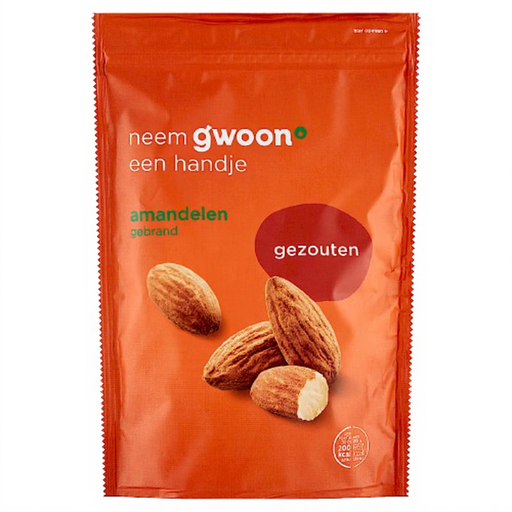 Image unavailable
According to the ingredients information, this roasted variety contains sunflower oil and salt.
The stated energy is 667 kcal per 100 g, and the salt content is 1 g per 100 g.
Contains almonds and may contain traces of peanuts and other nuts.
Multiply the kcal per 100 g on the pack by the weight you’ve measured out in grams, then divide by 100. Use the nutritional value for the exact variety; a handful is not an accurate way to measure weight.
No. A smaller portion does not change the product’s nutritional value per 100 g. According to the European Commission, the ‘low calorie’ claim for solid foods is only permitted at a maximum of 40 kcal (170 kJ) per 100 g. So describe the measured amount and the calculated energy per portion.
The unroasted varieties reviewed are sold as snacks or as additions to dishes. Follow the instructions on the pack; ‘unroasted’ doesn’t mean you have to cook the almonds first.
Store nuts in a cool, dry place in a well-sealed container, and follow the storage advice and best-before information on the pack. For the AH Terra varieties reviewed, Albert Heijn recommends storing them in a cool, dark, dry place and closing the pack after use.
Roasting does not reliably make almonds safe for someone with an almond allergy; the allergen remains stable when heated. Check the ingredients list and allergen warnings, and speak to a doctor about any personal questions concerning your allergy.