
Protein-conscious snackers
You want to know how much protein a measured portion of almonds provides, while keeping an eye on the energy content too. General food composition data and the labels on individual products can show different values.


Weigh out a portion and compare both protein and energy for that same amount; values vary between products. In a 25 g portion, AH Unsalted Almonds contain 6.75 g of protein (calculated from the label values), PLUS Unroasted and Unsalted Almonds contain 6 g (also calculated), and Jumbo Unsalted Almonds contain 5.3 g according to the product page. A large pack or a dietary goal does not automatically make a product legally ‘high in protein’; also check the ingredients and nutritional information for the exact product variant.
You want to know how much protein a measured portion of almonds provides, while keeping an eye on the energy content too. General food composition data and the labels on individual products can show different values.
You want to weigh out a portion in advance or take a pack with you. The difference between a portion, the full pack contents and a multipack helps you work out how much preparation is needed.
You’re looking for almonds with no added salt, so you check the exact product variant and ingredients list rather than relying on the brand name alone.
First, choose a portion you’ll actually want to take with you. Then compare the nutritional values and separately check how the almonds have been prepared and which ingredients have been added.
| What to consider | What should you check? | Who is this important for? |
|---|---|---|
| Protein and energy | Compare both nutritional values for the same weighed amount and the same product variant. | I want to know how much protein my snack provides, while keeping an eye on the energy content of that portion too. Around 39% of consumers prioritise the combination of protein and energy. |
| Taking a measured portion with you | Check the portion size against the net weight and see whether the packaging is resealable. | I want to take a set amount with me and be able to close the pack securely afterwards. Around 38% of consumers prioritise portion preparation and convenient packaging. |
| Unsalted ingredients | Read the ingredients list and check the salt, oil and preparation method separately. | I’m looking for an unsalted variant and want to know whether oil or other ingredients have been added. Around 23% of consumers prioritise ingredients and preparation. |
The AH 4-pack reviewed here contains four full 190 g packs and is supplied as individual items.
Check the contents of each item; don’t assume a multipack contains individual snack portions.
Voedingscentrum lists 5.4 g of protein and 158 kcal for a 25 g handful of unsalted almonds. A value per 100 g doesn’t directly tell you what you’re getting from a smaller portion.
Compare protein and energy for the same weighed amount, and use the nutritional information for the exact variant when looking at branded products.
Jumbo Unsalted Almonds contain sunflower oil, while the PLUS Unroasted and Unsalted variant reviewed here lists almonds as its only ingredient.
Check salt, oil and preparation method separately in the ingredients list.
Duyvis describes Almonds Original as roasted without added oil or fat, but this variant has a savoury coating containing salt. Unsalted Almonds is a separate product line with a different ingredients list.
Choose by the full product name and check the ingredients for that specific variant.
The Unsalted Almonds and Almonds Original product lines reviewed here each come in a 125 g pack.
AH Unsalted Almonds are a roasted variety with a stated portion size of 25 g.
Jumbo Unsalted Almonds 140 g are roasted and show nutritional values per 100 g and per 25 g portion.
Lidl has a product page for Unsalted Almonds and a separate page for Alesto Spanish almonds in different varieties.
ALDI offers Trader Joe’s roasted, unsalted almonds in a 200 g pack.
PLUS Unroasted and Unsalted Almonds Per Stand-up Pouch 200 g is a good fit if you want to measure out unroasted almonds yourself.
These packs of almonds are intended for you to portion yourself. For seasoned or sweetened varieties, check the ingredients, as they’re not automatically suitable if you’re looking for an unsalted option.
 No image available
A good fit if you want to weigh out your own portions and compare nutritional values per 100 g.
Ingredients: 100% almond kernels. The pack contains 160 g and, according to the product description, can be resealed after opening.
 No image available
An option if you want to weigh out unsalted almonds yourself and compare nutritional values per 100 g.
The product description calls these raw, unsalted almonds and lists almonds as the only ingredient. The pack contains 200 g.
 No image available
A good fit if you want to divide a larger pack into your own portions and use the nutritional values per 100 g.
The product description calls these natural, unsalted almonds; the ingredients list states 100% almonds. The pack contains 500 g.
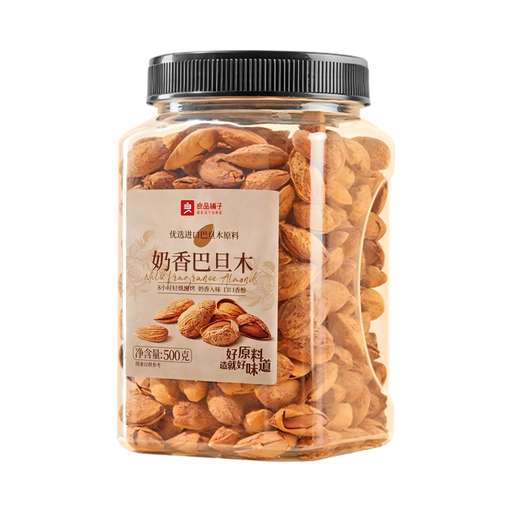 No image available
Only suitable if the flavour coating and added ingredients are what you’re looking for; this isn’t an unsalted variety.
The product information lists sweeteners and 1.2 g of salt per 100 g. The pack contains 500 g.
Multiply the protein value per 100 g by the weight of your measured portion in grams, then divide by 100. For the PLUS variant reviewed here, that’s 24 × 25 ÷ 100 = 6 g of protein in a 25 g portion. Use the same calculation for energy so you’re comparing values for the same portion.
Store nuts in a dry place in a tightly sealed container or pack. Voedingscentrum recommends keeping them somewhere cool; also follow the storage advice on the packaging. Albert Heijn advises closing the pack securely after use and storing it somewhere cool, dark and dry.
Albert Heijn’s product page warns that young children can choke on nuts. So don’t automatically assume that whole almonds are a suitable snack for young children.
Check both the ingredients and any warnings about other allergens on the current packaging. The Albert Heijn, Jumbo and PLUS products reviewed here list almonds and include warnings about possible cross-contamination with other allergens. The Netherlands Food and Consumer Product Safety Authority says allergens must be clearly stated; the absence of a separate warning doesn’t prove that allergens aren’t present.
Compare the nutritional values on the same basis, for example per measured 25 g portion, and look at the net weight separately. This helps you see how much you actually want to take with you and whether you’ll need to weigh out and store the rest yourself.