Unsalted almonds are an easy addition to your lunchtime sandwich if you want to limit your salt intake. According to the Voedingscentrum, a reference portion of 25 g of unsalted almonds provides 5.4 g of protein and 158 kcal. If you’re keeping an eye on protein for sport, consider your sandwich, fillings and overall diet too, rather than simply increasing the amount of almonds. Check the exact variety, portion size and nutritional values on the label: a contribution of protein doesn’t prove that a particular product can be described as ‘high in protein’ or offers a recovery benefit.
Who might want almonds with their lunch?
Lunch shoppers keeping an eye on protein
You’re picking up a sandwich and want to know what a portion of almonds adds, perhaps around strength training or endurance sport. Consider the protein contribution alongside your whole lunch and overall diet; the Voedingscentrum doesn’t link any particular almond brand with a proven recovery benefit.
Shoppers looking for an unsalted addition to lunch
You’re looking for almonds without added salt to go with your sandwich. Check the exact variety on the label: a brand name or preparation method won’t necessarily tell you how much salt the product contains.
Shoppers buying almonds to take away or portion out
You want to take almonds with you and divide them between several lunches. Check the pack size, whether it can be resealed and the storage instructions: a retail pack isn’t automatically a single portion.
What should you look for when choosing?
Start with a variety that suits your lunch preferences, then compare the nutritional values using the same portion size. The percentages shown in each row indicate the main priority.
| What to consider |
What should you check? |
Who might prioritise this? |
| Protein per portion |
Compare the protein and energy values on the label for the amount you eat; include your bread and fillings too. |
If protein needs to count towards my sandwich, I want to know what my portion adds to lunch. Around 38% of consumers make protein contribution their main priority. |
| Salt and ingredients |
Check the variety name, ingredients and salt content; ‘no added oil’ doesn’t mean ‘unsalted’. |
I want an unsalted addition and would rather choose based on the ingredients than just a savoury taste. Around 31% of consumers prioritise an unsalted product. |
| Portioning, taking with you and storage |
Check the pack size and whether the packaging can be resealed; follow the storage instructions on the pack. |
If I take almonds with me for several lunches, packaging that I can seal properly is practical. Around 31% of consumers make portioning and convenience for taking them with you their main priority. |
Common mistakes
-
Confusing nutritional values per 100 g with your lunch portion
A value per 100 g may differ from the amount you actually eat. The Voedingscentrum lists 5.4 g of protein and 158 kcal for 25 g of unsalted almonds.
Measure your portion first, then compare the protein and energy values for that same amount.
A larger portion also provides more energy.
-
Reading ‘no added oil’ as ‘unsalted’
Duyvis describes Almonds Original as oven-roasted without added oil or fat. That’s a different product feature from being unsalted; Duyvis has a separate product range for unsalted almonds.
Check the exact variety name and salt content on the packaging, separately from the preparation method.
-
Treating a retail pack as a single portion
The product pages from Duyvis, Jumbo and ALDI list packs of 125 g, 140 g and 200 g respectively. These are pack sizes, not recommended portions.
Decide how much you’ll have with lunch and store the rest according to the instructions on the packaging.
Without measuring your portion, you may end up using more than you intended for that lunch without realising.
-
Taking a protein statement as proof of a recovery benefit
The amount of protein on the label shows the product’s nutritional value, but doesn’t prove that those almonds offer a specific recovery benefit. The NVWA points out that nutrition claims must comply with European rules.
Compare specific nutritional values and don’t base your choice on a promise of faster recovery.
Almond brands and supermarket varieties for reference
Duyvis
The manufacturer has separate product pages for unsalted almonds and Almonds Original.
- Duyvis describes Almonds Original as oven-roasted without added oil or fat and lists a pack size of 125 g.
- These specifications don’t in themselves indicate a higher protein content or a benefit for sports recovery; the savoury variety isn’t the same as the unsalted range.
Albert Heijn
Albert Heijn has an official product page for AH Unsalted Almonds.
- The product page gives you a straightforward option if you’re looking for unsalted almonds with your groceries.
- The product listing doesn’t support any claim of a benefit for sport; check the latest nutritional information on the packaging.
Jumbo
Jumbo lists a 140 g variety of Unsalted Almonds.
- The official product page lists the pack size and advises storing the product in a cool, dry and dark place.
- The pack size isn’t a lunch portion, and the product name doesn’t tell you how much protein your portion provides.
Lidl
Lidl Netherlands has an official product page for unsalted almonds.
- The product listing makes it easy to identify an unsalted variety.
- A product page alone doesn’t show that a product is nutritionally superior; check the label for the exact variety.
ALDI
ALDI Netherlands lists Trader Joe’s unroasted almonds, as well as separate roasted varieties with different flavours.
- The unroasted variety reviewed is described as coming in a resealable 200 g pack.
- Features of roasted or salted varieties don’t automatically apply to the unroasted variety.
PLUS
PLUS lists a 200 g stand-up pouch of unroasted, unsalted almonds.
- The variety name clearly states that the almonds are both unroasted and unsalted.
- The product name doesn’t support a specific protein claim; check the nutritional information on the packaging.
Almonds at Joybuy
This Joybuy selection includes almond kernels, a product explicitly described as raw and unsalted, and roasted varieties. Compare the variety, nutritional values and amount you want to use for lunch for each pack.
 Image unavailable
Jia Zhou Yuan Ye Original Almond Kernels 160 g
The nutritional information lists 21.5 g of protein per 100 g; work out how much that is for the portion you eat with lunch.
The product information lists 100% almond kernels and a pack size of 160 g. After opening, close the pack and store it in a cool, dry place according to the product instructions.
Joybuy
 Image unavailable
g'woon Almonds Raw & Unsalted 200 g
The product title specifies raw, unsalted almonds, making these a good fit if you’re looking for an unsalted addition to lunch.
The nutritional information lists 24 g of protein and 0.03 g of salt per 100 g. The pack contains 200 g; keep it closed after opening.
Joybuy
 Image unavailable
Anatolia Roasted Salted Almonds 500 g
The product title specifies roasted, salted almonds; check the salt content on the packaging if that’s a deciding factor for your lunch.
The nutritional information lists 21 g of protein per 100 g. The pack contains 500 g.
Joybuy
 Image unavailable
Anatolia Badem Natural (Almond) 500 g
The title says Badem Natural, while the product description specifies roasted, salted almonds. Check the variety on the packaging before choosing.
The nutritional information lists 21 g of protein and 1 g of salt per 100 g. The pack contains 500 g.
Joybuy
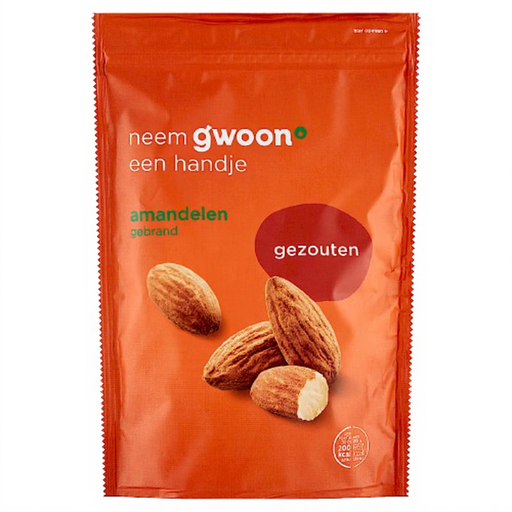 Image unavailable
g'woon Roasted & Salted Almonds 150 g
The product title specifies roasted, salted almonds; the description says the bag is resealable, making it suitable for use on several occasions.
The description lists 97% almonds, sunflower oil and salt. The nutritional information lists 21 g of protein and 1 g of salt per 100 g; the pack contains 150 g.
Joybuy
Frequently asked questions
How much protein do almonds add to my lunch?
According to the Voedingscentrum, 25 g of unsalted almonds provides 5.4 g of protein and 158 kcal. For a specific pack, use the nutrition table for that variety; values can vary between brands.
Do I need special high-protein almonds for sports recovery?
No specific almond product has been shown to be a standalone solution for recovery. The Voedingscentrum says that protein requirements may be higher for strength training and endurance sport, so consider your overall diet rather than just the almonds.
What allergen information applies to a sandwich with almonds?
The NVWA lists nuts as allergens. Prepacked products should have allergen information on the label, and sellers of non-prepacked foods must also inform customers about allergens. If in doubt, ask the seller for information about the sandwich and the ingredients used.
How should I store a bag of almonds for several lunches?
Follow the storage instructions on the exact pack. For the Jumbo Unsalted Almonds reviewed, Jumbo advises storing them in a cool, dry and dark place; the ALDI unroasted almonds reviewed are listed in resealable packaging. This information doesn’t provide general guidance on how long the product keeps after opening.
Does ‘no added oil’ mean that almonds are unsalted?
No, these are different features. Duyvis describes Almonds Original as oven-roasted without added oil or fat and also has a separate product range of unsalted almonds. Check the ingredients and salt content for the variety you choose.


