Who is this buying guide for?

Sporty people watching their protein intake

You want to know how much protein a buffet portion of almonds provides, without treating that snack as a complete post-workout option. The Netherlands Nutrition Centre lists 5.4 grams of protein per 25-gram handful of unsalted almonds.

Fans of unsalted snacks

You’re looking for almonds with no added salt and want to weigh up whether raw or roasted almonds would suit your buffet. The Netherlands Nutrition Centre includes unsalted nuts in its Wheel of Five.

Buffet planners

You want to match the flavour, ingredients, packaging and allergen information to your guests, and store any unused nuts according to the product instructions.

What should you look for when buying?

Raw and unsalted

A good fit if: you’re looking for a simple ingredients list and a neutral flavour for the buffet. PLUS lists almonds as the only ingredient.

What to consider: PLUS’s nutritional information lists 24 grams of protein per 100 grams; that figure alone does not determine whether a nutrition claim is permitted for the product.

Roasted and unsalted

A good fit if: you want roasted almonds with no added salt. AH lists almonds as the only ingredient; Jumbo lists 99% almonds and sunflower oil.

What to consider: AH lists 27 grams of protein per 100 grams and Jumbo lists 21 grams per 100 grams. These figures apply to those specific products, not every variety from either brand.

Savoury or salted

A good fit if: savoury flavour is your priority. Duyvis describes Almonds Original as savoury oven-roasted almonds; ALDI lists roasted salted almonds as well as a smoky-flavour variety.

What to consider: a description such as ‘no oil or fat added’ does not tell you whether a product is unsalted or how much protein it contains.

What to consider What should you check? Who is this important for?
Protein per serving Compare protein and energy for the same quantity, such as 25 grams; a value per 100 grams is not the same as a buffet serving. If I want to assess the protein contribution, I compare servings of the same size; around 34% of consumers put protein per serving at the top of their list.
Unsalted recipe Check both the ingredients list and the nutritional information; ‘unsalted’ does not automatically mean that almonds are the only ingredient. I want unsalted almonds and also check for any other ingredients; for around 20% of consumers, this choice of recipe comes first.
Flavour and preparation Check whether the variety is described as raw, roasted, salted or smoky-flavoured. For my buffet, I want to choose a suitable savoury flavour first; this is the top priority for around 20% of consumers.
Allergens for guests Check the ‘contains’ and ‘may contain’ information on the packaging. Almonds are an allergen in their own right. When I’m shopping for guests, I first check whether the allergen information meets their needs; for around 13% of consumers, suitability for guests is the top priority.
Pack size and leftovers Match the net weight to the quantity you want to serve, and follow the storage instructions for any leftovers. I want to buy enough for the buffet and store any unused almonds properly; for around 13% of consumers, quantity matters most.

Common pitfalls

  • Assuming that containing protein proves a ‘high protein’ claim

    A protein figure alone does not automatically justify a nutrition claim for a specific product.

    Compare the nutritional value per equal serving. Only use a claim once you have checked that the product meets the relevant requirements; the Netherlands Nutrition Centre and Regulation (EC) No 1924/2006 explain that nutrition claims are subject to conditions.

  • Assuming no added fat means unsalted

    Duyvis’s description of roasting without adding oil or fat does not, by itself, answer the question of salt content.

    Check the salt, flavour variety and ingredients separately in the product information.

  • Assuming a short ingredients list means a product is allergen-free

    A product with almonds as its only ingredient still contains almonds; some of the packaging reviewed also mentions the possible presence of other nuts or peanuts.

    Read the full allergen information and make it clear which type of nut you have used in buffet dishes.

  • Comparing packs without considering their contents

    The packs described range from 125 to 200 grams, so the quantity in each bag varies.

    Compare the net weight and choose a pack that suits the quantity you want to serve.

Brands to compare

Duyvis

Duyvis describes Almonds Original as savoury oven-roasted almonds in a 125-gram pack, intended as a snack or for cooking.

  • Duyvis says no oil or fat is added during roasting.
  • This product description does not prove that the almonds are unsalted or contain more protein than other almonds.

Albert Heijn

AH Unsalted Almonds are a 190-gram roasted variety which, according to AH, contains almonds as its only ingredient.

  • AH lists 27 grams of protein, 627 kilocalories and 0 grams of salt per 100 grams.
  • The product contains almonds and may contain peanuts and other types of nuts; these figures apply to this variety.

Jumbo

Jumbo Unsalted Almonds are a 140-gram roasted variety.

  • Jumbo lists 5.3 grams of protein per 25-gram serving.
  • The ingredients list names 99% almonds and sunflower oil; the product information mentions the possible presence of peanuts.

Lidl

Lidl lists a product called Unsalted Almonds, which is worth considering if you’re looking for an unsalted option in its range.

  • The product description says the almonds are unsalted.
  • That description alone provides no information about a higher protein content or a specific ingredients list.

ALDI

ALDI describes TRADER JOE’S Raw Almonds in a 200-gram pack, as well as roasted varieties with different flavour descriptions.

  • ALDI describes the raw variety as untreated and packed in a resealable bag.
  • Preparation and flavour varieties do not prove a difference in protein content.

PLUS

PLUS Raw and Unsalted Almonds come in a 200-gram stand-up pouch and, according to PLUS, contain almonds as the only ingredient.

  • PLUS lists 24 grams of protein and 591 kilocalories per 100 grams for the unprepared product.
  • The pack contains almonds and may contain peanuts and other types of nuts; a short ingredients list does not mean the product is allergen-free.

Almonds at Joybuy

These product choices include raw and unsalted almonds, savoury roasted varieties and plain almond kernels to suit different buffet preferences.

Jia Zhou Yuan Ye Original Almond Kernels, 160 g

Jia Zhou Yuan Ye Original Almond Kernels 160 g

The product information describes these almond kernels as a snack and as an addition to yoghurt, breakfast cereal or salad.

According to the product information on Joybuy, they contain 100% almond kernels and 21.5 grams of protein per 100 grams.

Joybuy

g’woon Almonds Raw & Unsalted, 200 g

g’woon Almonds Raw & Unsalted 200 g

This unprocessed, unsalted variety is a good choice if you want to serve almonds with no added salt or oil.

The product information on Joybuy lists almonds as the ingredient and 24 grams of protein per 100 grams.

Joybuy

Anatolia Roasted Salted Almonds, 500 g

Anatolia Roasted Salted Almonds 500 g

This roasted, salted variety is an option if you want to offer a savoury snack on the buffet.

The product information on Joybuy lists 21 grams of protein per 100 grams. The almonds contain almonds and are salted.

Joybuy

Anatolia Badem Natural, almond, 500 g

Anatolia Badem Natural (Almond) 500 gr

This plain variety is a good choice if you’re looking for almonds to serve as a snack or topping.

The product information on Joybuy lists 21 grams of protein and 0.00 grams of salt per 100 grams. The ingredients list names almonds.

Joybuy
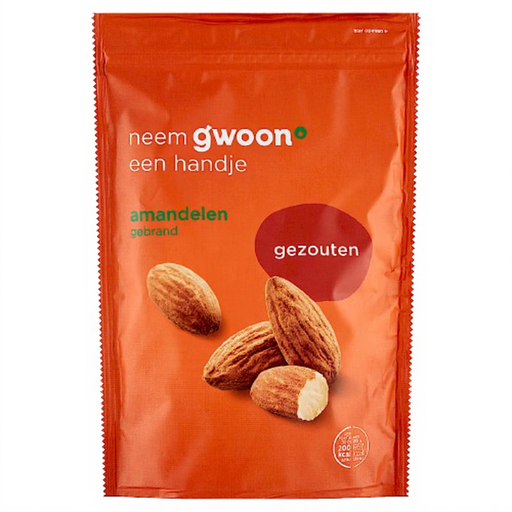
g’woon Roasted & Salted Almonds, 150 g

g’woon Roasted & Salted Almonds 150 g

These roasted and salted almonds come in a resealable pack, making them a good choice if you’re looking for a savoury buffet option.

The product information on Joybuy lists 21 grams of protein and 1 gram of salt per 100 grams.

Joybuy

Frequently asked questions

Can all almonds that contain protein be marketed as ‘high protein’?

No, simply containing protein is not enough to use that nutrition claim. A claim must be permitted, and the specific product must meet the relevant requirements; Regulation (EC) No 1924/2006 covers nutrition claims.

How do you compare the protein content of different almonds?

Compare the same quantity, such as 25 grams, and divide a figure per 100 grams by four. AH lists 27 grams of protein per 100 grams, which works out at 6.75 grams per 25 grams; PLUS lists 24 grams per 100 grams, or 6 grams per 25 grams. Jumbo lists 5.3 grams per 25-gram serving. These nutritional values apply to the specific products.

Do you need special protein snacks for post-workout recovery?

According to the Netherlands Nutrition Centre, most people who do sport don’t need special protein shakes or bars if they eat a healthy, varied diet. Strength training and endurance sports can increase your protein needs, so consider your overall diet rather than just the almonds on the buffet.

What should you check if guests need to avoid certain nuts or peanuts?

Read both the ‘contains’ and ‘may contain’ information on the packaging, and don’t serve almonds to anyone who needs to avoid them. The AH and PLUS products reviewed contain almonds and mention the possible presence of other nuts and peanuts; Jumbo mentions the possible presence of peanuts.

Do you need to state which nuts are present at a professional buffet?

For providers such as restaurants and caterers covered by the guidance from the Netherlands Food and Consumer Product Safety Authority, information about allergens present must be available. When nuts are involved, it must be clear which type of nut they are. This applies to professional food service and is not a general legal requirement for a private family buffet.
