Who are these options relevant to?

Lunchers keeping track of protein

You want to know how much protein your packed portion adds, so you check its weight alongside the nutritional values per 100 g. The Netherlands Nutrition Centre gives a general figure for unsalted almonds; labels for specific products may differ.

People having lunch after a workout

You take almonds as part of a meal around a strength or endurance workout and consider your overall diet, rather than expecting a specific recovery result from a single snack. The Netherlands Nutrition Centre and the Dutch Association of Sports Nutrition Experts describe protein as part of the wider nutritional choices around exercise.

Daily lunchers on the go

You’re looking for something you can take with you, and paying attention to unsalted options, resealable packaging and splitting larger bags into portions. The Netherlands Nutrition Centre discusses unsalted nuts as a food choice; always check your product’s storage instructions.

What should you look for in almonds to take with you?

First compare the protein in the portion you’re taking with you, then choose between unsalted and savoury, and finally check that the packaging suits the way you plan to portion it.

What to consider What to look for when buying Who it’s for
Protein per serving Check the protein per 100 g on the label and weigh your own portion; factor in the rest of your lunch too. If you want to know what your weighed portion contributes, protein per serving is your main consideration. Around 36% of consumers prioritise this protein contribution.
Portioning and taking it with you Check the net weight, whether the bag is resealable and the storage instructions after opening. If you’re splitting almonds across several lunches, resealability and easy portioning matter. Around 29% of consumers prioritise convenience on the go.
Ingredients and salt Compare the ingredients list and salt per 100 g; roasted without added fat does not automatically mean unsalted. If you’re choosing between an unsalted or savoury option, check the label for that exact flavour. Ingredients are the main consideration for around 21% of consumers.
How much you use Compare the net weight and current price per kilogram for the same variety, and consider how many portions you’ll get from the pack. If you want to work out what a pack costs for the amount you use, compare the unit price and number of portions. Around 14% of consumers prioritise the cost per amount used.

Common buying mistakes

  • Confusing the value per 100 g with your lunch portion

    The amount of protein and energy you get depends in part on how many almonds you actually eat. A general nutritional value is not the same as the label value for every variety.

    Weigh your portion and calculate its contribution using the nutritional information for that exact product.

  • Confusing no added cooking fat with unsalted

    Duyvis describes Almonds Original as oven-roasted without added oil or fat. For the specific savoury Duyvis variety, PLUS lists 1.1 g of salt per 100 g.

    Compare the roasting method, ingredients and salt separately. Choose an unsalted variety if that suits your lunch.

  • Treating a large bag as a single portion to take with you

    A 200 g or 500 g pack is not the same as a pre-measured portion. Resealable packaging also doesn’t mean the contents have already been divided into portions for each lunch.

    Weigh out portions in advance and follow the storage instructions for the opened pack.

  • Confusing a flavoured snack with plain almonds

    A flavoured variety may contain ingredients other than almonds. This means its nutritional values and ingredients are not necessarily comparable with a plain product.

    Check the full product name, ingredients list and net weight of the exact variety.

Brands to consider

Duyvis

Relevant in these product categories for both unsalted almonds and roasted varieties with savoury flavours.

  • Duyvis describes Almonds Original as oven-roasted without added oil or fat.
  • PLUS lists 21 g of protein and 1.1 g of salt per 100 g for the specific Oven roasted variety. These values do not automatically apply to Unsalted Almonds or other Duyvis products.

Albert Heijn

AH Terra Unroasted Almonds, 200 g, are a specific unsalted option for weighing out your own lunch portions.

  • Albert Heijn lists 26 g of protein and 0 g of salt per 100 g for this variety.
  • These label values don’t mean all Albert Heijn almond products have the same composition.

Jumbo

Jumbo Unsalted Almonds, 140 g, are an option for anyone looking for unsalted almonds.

  • Jumbo recommends storing this product in a cool, dark place.
  • Don’t assume the product name or storage advice means it offers a protein benefit; check the nutritional information for the exact pack.

ALDI

The 200 g unroasted almonds are part of ALDI’s range and are sold under the Trader Joe’s product label.

  • ALDI describes this variety as being packed in a resealable bag.
  • Resealable packaging doesn’t mean the bag has been pre-divided into individual lunch portions.

PLUS

PLUS Unroasted and Unsalted Almonds in a 200 g stand-up pouch are a own-brand option for weighing out your own portions.

  • The product page confirms the variety and net weight of 200 g.
  • The packaging information does not support a brand-wide claim about protein content.

Lidl

Lidl has a Dutch product page for unsalted almonds, making it a relevant option in this category.

  • The product listing is a useful starting point if you’re comparing unsalted almonds.
  • This listing does not imply a ranking, protein benefit or current in-store availability.

Almond products at Joybuy

This selection includes roasted, salted and flavoured almonds. Compare the portion size, salt and ingredients for each variety if you’re looking for something to take for lunch.

Anatolia Roasted Salted Almonds, 500 g

Anatolia Roasted Salted Almonds 500 g

A good fit if you’re looking for roasted, salted almonds and want to weigh out your own lunch portions.

The product information lists 21 g of protein and 1.0 g of salt per 100 g. The pack contains 500 g, so you’ll need to portion it yourself.

View at Joybuy
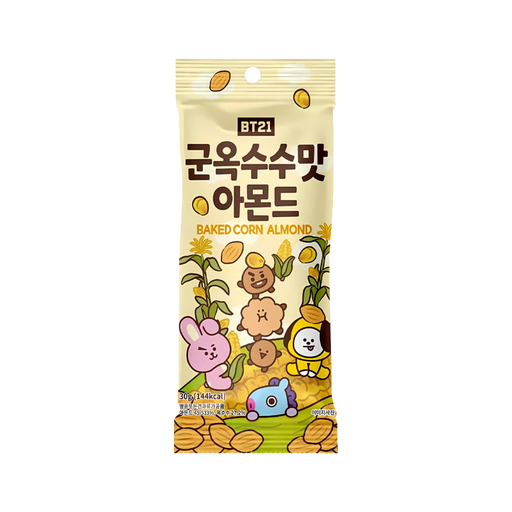
BT21 Baked Corn Flavor Almond M, 30 g

BT21 Baked Corn Flavor Almond M 30 g

A good fit if you’re looking for a pre-portioned 30 g corn-flavoured snack; this isn’t a plain variety.

The product information lists 13.3 g of protein, 0.3 g of salt and 16.7 g of sugars per 100 g. The ingredients include corn, sugar, honey, condensed milk and soya.

View at Joybuy

Frequently asked questions

How much protein is in a handful of almonds?

The Netherlands Nutrition Centre gives an average of 5.4 g of protein per 25 g handful of unsalted almonds. For a specific product, calculate the amount using the label value per 100 g and the weight of your portion. Based on the label values, 25 g of AH Terra Unroasted Almonds provides 6.5 g of protein.

Do you need special protein snacks for sports recovery?

Not necessarily. The Netherlands Nutrition Centre says that most people who exercise don’t need special protein shakes or bars if they eat a healthy, varied diet. Consider the protein in your overall diet around intensive exercise; a portion of almonds on its own doesn’t guarantee a specific recovery result.

How should you store an opened bag for your next lunch?

Follow the instructions for the exact variety. AH Terra says to close the pack securely after use and store it in a cool, dark and dry place. For Duyvis Oven roasted, the PLUS product page recommends keeping an opened bag in an airtight, lightproof container.

Are unsalted almonds suitable if you have an almond allergy?

No. Unsalted doesn’t mean the product contains no almonds. Check the ingredients and relevant warnings about possible cross-contamination too; the Netherlands Food and Consumer Product Safety Authority explains that sellers must inform customers about allergens present in their products.

How do you compare small and large bags?

Compare the current price per kilogram for the same variety and check how many weighed portions you’ll get from the pack. Net weight and resealability help you decide whether a pack size suits your needs; the price of the whole bag alone doesn’t tell you the cost per amount used.
