
Lunch snackers mindful of portions
You want almonds with your lunch and would like to know how much energy your weighed portion contains, rather than relying on words such as natural or unsalted.


First, compare almonds by kcal per 100 g, then work out what your weighed lunch portion contains. The labels for AH Terra, AH Unsalted Almonds, PLUS and Jumbo list 153.25, 156.75, 157 and 165.25 kcal respectively for 25 g. None of these standard almond varieties meets the EU requirement for the ‘low energy’ claim. Also check the ingredients and salt content, and how to store the pack after portioning.
You want almonds with your lunch and would like to know how much energy your weighed portion contains, rather than relying on words such as natural or unsalted.
You keep an eye on added salt and want to distinguish between unsalted almonds, roasted varieties with oil and savoury seasoned products.
You divide a larger pack between several lunches and pay attention to portion information, whether the pack can be resealed and how to store it.
Start with kcal per 100 g, then work out the energy in your portion and check the ingredients and packaging.
| What to consider | What to look for | Who it matters to |
|---|---|---|
| Energy per portion | Compare kcal per 100 g and weigh the amount you eat. Multiply the value per 100 g by the portion weight, then divide by 100. | If I want to know how much energy my lunch snack contains, I compare equal weights and weigh my portion. Around 50% of consumers prioritise the energy in a portion. |
| Unsalted ingredients | Read the ingredients list and the salt value for the exact variety. Unsalted does not automatically mean no added oil. | If you want to avoid added salt, you can also check whether oil or other ingredients have been added. Around 30% of consumers prioritise the ingredients. |
| Portioning and storage | Check the net weight, portion information, whether the pack can be resealed and the storage instructions on the packaging. | If I take a larger bag for several lunches, I want to be able to seal and store the rest properly. Around 20% of consumers prioritise this convenience. |
These descriptions do not tell you how much energy the product contains. For solid foods, the European Commission sets a maximum of 40 kcal (170 kJ) per 100 g for the ‘low energy’ claim.
Check the kcal per 100 g on the packaging, then work out the energy in the portion you actually eat. Don’t base a calorie claim solely on how the almonds are prepared or on the absence of added salt.
The AH Terra pack contains 200 g and lists a 25 g portion, so it contains eight portions of that size.
Weigh the amount you want to eat with lunch in advance and seal the rest properly.
Preparation, ingredients and salt content can vary between varieties. ALDI sells unroasted and roasted unsalted almonds as separate products, alongside salted or smoked varieties. Duyvis describes Almonds Original and Unsalted Almonds as different product ranges.
Check the full product name, preparation method, ingredients and allergen information on the pack you choose.
Duyvis describes Unsalted Almonds as unsalted almonds, while Almonds Original is a separate oven-roasted variety.
Albert Heijn lists both unroasted AH Terra almonds and roasted unsalted almonds.
Jumbo lists a roasted unsalted almond variety in a 140 g pack.
Lidl lists a specific variety labelled unsalted and sells Alesto as its range of nuts and dried fruit.
ALDI’s product information distinguishes Trader Joe’s almonds by preparation and flavour.
PLUS lists a roasted unsalted almond variety in a 150 g stand-up pouch.
These Joybuy products range from natural and unsalted almonds to salted varieties and a mixed corn snack. Only compare kcal per 100 g between products with a similar composition.
 Image unavailable
An unsalted option if you want to weigh out your own portion for lunch.
The product information lists 591 kcal per 100 g and almonds as the ingredient. Seal the pack well after opening.
 Image unavailable
A natural option if you want to weigh out almonds and check the ingredients list.
The product information lists 578 kcal per 100 g and 100% almonds. Seal the pack after opening.
 Image unavailable
This variety could suit you if you’re looking for almonds without other ingredients and want to choose your own portion size.
The product information lists 622 kcal per 100 g and 100% almonds.
 Image unavailable
A roasted, salted option if you’re looking for this combination and don’t need to avoid salt.
The product information lists 620 kcal and 1.0 g of salt per 100 g. The ingredients include almonds and salt.
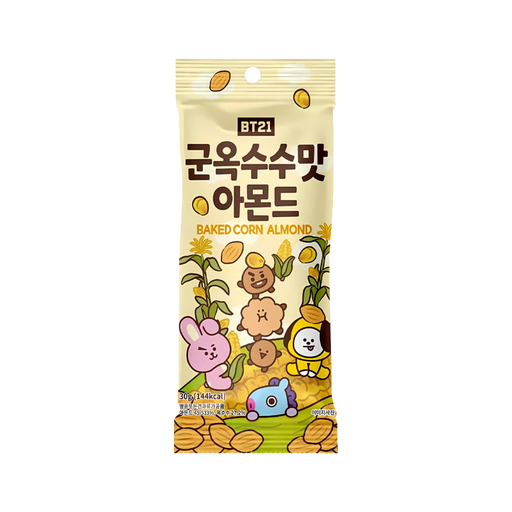 Image unavailable
This is a mixed corn snack with almonds, not a standard almond variety, so bear that in mind when comparing products.
The product information lists 480 kcal per 100 g for the whole product and a pack size of 30 g. Ingredients include corn, sugar, honey, rapeseed oil, salt and condensed milk, among others.
‘Unsalted’ does not describe the energy content. According to the European Commission, the ‘low energy’ claim may only be used for solid foods containing no more than 40 kcal (170 kJ) per 100 g. The product values for the standard almond varieties in this article are higher.
First compare the kcal per 100 g, then calculate based on the amount you actually eat. The labels for AH Terra, AH Unsalted Almonds, PLUS and Jumbo list 613 to 661 kcal per 100 g. For a 25 g portion, that works out at 153.25 to 165.25 kcal.
No. AH describes AH Terra Unroasted Almonds as suitable for eating as they are or adding to dishes. Check the label for each variety for its energy content, ingredients and any preparation instructions.
The Netherlands Nutrition Centre recommends storing nuts in a dry place in a tightly sealed container. Also follow the storage instructions on your product’s packaging.
Almonds are tree nut allergens, so check the product’s allergen information. For unpackaged canteen products, ask the seller what information is available. The NVWA states that allergen information must be clearly displayed on the label of prepacked products and made available for unpackaged products.