What should you look for when buying?
First, find out which ingredient a guest needs to avoid. Then compare the ingredients and allergen information for the exact variety, and think about how you’ll serve the snacks separately.
| What to consider |
What should you check? |
Who is this important for? |
| Specific dietary requirement |
Check the ingredients and product information for the ingredient someone avoids. Assess the specific variety listed. |
If I’m catering for someone avoiding gluten or lactose, I want to know whether that particular variety is suitable. Around 36% of consumers prioritise specific dietary suitability. |
| Possible unintended contact |
Read warnings such as ‘may contain’ alongside the ingredients list. Keep suitable snacks and serving utensils separate. |
When guests have different dietary requirements, I want to be able to check the labels and keep the snacks separate. Around 29% of consumers prioritise possible cross-contamination and contact during serving. |
| Ingredients and flavour |
Check whether oil, salt or seasonings have been added. Unroasted and unsalted describe preparation, not allergen status. |
If I’m looking for a simple ingredient list or a savoury party flavour, I compare the ingredients in each variety. Around 21% of consumers prioritise ingredients and flavour for nibbles. |
| Quantity and storage |
Choose a pack size to suit the guests who can eat this snack, and follow the storage instructions on the label. |
For a garden party, I want to have enough without leaving opened leftovers out for too long. Around 14% of consumers focus mainly on quantity, packaging and storage. |
Almond products at Joybuy
These are almond snacks, including both natural and salted varieties. They are not an almond-free option. Check the product information and current packaging for the specific dietary details that matter to your guests.
 No image available
Jia Zhou Yuan Ye Original almond kernels 160 g
Suitable as a snack or an addition to dishes; the product description says the almond kernels are ready to eat.
The ingredients list states 100% almond kernels. The Netherlands Nutrition Centre classifies almonds as an allergen.
View at Joybuy
 No image available
g’woon raw, unsalted almonds 200 g
An option if you’re looking for raw, unsalted almonds with a simple ingredient list.
The product information lists only almonds as an ingredient and advises sealing the pack tightly after opening. The Netherlands Nutrition Centre classifies almonds as an allergen.
View at Joybuy
 No image available
Anatolia Badem Natural almonds 500 gr
The product description says they can be enjoyed as a snack or used in dishes.
The ingredients list states 100% almonds. The product information warns of a choking hazard for young children and says the product is not suitable for babies. The Netherlands Nutrition Centre classifies almonds as an allergen.
View at Joybuy
 No image available
Anatolia roasted, salted almonds 500 g
A savoury option if you’re looking for roasted, salted almonds.
The product information lists almonds and salt as ingredients and advises storing the product in a cool, dry place. The Netherlands Nutrition Centre classifies almonds as an allergen.
View at Joybuy
 No image available
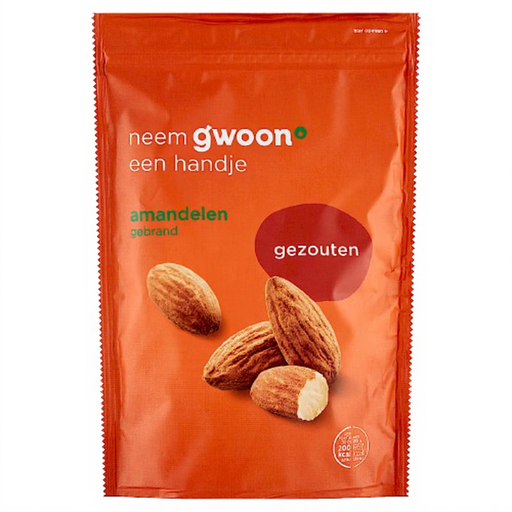
g’woon roasted, salted almonds 150 g
A smaller pack for anyone looking for a roasted, savoury almond snack.
The product information lists 97% almonds, sunflower oil and salt, and says the pack is resealable. It also states that the product may contain traces of peanuts and other nuts. The Netherlands Nutrition Centre classifies almonds as an allergen.
View at Joybuy
Frequently asked questions
Does lactose-free mean suitable for someone with a milk allergy?
No. Lactose intolerance affects the digestion of milk sugar, while a milk allergy is a reaction to milk proteins. If someone has a milk allergy, check for milk ingredients and relevant warnings, not just the ‘lactose-free’ label.
What does ‘may contain’ mean on Dutch packaging?
It warns of possible accidental presence and is separate from information about ingredients deliberately used in the product. Dutch guidance on precautionary allergen labelling says these warnings should be based on a risk assessment; the Netherlands Food and Consumer Product Safety Authority (NVWA) has been responsible for monitoring labelling since 1 January 2026.
How should you serve snacks at a table for guests with different dietary requirements?
Keep snacks separate from ingredients and crumbs that guests avoid, use dedicated serving utensils for each bowl, and keep the labels. These are practical precautions, not a guarantee that a snack is suitable for every guest.
Is the ‘gluten-free’ claim regulated?
Yes. Commission Implementing Regulation (EU) No 828/2014 sets conditions for the claims ‘gluten-free’ and ‘very low gluten’. It has applied since 20 July 2016; the European Commission also notes that Regulation (EC) No 41/2009 was repealed at that time.
Can young children eat whole almonds?
Don’t assume whole almonds are suitable as a snack for young children. The AH packaging reviewed warns of a choking hazard for small children; check the warnings on the pack you buy too.


