
Regular stock-up shoppers
You use almonds on several evenings or with other meals too. In that case, the total quantity and how you can store the pack after opening are important.


Choose a larger bag if you use the contents regularly and can store them properly; a multipack is a better fit if you prefer to open a separate pack each time. As well as the quantity, check how the almonds are prepared, their salt content and the ingredients, as raw, roasted unsalted and savoury seasoned almonds are not the same.
You use almonds on several evenings or with other meals too. In that case, the total quantity and how you can store the pack after opening are important.
You’re looking for unsalted almonds and check the ingredients rather than relying on terms such as ‘roasted’ or ‘without oil’. Also check the salt content and allergen information on the label.
You don’t want to open more than you’ll use, so you look for a smaller pack or individually wrapped portions in a multipack. If young children are sharing the snack, also look for choking warnings on the label.
Choose a pack size that suits how often you eat almonds, then check that the flavour and ingredients match your preferences.
| What to consider | What should you check? | Who should pay particular attention? |
|---|---|---|
| Pack size for regular use | Net weight and whether you’ll use the almonds beyond film nights. | If I eat almonds regularly, I want to choose a pack size I can finish; around 36% of consumers give pack size for regular use top priority. |
| Unsalted ingredients | Ingredients list, salt content per 100 g and allergen information. | I want unsalted almonds, so I check the label; for around 29% of consumers, this is the main priority. |
| Storing after opening | Whether the pack is resealable, whether individual packs are supplied separately and what the storage instructions say. | If I only eat almonds occasionally, I don’t want to open too many at once; limiting how much I have open is the top priority for around 21% of consumers. |
| Flavour and preparation | Whether the almonds are raw, roasted and unsalted, or flavoured. | For a savoury film-night snack, I choose a flavour I’ll enjoy, even if it isn’t unsalted; around 14% of consumers prioritise flavour and preparation. |
Oven-roasted almonds can still contain salt and flavourings. According to the product information, the Duyvis variety reviewed contains salt.
Read the ingredients list and nutrition table alongside the preparation details.
A resealable pack doesn’t remove the need to store almonds in a dry, airtight place. The Voedingscentrum recommends storing nuts in a dry, airtight place.
Seal the pack properly after use and follow the storage instructions on the label.
Warnings about possible traces of other nuts, peanuts or other allergens vary by product. Some of the labels reviewed also warn about choking hazards for young children.
Check the latest label before serving the almonds and consider who’ll be eating them.
Albert Heijn lists AH Terra raw, unsalted almonds in 200 g and 500 g packs. The roasted AH variety is a different product line.
ALDI Netherlands describes Trader Joe’s Almonds as a 200 g roasted, unsalted variety.
The Duyvis Oven roasted almonds reviewed are a 125 g savoury variety. Albert Heijn lists 97% almonds and 1.1 g salt per 100 g.
PLUS lists a 150 g stand-up pouch of unsalted almonds.
Jumbo lists unsalted almonds in a 140 g pack.
Lidl Netherlands sells Alesto as its own brand. The product information for Spanish almonds describes 200 g varieties.
These Joybuy products include options for smaller snack portions and larger packs, with both unsalted and salted varieties.
 No image available
The 160 g pack is a good fit if you’re looking for a smaller amount for a snack.
 No image available
The product name describes raw, unsalted almonds in a 200 g pack.
 No image available
The 500 g pack is a larger quantity for anyone who uses almonds regularly.
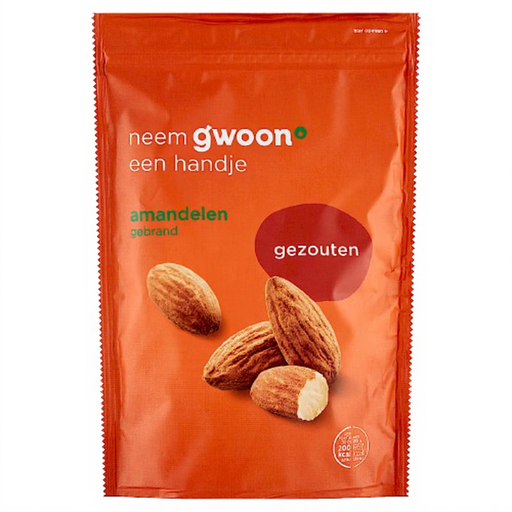 No image available
The name describes roasted, salted almonds in a 150 g pack. The product information mentions sunflower oil and possible traces of peanuts and other nuts.
 No image available
The product name describes roasted, salted almonds in a 500 g pack. The product information warns of a choking hazard for young children and states that this product is not suitable for babies.
Add together the net weight of the individual packs and compare it with the total weight of the standard pack. Also check that they’re prepared in the same way and that you can store the individual packs without opening them.
Seal the pack properly and store the almonds in a dry place, as the Voedingscentrum recommends for nuts. Also follow the instructions on the product label.
Check the warnings on the label and bear in mind the risk of choking. Some of the product labels reviewed specifically warn of this risk for young children.
Check the ingredients list and allergen warnings on the current label. According to the Netherlands Food and Consumer Product Safety Authority, allergen information must appear on the label of pre-packed foods; warnings about possible traces of other allergens can vary by product.
Check the product description, ingredients list and nutrition table; ‘roasted’ or ‘no added oil’ doesn’t in itself mean ‘unsalted’. Compare the salt content per 100 g if you’re choosing between varieties.