
Families who eat almonds regularly
You use almonds at breakfast, in meals or as a snack. Check the pack size and choose an amount that suits your household’s consumption.


A larger bag is a good fit for a family that eats almonds regularly and can seal the pack securely after opening. Choose smaller packs if your consumption varies or you take longer to get through them. Consider the weight, ingredients and storage instructions rather than size alone.
You use almonds at breakfast, in meals or as a snack. Check the pack size and choose an amount that suits your household’s consumption.
You don’t want to open more than you can use at once. A resealable pack and the storage instructions on the label may influence your choice. The Netherlands Nutrition Centre advises storing nuts in a dry, airtight place.
You check whether the almonds are unsalted, which ingredients have been added and what allergen information appears on the pack. If you’re serving whole nuts, also consider how children eat and chew.
First, work out how many almonds your household actually eats and how you’ll store the pack once it’s open. Then compare the pack size and ingredients of products prepared in the same way.
A good fit for: regular use at breakfast, with meals or as an unsalted snack.
Bear in mind: you’ll open more of your supply at once. Seal the pack securely and choose an amount that matches how much you use.
A good fit for: varying consumption, or if you’d rather open a smaller amount at a time.
Bear in mind: check the weight and ingredients of each pack. Roasted or savoury almonds are not the same as unroasted, unsalted almonds.
| What to consider | What should you check? | Who should pay particular attention? |
|---|---|---|
| Pack size and consumption | Compare the net weight with how much your household usually eats and how long the pack will stay open. | If I serve almonds regularly, I want an amount that suits how much we eat. Around 33% of consumers in this family shopping scenario prioritise pack size and value for use. |
| Storage after opening | Check whether the pack is resealable and follow the storage instructions on the label. | If our consumption varies, I want to be able to seal and store the opened pack properly. Around 27% of consumers give usable storage the highest priority. |
| Ingredients and family use | Read the ingredients and allergen information; take care with whole nuts when children are eating. | If ingredients and how the almonds are served to children matter most to me, I check each pack individually. Around 27% of consumers prioritise these points. |
| Preparation and flavour | Distinguish between unroasted almonds, roasted almonds and savoury varieties; check the salt content too. | If I’m mainly looking for a savoury almond snack, I want to know what else has been added. Around 13% of consumers prioritise their preferred snack flavour. |
A larger pack doesn’t necessarily mean the amount is right for your household. Products prepared in different ways are not directly comparable either.
Compare the net weight and preparation method, and think about how much you can use and store once the pack is open.
According to the product information, the Duyvis Oven roasted variety is roasted without added oil or fat, but it has a savoury seasoning mix and contains salt.
Check both the ingredients list and the nutrition table, particularly the salt content.
The Lidl promotion page reviewed was for an offer running from 5 to 11 October 2026. That period has passed.
Check the promotion dates and any membership terms when you’re ready to buy.
The Netherlands Nutrition Centre advises storing nuts in a dry, airtight place because they are susceptible to mould.
Seal the pack carefully or use a suitable airtight container, and follow the product label.
The AH Terra products reviewed are unroasted, unsalted almonds in 200 g and 500 g packs.
The PLUS variety reviewed comes in a 200 g stand-up pouch and contains unroasted, unsalted almonds.
The TRADER JOE'S almonds reviewed are unroasted and come in a 200 g bag.
The Jumbo Unsalted Almonds reviewed are a roasted variety in a 140 g pack.
The product page reviewed described 200 g of unroasted almonds.
The 125 g Duyvis Oven roasted almonds reviewed are a savoury snack variety. According to the product information, they are roasted without added oil or fat.
This selection includes plain almonds as well as roasted or salted varieties. Check the ingredients of each product to find one that suits how you plan to use it.
 No image available
A smaller pack for anyone looking for almond kernels; the product information lists 100% almond kernels and a resealable pack.
Pack size: 160 g.
Ingredients: 100% almond kernels.
Packaging: resealable.
 No image available
A smaller option if you’re looking for unroasted, unsalted almonds. The product information advises keeping the pack tightly closed and storing it in a cool, dry place after opening.
Pack size: 200 g.
Preparation: unroasted and unsalted.
Storage: follow the instructions on the pack.
 No image available
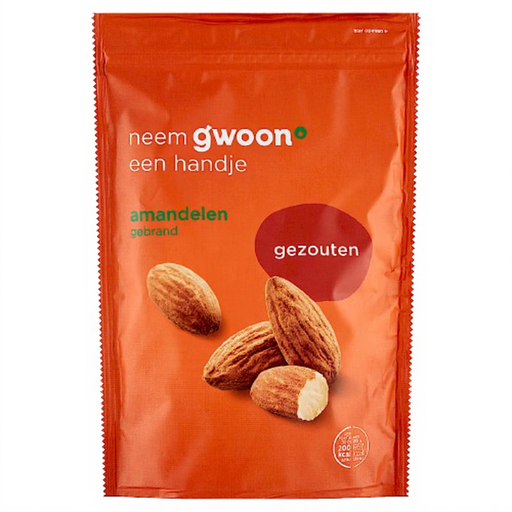
A smaller pack of roasted, salted almonds for snacking; not an unsalted option to stock up on.
Pack size: 150 g.
Ingredients: 97% almonds, sunflower oil and salt.
The product information warns that it may contain traces of peanuts and other nuts.
Packaging: the product description mentions a resealable bag.
 No image available
The largest pack listed in this product selection, but the almonds are roasted and salted, so they’re not an unsalted option to stock up on.
Pack size: 500 g.
Preparation: roasted and salted.
The product information warns that these almonds pose a choking risk to young children and are not suitable for babies.
Keep track of how many grams your household actually eats each week and choose a pack size to match. A serving suggestion on the pack isn’t automatically dietary advice for every family member.
Store almonds in a dry, airtight place and follow the instructions on the pack. The Netherlands Nutrition Centre recommends keeping them cool, for example at 10 to 15 °C.
No. Bear in mind that whole nuts can pose a choking risk. The Netherlands Nutrition Centre recommends, among other things, that children eat sitting calmly and under supervision. Consider what your child can chew. This is practical advice, not a legal age limit.
Under EU labelling rules, any allergens present must be clearly highlighted in the ingredients information. Dutch government guidance states that label information must be available in Dutch and, for online sales, online too. Check the information on the pack you buy.
‘May contain’ warns that an allergen could be present unintentionally, for example through cross-contamination; it isn’t the same as listing it as an ingredient. From 1 January 2026, the Netherlands Food and Consumer Product Safety Authority (NVWA) will oversee the rules for these warnings in the Netherlands.