When choosing almonds for an evening snack, check the nutritional value of the portion you actually eat, not just the figure per 100 g. According to the Netherlands Nutrition Centre, an average 25 g portion of unsalted almonds contains 5.4 g of protein and 158 kcal. After intense exercise, the composition of your overall meal still matters too.
Who are almonds a good snack for?
Active people who want their snacks to count
You want to know how much protein a portion provides and whether you also need a meal after intense exercise. The Netherlands Nutrition Centre recommends considering your overall diet, while the Dutch Association of Sports Nutrition Experts describes recovery nutrition as including both protein and carbohydrates.
Snackers who want to keep an eye on their portion
You want to enjoy almonds alongside the rest of your evening meal without confusing the nutritional value of a whole bag with that of a single portion. The Netherlands Nutrition Centre provides nutritional values for a 25 g portion; Albert Heijn recommends resealing the pack securely after use.
Fans of savoury almonds
You’re looking for roasted or seasoned almonds and want to know what they contain besides almonds. Jumbo lists sunflower oil in its unsalted variety, while Duyvis describes Almonds Original as having a savoury seasoning; ALDI lists roasted salted and smoky-flavoured varieties.
What should you look for when choosing?
Start by comparing the nutritional value of a suitable portion, then check how the almonds are prepared, their ingredients and the information relevant to everyone sharing them.
| What to consider |
What to look for |
Who is this important for? |
| Protein per serving and post-exercise recovery |
Compare the nutritional value of the exact variety using the same serving weight. The Netherlands Nutrition Centre gives an average of 5.4 g of protein per 25 g of unsalted almonds; consider this as part of your overall diet. |
I want to know what my portion actually contributes after exercise and how it fits into the rest of my diet. Around 31% of consumers prioritise protein per serving. |
| Serving size and energy |
Check the serving size and energy per 100 g on the label. If you like, measure out a portion into a bowl beforehand instead of eating from the pack. |
If I’m eating almonds alongside other snacks, I want to be able to balance my portion with the rest of my evening meal. Around 25% of consumers prioritise portion control. |
| Preparation and ingredients |
Read the ingredients list and check separately whether the almonds are roasted, unroasted, salted or prepared with oil. ‘Unsalted’ doesn’t automatically mean ‘oil-free’. |
I mainly choose based on the savoury flavour and preparation I’m looking for in an evening snack. Around 19% of consumers prioritise flavour and preparation. |
| Allergen information |
Read the ingredients and check the pack for any warnings about the possible presence of other allergens. The Netherlands Nutrition Centre lists almonds as a tree nut allergen. |
I want to check in advance whether the snack is suitable for everyone sharing it. Around 13% of consumers consider allergen information a deciding factor. |
| Packaging and storage |
Choose a pack size that suits how much you use, and follow the storage advice on the specific pack. |
If I want to enjoy the almonds over several evenings, I look for a suitable quantity and check how to store the pack after opening. Around 12% of consumers prioritise convenience and avoiding waste. |
Common mistakes
-
Assuming the protein figure per 100 g applies to one handful
A portion provides less protein than the figure per 100 g. The Netherlands Nutrition Centre gives an average of 5.4 g of protein and 158 kcal per 25 g of unsalted almonds.
Compare products using the same portion weight and check the nutritional value of the exact variety.
-
Treating unsalted, oil-free and single-ingredient as the same thing
Jumbo’s unsalted variety lists sunflower oil, while AH Unsalted Almonds lists unsalted almonds as its ingredient.
Check the product name, preparation method and ingredients list separately.
-
Assuming sporty packaging means better recovery
A product name or protein figure alone doesn’t prove that a variety improves recovery. The Netherlands Nutrition Centre emphasises the importance of your overall diet.
Look at the specific nutritional values and the composition of your meal, without assuming that a brand name comes with a recovery benefit.
-
Confusing a short ingredients list with complete allergen information
A simple ingredients list doesn’t rule out a warning about the possible presence of other allergens. The Netherlands Nutrition Centre lists almonds as a tree nut allergen.
Check the ingredients and warnings on the current pack. The Netherlands Food and Consumer Product Safety Authority says allergens must be clearly identifiable in the ingredients list.
Brands to consider
Duyvis
The product range includes Almonds Original and Unsalted Almonds, two varieties with different ingredients.
- Duyvis describes Almonds Original as oven-roasted without added oil or fat.
- The manufacturer lists sunflower oil in Unsalted Almonds; the ingredients in one variety don’t necessarily apply to the other.
Albert Heijn
AH Unsalted Almonds 190 g is an example of roasted almonds with almonds as the ingredient.
- Albert Heijn lists 27 g of protein per 100 g and a serving size of 25 g.
- The product information notes that it may contain peanuts and other nuts; check the current pack.
Jumbo
Jumbo Unsalted Almonds 140 g is a roasted variety whose ingredients list also includes sunflower oil.
- The product information states that it contains 99% almonds.
- For this variety, ‘unsalted’ doesn’t mean that no oil has been added; the product page also notes that it may contain peanuts.
Lidl
The Alesto range includes Spanish almonds in various 200 g varieties.
- Lidl describes natural almonds as part of the Alesto range.
- This range description doesn’t give specific nutritional values for every variety; check the label on the product itself.
ALDI
ALDI Netherlands lists TRADER JOE'S Almonds 200 g in roasted salted and roasted smoky-flavoured varieties.
- The product page mentions a resealable pack.
- Packaging information alone says nothing about protein content or any effect on recovery.
PLUS
PLUS lists both unroasted, unsalted almonds in a 200 g pack and roasted, unsalted almonds in a 150 g pack.
- The unroasted variety lists almonds as its only ingredient.
- The roasted variety lists 98% almonds and sunflower oil; this information applies to these specific products.
Almonds at Joybuy
This selection includes natural, unroasted and roasted almonds for snacking. Compare the nutritional values using the same portion size and check the ingredients of the variety you choose.
 No image available
Jia Zhou Yuan Ye Original Almond Kernels 160 g
A good choice if you want to snack on almonds and compare the nutritional value with your own portion size.
The product information lists 21.5 g of protein per 100 g and 100% almond kernels as the ingredients.
Joybuy
 No image available
g'woon Almonds Raw & Unsalted 200 g
A good choice if you’re looking for a raw, unsalted variety for a snack.
The product information lists 24 g of protein and 0.03 g of salt per 100 g. Contains almonds, a tree nut allergen.
Joybuy
 No image available
Anatolia Roasted Salted Almonds 500 g
A good choice if you’re looking for roasted, salted almonds for a savoury snack.
The nutritional information lists 21 g of protein and 1.0 g of salt per 100 g. Contains almonds, a tree nut allergen.
Joybuy
 No image available
Anatolia Badem Natural Almonds 500 g
A good choice if you’re looking for a natural almond variety with no added salt.
The product information lists 100% almonds, 21.0 g of protein and 0.00 g of salt per 100 g. Contains almonds, a tree nut allergen.
Joybuy
 No image available
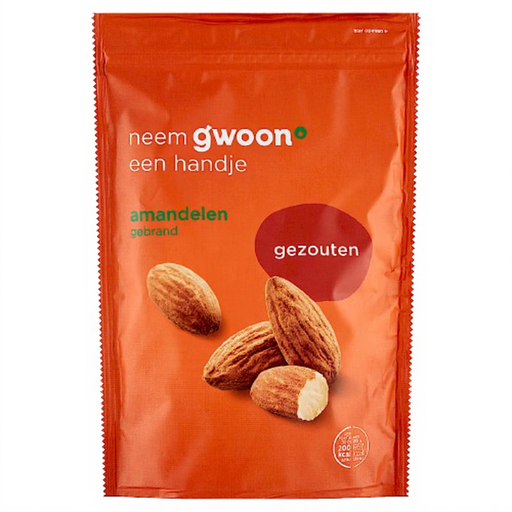
g'woon Roasted & Salted Almonds 150 g
A good choice if you’re looking for roasted, salted almonds in a resealable pack.
The product information lists 97% almonds, sunflower oil and salt. It contains 21 g of protein and 1 g of salt per 100 g; possible traces of peanuts and other nuts are noted.
Joybuy
Frequently asked questions
Do you need to buy special protein snacks after every workout?
Not necessarily: according to the Netherlands Nutrition Centre, recreational exercisers don’t need special protein shakes or bars. If you exercise intensely, consider the protein in your overall diet; almonds can contribute as part of your eating pattern.
Can almonds on their own replace a complete recovery meal?
Not automatically. The Dutch Association of Sports Nutrition Experts describes recovery nutrition after intense exercise as including protein and carbohydrates, for example quark with fruit and muesli. So consider almonds as part of a meal.
Does unsalted mean no oil has been added?
No. Jumbo Unsalted Almonds 140 g and Duyvis Unsalted Almonds list sunflower oil as an ingredient. Check the ingredients list for the exact variety to be sure.
What allergen information should I check?
Check the ingredients list and any warnings about the possible presence of other allergens. The Netherlands Nutrition Centre lists almonds as a tree nut allergen; the Netherlands Food and Consumer Product Safety Authority says allergens must be clearly identifiable in the ingredients list.
How should I store an opened pack?
Follow the advice on the pack for the variety you’ve chosen. Albert Heijn recommends storing almonds in a cool, dark and dry place and resealing the pack securely after use; Jumbo and PLUS recommend storing them in a dry, dark place.


