
Anyone planning a pre-workout snack
You’re looking for something to eat before exercise and want to avoid a large or heavy snack making your workout uncomfortable. The Voedingscentrum highlights the importance of timing and portion size.


Almonds are better suited to a measured snack eaten earlier than to a large portion just before your workout. The Voedingscentrum warns that large portions and foods high in fat, protein or fibre can cause discomfort at that point. According to their labels, the AH, PLUS and Jumbo almonds reviewed provide 27, 24 and 21 g of protein per 100 g respectively, but they do not meet the requirements for a ‘high protein’ claim: according to the European Union’s Your Europe website, at least 20% of the energy value must come from protein.
You’re looking for something to eat before exercise and want to avoid a large or heavy snack making your workout uncomfortable. The Voedingscentrum highlights the importance of timing and portion size.
You want to know how much protein you’re actually eating, without mistaking the figure per 100 g for the amount in a handful. You also want to know that the ‘high protein’ claim depends on the proportion of the energy value that comes from protein, as explained by the European Union’s Your Europe website.
You want to take almonds with you or portion them out at home, and choose between plain, roasted and seasoned varieties. Ingredients, pack size and storage information can help you compare your options.
First decide when you’ll eat them, then check the protein per portion, followed by the ingredients and packaging. The Voedingscentrum advises against eating a large portion just before exercise and recommends taking care with foods high in fat, protein or fibre.
| What to consider | What to check when buying | Who should pay particular attention? |
|---|---|---|
| Timing and portion size | Match the portion to when you plan to exercise. The Voedingscentrum advises against eating a large portion just before exercise. | If I eat shortly before my workout, I want to consider the portion size and timing. Around 31% of consumers give timing and how well a snack sits the highest priority. |
| Protein per portion | Compare the nutritional values per 100 g and per portion. The Voedingscentrum lists 5.4 g of protein for a 25 g handful of unsalted almonds. | I want to know how much protein my measured portion provides, not just what the label says per 100 g. Around 31% of consumers prioritise the protein provided per portion. |
| Ingredients and flavour | Check separately whether salt, oil or seasoning has been added; ‘roasted’ and ‘unsalted’ don’t mean the same thing. | If I want to avoid salt or oil, I check the ingredients list rather than relying on the preparation description. Around 23% of consumers give the ingredients and flavourings the highest priority. |
| Packaging and storage | Check the pack size, whether it can be resealed after opening and the storage instructions on the pack. | If I regularly take small portions with me, I want to know whether the packaging is practical to reseal and store. Around 15% of consumers prioritise portioning and everyday use. |
The claim depends on the proportion of the energy value that comes from protein, not just the number of grams of protein per 100 g.
Compare protein and energy on the same label basis, and bear your actual portion in mind. According to the European Union’s Your Europe website, at least 20% of the energy value must come from protein for the claim to be used.
The Voedingscentrum warns that a large portion, or a food high in fat, protein or fibre, can cause discomfort shortly before exercise.
Take the timing of your workout into account, and don’t automatically choose a larger portion because of its protein content.
A preparation claim doesn’t automatically tell you about the total fat content or whether salt has been added. For example, the Jumbo variety reviewed contains sunflower oil, even though ‘unsalted’ appears in the product name.
Check the ingredients, fat and salt separately on the label.
The AH Unsalted Almonds reviewed are roasted and sold in a 190 g bag.
PLUS Raw and Unsalted Almonds is the variety reviewed, sold in a 200 g stand-up pouch.
Jumbo Unsalted Almonds is the roasted variety reviewed, in a 140 g pack.
The product information describes a 200 g pack of unroasted almonds.
Lidl sells almonds as part of its Alesto nut range.
Duyvis Almonds Original is a savoury, seasoned, oven-roasted almond variety in a 125 g pack.
These Joybuy products are standard almonds for measured portions, with unsalted and salted varieties prepared in different ways.
 No image available
Suits anyone looking for a measured portion to eat earlier and who wants almond kernels as the only ingredient.
The label lists 21.5 g of protein and 622 kcal per 100 g, and around 5.4 g of protein per 25 g.
Contains 53.8 g of fat per 100 g and almonds; not suitable for anyone with an almond allergy.
 No image available
Suits anyone who wants to measure out unsalted almonds to eat earlier.
The product name says raw and unsalted, and the ingredients list names almonds only. The label lists 24 g of protein and 591 kcal per 100 g, or around 6 g of protein per 25 g.
Contains 50 g of fat per 100 g and almonds; not suitable for anyone with an almond allergy.
 No image available
Suits anyone looking for a measured portion of roasted, salted almonds to eat earlier.
The label lists 21 g of protein and 622 kcal per 100 g, or around 5.25 g of protein per 25 g.
Contains 53.8 g of fat per 100 g and almonds; not suitable for anyone with an almond allergy.
 No image available
Suits anyone looking to measure out salted roasted almonds to eat earlier.
The product information describes roasted almonds with almonds and salt as ingredients. The label lists 21 g of protein and 620 kcal per 100 g, or around 5.25 g of protein per 25 g.
Contains 54 g of fat per 100 g and salt; not suitable for anyone with an almond allergy.
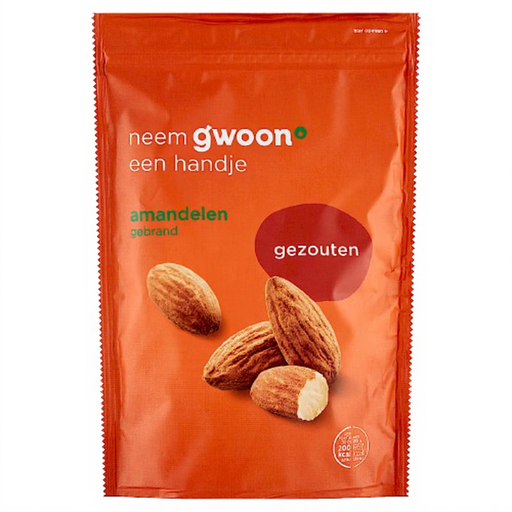 No image available
Suits anyone who wants to portion out roasted, salted almonds and reseal the pack after use.
The ingredients list 97% almonds, sunflower oil and 0.7% salt. The label lists 21 g of protein and 667 kcal per 100 g, or around 5.25 g of protein per 25 g.
Contains 53 g of fat per 100 g and almonds; the pack may contain traces of peanuts and other nuts.
Not necessarily. The Voedingscentrum advises against eating a large portion or foods high in fat, protein or fibre just before exercise. It’s better to eat almonds earlier and choose a portion that suits your plans.
No, the amount per 100 g alone isn’t enough. According to the European Union’s Your Europe website, at least 20% of the energy value must come from protein for the claim to be used; the declared values for the AH, PLUS and Jumbo varieties reviewed are below this threshold.
The Voedingscentrum lists 5.4 g of protein for a 25 g handful of unsalted almonds. The exact nutritional value can vary by product, so check the label on the variety you buy.
No, roasting doesn’t make almonds a suitable alternative for someone with an almond allergy. Stichting Voedselallergie states that the allergen remains stable when heated; check the allergen information on the pack too.
Follow the instructions for the specific product. Albert Heijn advises keeping the variety reviewed tightly closed in a cool, dark and dry place; for an opened bag of Duyvis Almonds Original, an airtight, lightproof container is recommended.