What should you look for when choosing?
Start with the portion you’ll actually eat. Then consider the timing and ingredients: unsalted, unroasted and made without added fat don’t mean the same thing.
| What to consider |
What to check |
Relevant to |
| Energy per portion |
Weigh your portion and calculate kcal per 100 g × the number of grams ÷ 100. |
If you want to limit your calorie intake, what you actually weigh out matters most; around 33% of consumers prioritise portion size and calories. |
| Timing and stomach comfort |
Decide when you’ll eat; portion size matters just before exercise. |
If you eat shortly before training, you’ll want to choose a snack that won’t feel heavy on your stomach as a large portion; around 33% of consumers prioritise timing and stomach comfort. |
| Ingredients and salt |
Read the ingredients list and nutritional information separately; if you have an allergy, check the allergen information too. |
If you want to take oil, seasoning or salt into account, the exact ingredients of the variety will help; around 20% of consumers consider ingredients and salt the most important factors. |
| Taking snacks with you and storage |
Check the packaging and storage instructions; keep a weighed portion separate from the rest. |
If you take snacks with you or portion them in advance, check whether the pack can be resealed and how to store it; around 14% of consumers prioritise convenience when taking snacks with them and storing them. |
Brands and varieties compared
The products listed differ in how they’re prepared and what they contain. Always compare the label for the specific variety; these examples aren’t a judgement on every product from each brand.
Duyvis
Duyvis offers separate varieties, including Almonds Original and Unsalted Almonds.
- According to the manufacturer, the Original almonds are oven-roasted without added oil or fat.
- The ingredients list for Unsalted Almonds includes sunflower oil. The way the Original variety is prepared doesn’t, on its own, tell you how many calories are in a portion.
Albert Heijn
AH Unsalted Almonds 190 g is a roasted variety containing almonds as an ingredient.
- Albert Heijn lists 627 kcal per 100 g and gives a 25 g serving size and storage advice on the product page.
- Unsalted doesn’t mean low in calories; weigh the amount you eat.
Jumbo
Jumbo Unsalted Almonds 140 g is a roasted variety.
- Jumbo’s product information lists 99% almonds and sunflower oil, with nutritional values per 100 g and per 25 g.
- For this specific variety, Jumbo lists 661 kcal per 100 g; don’t assume this figure applies to other Jumbo products.
Lidl
Lidl has a product listing for unsalted almonds.
- The product listing gives you a specific variety to check if you’re looking for unsalted almonds.
- Unsalted isn’t a claim about energy content. Compare the nutritional information and ingredients on the packaging of the variety you choose.
ALDI
ALDI lists TRADER JOE'S Unroasted Almonds 200 g.
- ALDI describes the almonds as untreated and supplied in a resealable pack.
- Unroasted and resealable don’t tell you how much energy a weighed portion provides; check the label for that.
PLUS
According to the product information, PLUS Unroasted and Unsalted Almonds 200 g contains only almonds.
- PLUS lists 591 kcal per 100 g for this variety.
- The nutritional information applies to this specific product; unroasted and unsalted doesn’t mean low in calories.
Almond products at Joybuy
These Joybuy products are almond varieties for anyone who wants to weigh out a portion. The product names distinguish between raw or unroasted varieties and roasted, salted varieties; check the product information for the nutritional value of the variety you choose.
 No image available
Jia Zhou Yuan Ye Original Almond Kernels 160 g
The product name indicates almond kernels in a 160 g pack; weigh out the amount you’ll eat before training.
View on Joybuy
 No image available
g'woon Almonds Raw & Unsalted 200 g
A good choice if you’re looking for raw, unsalted almonds; the product name states that the pack contains 200 g.
View on Joybuy
 No image available
Anatolia Roasted Salted Almonds 500 g
The product name identifies this as a roasted, salted almond variety in a 500 g pack.
View on Joybuy
 No image available
Anatolia Badem Natural (Almond) 500 gr
The product name indicates an almond variety weighing 500 gr; check the label for the exact ingredients and nutritional information.
View on Joybuy
 No image available
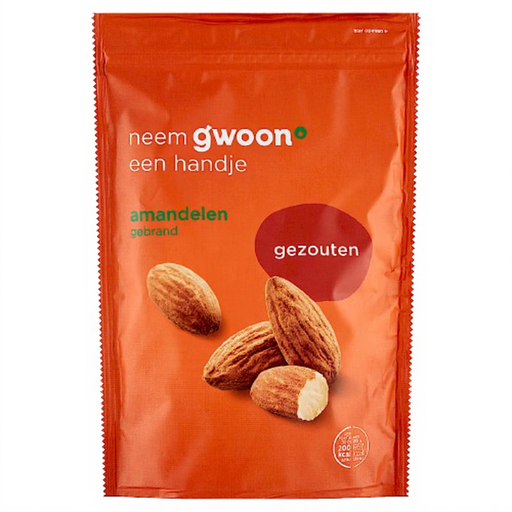
g'woon Roasted & Salted Almonds 150 g
A good choice if you’re looking for roasted, salted almonds; the product name states that the pack contains 150 g.
View on Joybuy
Frequently asked questions
How do you calculate the calories in a small portion of almonds?
Multiply the kcal per 100 g on the label by the number of grams you’ve weighed out, then divide by 100. For 15 g of AH Unsalted Almonds, that’s 627 × 15 ÷ 100 = 94.05 kcal, based on the nutritional information Albert Heijn lists for that variety. This is a calculation example, not a recommended portion size.
Are almonds a suitable snack just before exercise?
It depends in part on the timing and portion size. The Netherlands Nutrition Centre advises against having a large portion containing lots of fat, protein or fibre just before exercise; this general advice doesn’t prove that a particular almond variety is better.
Are unsalted almonds automatically free from oil?
No. According to Jumbo, Jumbo Unsalted Almonds 140 g contains sunflower oil, while AH Unsalted Almonds 190 g lists almonds as its only ingredient. Check the ingredients list for the exact variety.
When should you eat a meal before exercising?
The Netherlands Nutrition Centre advises having a proper meal around 2 to 3 hours before exercising. This is general advice about meals, not proven optimal timing for a specific portion of almonds.
When can a product be called ‘low in calories’?
According to the European Commission, the ‘low energy’ claim for solid foods applies to products containing no more than 40 kcal (170 kJ) per 100 g. A smaller portion doesn’t change this limit per 100 g, so check the nutritional information for the product itself.


