If your child can eat almonds, unsalted almonds can make a suitable after-school snack; the Voedingscentrum lists unsalted nuts as a possible snack for children aged 4 to 12. If you’re looking for almonds with specific dietary claims, check all the allergen information for the exact product too. For example, AH Amandelen ongebrand is labelled gluten-free and lactose-free, but contains almonds and carries a warning about the possible presence of other allergens. If your child has an almond allergy or their school has a nut-free policy, choose a snack that doesn’t contain nuts. For young children, also consider the form of the food and supervise them while they eat, as the Voedingscentrum advises.
Who are almonds suitable for as an after-school snack?
Following a specific diet
Your child can eat almonds, but you’re looking for a product labelled, for example, gluten-free or lactose-free. Check these claims as well as the warnings about other allergens on the exact product. Albert Heijn gives both dietary claims for AH Amandelen ongebrand. The product contains almonds and, according to Albert Heijn, may also contain peanuts and other nuts.
Taking school rules into account
You want to pack almonds for school or childcare and need to follow the rules at that location. For example, OBS De Venen publishes a policy excluding nuts and peanuts throughout the school, so check the rules at your own school or childcare setting.
A simple everyday snack
Your child can eat almonds and you’re looking for an unsalted snack for after school. The Voedingscentrum lists unsalted nuts as a possible snack for children aged 4 to 12. For young children, the form of the food also needs consideration.
What should you look for in almonds as an after-school snack?
Start with the ingredient your child needs to avoid and any rules set by their school or childcare setting. Then compare the ingredients and the form of the food. An unsalted variety won’t automatically suit every diet or every location.
| Buying consideration |
What should you check? |
Who does this matter to? |
| Suitable for the diet |
The claim for the specific ingredient, along with the ingredients and warnings for the exact product. |
If I need to avoid gluten or lactose, I want to check the dietary claim and other allergen information; around 36% of consumers put this specific dietary suitability first. |
| Suitable for school or childcare |
The current rules at the relevant location and whether they apply to all nut products. |
When I pack a snack, I first check whether nuts are allowed; around 29% of consumers give the rules at the location top priority. |
| Unsalted ingredients |
Whether the variety is unsalted and what other ingredients are listed. |
For an everyday after-school snack, I look for an unsalted variety and check what has been added; around 21% of consumers put this everyday dietary choice first. |
| Form and portioning |
Whether whole nuts are suitable for your child and whether the pack works for how you plan to use it. |
If I’m giving the snack to a young child, I first check whether the form is suitable and whether I can supervise them while they eat; around 14% of consumers put form and portioning first. |
Common mistakes when choosing
-
Assuming gluten-free or lactose-free means suitable for every allergy
These claims don’t mean that a product is free from almonds or other allergens. For example, AH Amandelen ongebrand is labelled gluten-free and lactose-free, but contains almonds and, according to Albert Heijn, may contain peanuts and other nuts.
Check which ingredient you need to avoid and read the ingredients and allergen information for the exact product.
-
Assuming a snack that’s suitable at home can automatically go to school
A school or childcare setting may have its own rules about nuts and peanuts, even if your child can eat almonds.
Check the rules at the location before buying almonds for school or childcare.
If nuts aren’t allowed at the location, you won’t be able to use the pack for that snack time.
-
Confusing no added oil with unsalted
Duyvis describes roasting one variety without added oil or fat. The Duyvis Oven roasted variety reviewed also contains salt and flavourings, and Albert Heijn lists the possible presence of wheat, peanuts and various nuts.
Read the ingredients and allergen information for the flavoured variety instead of relying on the description of how it’s prepared.
-
Treating the product serving as personal advice for your child
The serving size shown on a pack isn’t automatically suitable for every child. The Voedingscentrum advises taking care with whole nuts to prevent choking, ensuring children sit calmly and supervising them.
Consider whether the form of the food is suitable for your child and stay nearby while they eat.
Brands and varieties to consider
Duyvis
Worth considering if you’re looking for a savoury almond variety, such as Duyvis Oven roasted almonds 125 g.
- Duyvis describes Almonds Original as roasted without added oil or fat; this is the manufacturer’s description.
- The Oven roasted variety reviewed contains salt and flavourings. Albert Heijn lists the possible presence of wheat, peanuts and various nuts.
Albert Heijn
AH Amandelen ongebrand 450 g is worth considering if you’re looking for explicit gluten-free and lactose-free claims.
- Albert Heijn lists almonds as an ingredient and labels the variety gluten-free and lactose-free. The product information also states that no salt or sugars have been added.
- The variety contains almonds and, according to Albert Heijn, may contain peanuts and various other nuts. These claims don’t make the product suitable for every allergy.
Jumbo
Jumbo Ongezouten Amandelen 140 g is a roasted variety to consider if unsalted is one of your buying criteria.
- The official product information lists 99% almonds and sunflower oil.
- Jumbo lists the possible presence of peanuts. The product name ‘unsalted’ isn’t an allergen claim.
Lidl
Lidl lists a variety called Amandelen ongezouten (unsalted almonds).
- The product title indicates that these are unsalted almonds.
- The product title alone isn’t a gluten-free, lactose-free or other allergen claim. Check the information on the variety you buy.
ALDI
Under its Trader Joe's product line, ALDI lists both unroasted and roasted unsalted almonds in 200 g packs.
- ALDI describes the packs as resealable and distinguishes between the unroasted and roasted unsalted varieties.
- These product descriptions aren’t a general guarantee that a product is free from a specific ingredient. Check the ingredients and allergen information for the variety.
PLUS
PLUS Amandelen ongezouten 150 g is a roasted variety with ingredients and allergen information available.
- PLUS lists 98% almonds, sunflower oil and 0 g of added sugars per 100 g.
- PLUS warns about the possible presence of peanuts and various other nuts. The product information also warns that small children may choke on the product.
Joybuy products for an unsalted snack
These products are suitable for an unsalted almond snack: a pack of raw almonds and an unroasted nut mix. If you choose the mix, check that all the nuts listed are suitable; it isn’t a nut-free option.
 No image available
g'woon Almonds Raw & Unsalted - 200g
An option if you’re looking for raw, unsalted almonds and your child can eat almonds.
The product name states that they’re raw and unsalted; almonds are an ingredient.
View at Joybuy
 No image available
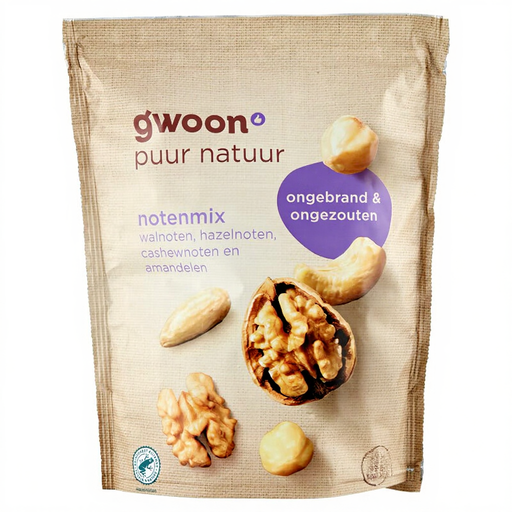
g'woon Unroasted Mixed Nuts - 500g
An unroasted nut mix for a snack, if your child can eat all the nuts listed.
The mix contains 20% almonds, hazelnuts, walnuts and cashews. The product information lists 0 g of salt per 100 g.
Don’t choose this mix if your child needs to avoid any of the nuts listed.
View at Joybuy
Frequently asked questions about almonds after school
Does lactose-free also mean a product is suitable for someone with a milk allergy?
No. Lactose-free and suitable for someone with a milk allergy don’t mean the same thing. Stichting Voedselallergie explains that a milk allergy is a reaction to milk proteins, so choose products based on the specific dietary need and the full product information.
What does ‘may contain’ mean on a Dutch label?
It’s a precautionary warning about the possible accidental presence of an allergen, not the same as an allergen being added as an ingredient. The NVWA states that, since 1 January 2026, rules for these warnings have been based on a risk assessment and reference values.
Is ‘gluten-free’ just an optional marketing term?
No. The European Commission sets out the conditions for claims such as ‘gluten-free’ and ‘very low gluten’ under Regulation (EU) 828/2014. An ingredients list that doesn’t mention wheat isn’t the same as an explicit gluten-free claim.
How should you give whole almonds to a child?
Consider whether whole nuts are suitable for your child and supervise them while they eat. The Voedingscentrum warns that whole nuts can cause choking and advises having your child sit calmly and staying nearby.
What allergen information must a Dutch retailer provide?
The NVWA states that retailers must inform consumers about allergens present. For pre-packed products, this information appears on the label; consumers must be able to get the information before buying.


