For your weekly shop, choose based on the weight of each pack and how much your household uses: the AH multipacks reviewed here contain individual packs, not ready-made lunchbox portions. Albert Heijn lists a 3-pack with three 190 g packs, weighing 570 g in total, and 6-packs with individual packs of either 190 g or 450 g, weighing 1,140 g and 2,700 g respectively. You’ll need to weigh out portions yourself for lunchboxes. If you’re not yet sure how much you’ll use, a smaller quantity can help you keep your stock at a suitable level.
Who is an almond multipack for?
Filling lunchboxes
You want to buy enough almonds during your weekly shop to portion out yourself later. The AH packs reviewed here contain individual packs, not single-serving snacks. Don’t give whole nuts to children under 4; the Netherlands Nutrition Centre recommends ground nuts or nut butter as an alternative.
Households sharing together
You share the same almonds with several people and want to match the number of packs to your household’s combined consumption. The AH 6-packs reviewed here differ in the weight of each pack: 190 g compared with 450 g.
Weekly shoppers who like to plan ahead
You want enough in stock without automatically opting for a large multipack. Compare the total weight with how much your household uses, and store opened almonds as recommended by the Netherlands Nutrition Centre: well sealed, cool, dark and dry.
What should you consider when choosing?
First decide whether you want to portion out standard packs yourself or need individual portions. Then compare the total weight with how much you use and how you plan to enjoy the almonds.
Albert Heijn supplies the packs reviewed here as individual items: three 190 g packs, six 190 g packs or six 450 g packs. That works out at 570 g, 1,140 g and 2,700 g in total, respectively.
| What to consider |
What should you check? |
Who is this important for? |
| Lunchbox portions |
Check the weight of each pack and bear in mind that you’ll need to weigh out portions yourself. |
When I buy almonds for lunchboxes, I want to be able to choose the portion sizes myself. Around 29% of consumers say convenient portioning is their top priority. |
| Keeping the right amount in stock |
Multiply the number of packs by the weight of each pack, then compare the total with how much your household uses. |
When we share almonds at home, I want to buy enough without ending up with far more in stock than we need. Around 29% of consumers prioritise keeping a suitable amount in stock. |
| Variety and label |
Read the ingredients and allergen information on the exact pack; unsalted doesn’t automatically mean it contains only almonds. |
When several people eat the almonds, I want to choose the variety and form carefully. Around 21% of consumers pay particular attention to ingredients and safety. |
| Storing after opening |
Use an airtight container and store opened almonds somewhere cool, dark and dry, as recommended by the Netherlands Nutrition Centre. |
When a pack isn’t used all at once, I want to be able to store the rest properly. Around 21% of consumers prioritise storage after opening. |
Common purchasing mistakes
-
Mistaking a multipack for lunchbox portions
The AH packs reviewed here are supplied as individual items. So the number of packs doesn’t tell you how many ready-to-go lunchbox portions you’ll get.
Check the weight of each pack and decide in advance whether you’re happy to weigh out portions yourself.
Portioning the almonds yourself takes time and may mean you need an airtight container.
-
Choosing a 6-pack without calculating the total weight
The AH 6-packs reviewed here contain 1,140 g or 2,700 g in total. The number of packs alone doesn’t show how much you’ll have in stock.
Multiply the number of packs by the weight of each pack, then compare the result with how much you use and what you already have at home.
If the quantity doesn’t match how much you use, it can take up storage space and sit around for longer than intended.
-
Assuming unsalted means no oil or allergens
The varieties reviewed here differ in their ingredients and in their warnings about the possible presence of other nuts or peanuts.
Read the ingredients and allergen information on the exact pack; don’t rely on the brand name or the word ‘unsalted’ as a substitute.
-
Assuming whole almonds are suitable for young children
The Netherlands Nutrition Centre advises against giving whole nuts to children under 4 because of the risk of choking.
Choose a suitable form for young children. Older children should eat slowly, and you should stay with them when they’re eating whole nuts.
Almond brands to consider
Albert Heijn
The pack combinations reviewed here include unsalted 3-packs and 6-packs, as well as a 6-pack of unroasted almonds. Albert Heijn’s pack pages list the number of packs and the weight of each one.
- The packs let you combine several individual items in one order.
- They aren’t individual lunchbox portions. The combinations reviewed range from 570 g to 2,700 g in total.
PLUS
The own-brand product reviewed is PLUS Raw and Unsalted Almonds, in a 200 g stand-up pouch.
- The ingredients list contains only almonds.
- The label warns that peanuts and other nuts may be present, so a short ingredients list doesn’t mean the product is free from potential allergens.
Jumbo
The Jumbo Unsalted Almonds reviewed here are available in a single 140 g pack.
- The product information lists the ingredients and allergen warning.
- The ingredients are 99% almonds and sunflower oil; the pack warns that peanuts may be present.
Duyvis
The range reviewed includes Unsalted Almonds and Almonds Original, both in 125 g packs.
- The two product names distinguish between an unsalted variety and a savoury, seasoned variety.
- The unsalted variety lists sunflower oil; Original contains a mix of salt and flavourings. Duyvis describes Original as oven-roasted without added oil or fat.
Lidl
Lidl Netherlands lists almonds and unsalted almonds among its products.
- The ‘unsalted’ description helps you identify the variety.
- When choosing, check the weight of each pack and the ingredients and allergen information on the label.
ALDI
A historical offer listing from Beste.nl showed a 500 g pack of almonds.
- The listing gives an example of a larger single pack.
- The offer ran from 27 September to 4 October 2026; this listing doesn’t confirm a current offer or availability.
Almond products at Joybuy
These Joybuy products are individual packs of almonds for you to portion out yourself, not multipacks. Compare the pack details and variety listed with how you use almonds at home.
 No image available
Jia Zhou Yuan Ye Original Almond Kernels 160 g
A single pack to weigh out yourself; the product name lists almond kernels and 160 g.
View at Joybuy
 No image available
g'woon Almonds Raw & Unsalted 200 g
A single pack to portion out yourself; the product name lists raw, unsalted almonds and 200 g.
View at Joybuy
 No image available
Anatolia Roasted Salted Almonds 500 g
A single pack to weigh out yourself; the product name lists roasted, salted almonds and 500 g.
View at Joybuy
 No image available
Anatolia Badem Natural (Amandel) 500 gr
A single 500 gr pack; the product name lists Anatolia Badem Natural (Amandel).
View at Joybuy
 No image available
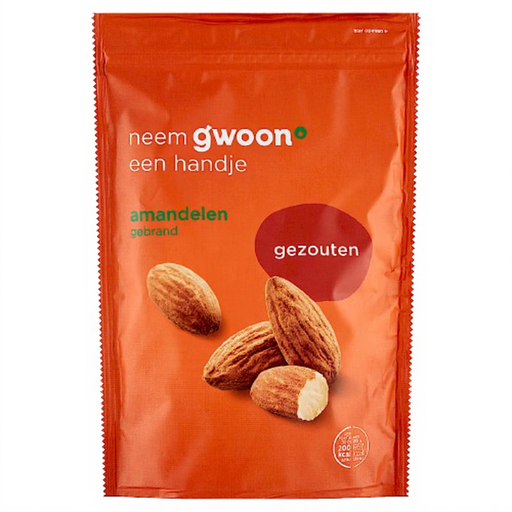
g'woon Roasted & Salted Almonds 150 g
A single pack to portion out yourself; the product name lists roasted, salted almonds and 150 g.
View at Joybuy
Frequently asked questions
Is a 6-pack the same as six lunchbox portions?
No. The AH packs reviewed here contain six individual packs, not six separate lunchbox portions. Albert Heijn lists 190 g packs for the unsalted combination and 450 g packs for the unroasted combination; you’ll need to portion out an amount yourself for lunchboxes.
How do I work out how many almonds I need for the week?
Multiply the number of people by the number of times you plan to eat almonds and the amount you’ve planned for each occasion. Compare the result with the total weight of the multipack and the stock you already have. This is a planning calculation, not nutritional advice; pack weights aren’t recommended portion sizes.
How should I store opened almonds?
The Netherlands Nutrition Centre recommends storing them in a well-sealed container somewhere cool, dark and dry. For opened, unsalted almonds, the Storage Guide advises that they’ll keep for 6 months in a kitchen cupboard and 1 year in the freezer; their quality may decline after that. For unopened packs, follow the storage instructions and best-before date on the packaging.
Can I give whole almonds to young children?
The Netherlands Nutrition Centre advises against giving whole nuts to children under 4 because of the risk of choking. Ground nuts or nut butter are suggested alternatives. Older children can choke too, so make sure they eat slowly and stay with them when they’re eating whole nuts.
Does ‘unsalted’ mean the pack contains only almonds?
No. The PLUS variety reviewed here lists only almonds, while Jumbo Unsalted Almonds 140 g and Duyvis Unsalted Almonds also list sunflower oil. Check the allergen information on the exact pack too: the products mentioned may carry warnings about the possible presence of other nuts or peanuts.


