
Baker with limited worktop space
First, you’re looking for an appliance that fits in its designated spot with the required clearance. Then you can decide how much baking tray space you can do without.


Start with the space you have available and how many biscuits you want to bake at a time. Measure the appliance with the required clearance, and check the usable baking tray rather than relying on the stated capacity in litres. A small mini oven may take up less worktop space, but could mean baking in more batches; a larger oven will take up more room. An air fryer is worth considering for small batches if a suitable baking tin fits, there is enough room for air to circulate and the instructions for the exact model allow it.
First, you’re looking for an appliance that fits in its designated spot with the required clearance. Then you can decide how much baking tray space you can do without.
You want to bake fewer batches, so you’re looking at the usable tray area and the space needed between biscuits, even if the appliance takes up more room.
You bake a few biscuits now and then, and are considering an air fryer if the tin, air circulation and instructions for your chosen model make it suitable.
A good fit if: you have limited worktop space and usually bake small quantities. Compare the external dimensions and baking tray of the exact model.
The trade-off: a smaller tray may mean you need to bake more batches.
A good fit if: you often bake larger quantities and the external dimensions, including the required clearance, work on your worktop.
The trade-off: a larger oven may take up the worktop space you have available. Capacity in litres doesn’t tell you how many biscuits will fit on the tray.
A good fit if: you want to bake small batches or use an air fryer for other things too, and a tin fits in the exact model with enough room for air to circulate.
The trade-off: oven settings aren’t automatically suitable for an air fryer. Check the model instructions and the size of the baking tin.
First, measure the space, including the clearance specified in the manual. Then check the tray or baking tin and the heating settings against your recipe.
| Consideration | What to look for when buying | Who is this important for? |
|---|---|---|
| Safe positioning | Measure the width, depth and height, then compare them with the external dimensions and positioning instructions for the exact model. | If I have limited worktop space, I want to know how much room the appliance needs, including clearance; around 36% of consumers put finding a suitable place for it at the top of their list. |
| Biscuits per batch | Check the usable tray size and allow for the spacing required by your recipe. | If I want to bake fewer batches, I look at how much room my biscuits will take up on the tray; around 29% of consumers prioritise baking capacity. |
| Heating settings | Compare the settings and temperature range explicitly listed for the model with the instructions in your recipe. | If I’m following a recipe that specifies a particular oven setting, I want to be able to select it; around 21% of consumers put the choice of settings first. |
| Energy use and maintenance | Only compare energy use on the same measurement basis, and take the number of batches into account. Also check which parts are included and how they can be cleaned. | If I want to factor in running costs and cleaning, I look at energy use per preparation as well as the number of batches; around 14% of consumers give running costs and maintenance their highest priority. |
External dimensions vary by model, and safe use may require additional ventilation and clearance.
Measure the available width, depth and height, and read the manual for the exact model before buying.
An oven that doesn’t fit in your chosen spot may need to be moved every time you use it.
The capacity in litres doesn’t tell you how many biscuits will fit on the supplied tray. Koopmans’ recipe asks you to leave space between the pieces of dough.
Check the usable tray size, and allow for the size of your biscuits and the spacing required by your recipe when arranging them.
A smaller usable tray may mean baking more batches.
The stated wattage alone doesn’t show how much energy a complete recipe will use, especially if you need to bake several batches. Milieu Centraal recommends comparing energy use per use or per year.
Compare figures measured on the same basis and factor the number of batches into your decision.
A Joybuy listing for the Severin TO 2052 gives conflicting capacity and power details, as well as a convection function that doesn’t match Severin’s specifications.
Compare the full model number and key specifications with the manufacturer’s information before assessing an offer.
The OV207B is a 20-litre freestanding oven for anyone looking for a baking tray and several heating settings.
The OV-3610 is a 10-litre mini oven for small batches.
The TO 2052 represents very small baking and toasting ovens in this comparison.
According to the manufacturer, the KB M19 is a 19-litre oven with switchable air circulation.
The NA229/00 offers an air fryer option if you also want to prepare other small dishes.
This selection includes air fryers and mini ovens with a baking function. For each model, check the required clearance and whether the tray or baking tin is suitable for your recipe.
 No image available
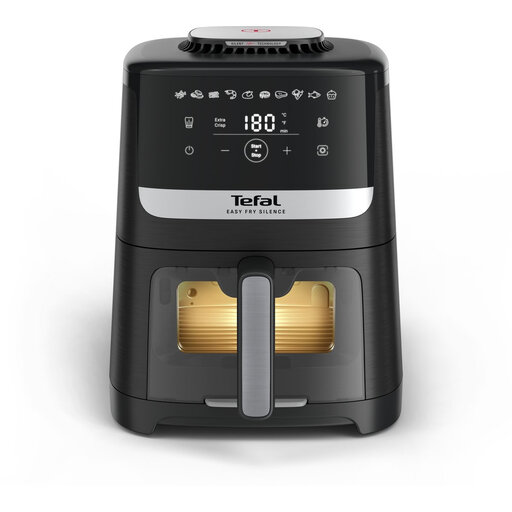
An air fryer to consider if you’re looking for an appliance with a baking function and the specified clearance fits on your worktop.
Capacity: 5 litres. Dimensions: 35 × 28 × 39,5 cm. The product listing requires at least 10 cm of clearance on all sides.
The description lists 10 programmes and an adjustable temperature range of 40–220 °C.
 No image available
This air fryer oven is an option if you’re looking for a baking function and a viewing window; check beforehand that the basket will fit in your available space.
The product description lists a 304 stainless steel basket, a viewing window with interior lighting and 360° air circulation.
Adjustable temperature range: 80–200 °C. The description says you can bake without turning food halfway through.
 No image available
This mini oven is worth considering if you want more oven space and its external dimensions, with the required clearance, will fit on your worktop.
Capacity: 45 litres. Power: 2000 W.
The product description lists top and bottom heat, convection and a baking function.
 No image available
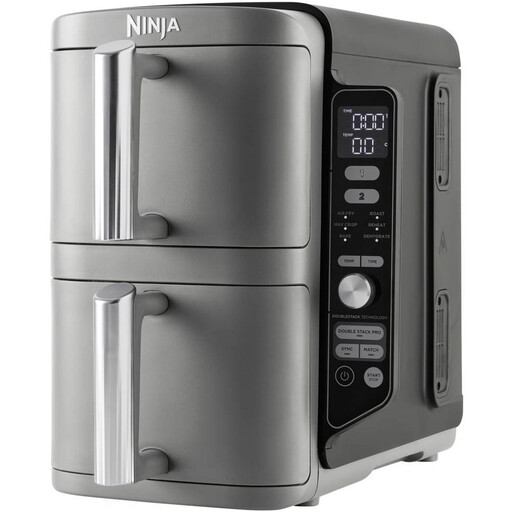
An air fryer with two independently controlled drawers to consider if you also want to prepare two dishes at once while baking.
The product description lists two drawers, each with a capacity of 4,75 litres, and cooking on up to four levels.
Adjustable temperature range: 80–240 °C. The listed functions include baking, roasting, dehydrating and reheating.
 No image available
This mini oven is an option if you want to use a baking tin up to the stated size and can place the oven somewhere suitable with room for ventilation.
Capacity: 22 litres. The product description lists baking tins up to 25 cm and a supplied baking and roasting tray.
The description lists five heating settings, including top and bottom heat with convection, and a temperature setting up to 230 °C.
No, not for every recipe. Koopmans’ recipe for these biscuits gives a temperature of 170 °C for a conventional electric oven and 160 °C for a fan oven, with a baking time of around 18 minutes. These instructions apply to that recipe; don’t automatically use them for other recipes or an air fryer.
No. Philips recommends using an ovenproof tin that fits, with space around it for air to circulate. Check the dimensions and instructions for the exact model; the Philips size chart referred to doesn’t confirm a maximum tin size for the NA229/00.
Follow the manual for the exact model to check ventilation and clearance, and don’t cover the ventilation openings. For the inside of the OV207B, Inventum recommends using a soft, damp cloth with a little washing-up liquid; check how removable parts can be cleaned for each model.
According to the Netherlands Food and Consumer Product Safety Authority, CE marking is compulsory for electrical products covered by Dutch requirements. This alone doesn’t establish whether a particular offer or product version meets those requirements.
When you buy as a consumer in the Netherlands, your product is covered by a legal guarantee. According to the Dutch government, the seller is your first point of contact if something goes wrong and can’t simply refer you to the manufacturer. Any additional manufacturer’s or seller’s guarantee is on top of your legal rights.