
Vandaag of morgen in huis

Kwaliteit gegarandeerd

Welkomstaanbiedingen ontgrendelen: GRATIS bezorging | Tot 80% korting | Gratis 30 dagen JoyPlus-proefperiode
Download de app
An air purifier can help filter airborne particles such as dust, pollen and smoke from indoor air. However, it is not advisable to rely solely on terms such as “powerful purification” or “suitable for the whole house”. The right choice depends mainly on the room, airflow rate, filter type and replacement costs.
A bedroom requires different features from a large living room. These practical checkpoints will help you avoid paying for features you are unlikely to use.
Manufacturers often list a large maximum floor area. This does not always mean that the air in that room is circulated quickly. Therefore, also check the CADR rating: Clean Air Delivery Rate, expressed in cubic metres per hour.
A model with wide room coverage but a low CADR may deliver results less quickly than expected in a large living room. Also check whether the stated coverage is based on one air change per hour or on a more intensive usage scenario.
An air purifier with a HEPA filter may be described as capturing a high percentage of particles. However, that percentage does not tell the whole story. The air must actually be drawn through the filter. A well-fitting filter, sufficient fan capacity and a sealed filter compartment are therefore important.
Claims such as “99.97%” are product specifications or brand claims. According to the relevant brand’s own research, such percentages may apply under certain test conditions. Do not regard them as a guarantee of a particular level of air quality in every UK home.
A quiet air purifier for the bedroom may produce very little noise on its lowest setting, but it can be noticeably louder at a higher fan speed. Therefore, always check whether the manufacturer lists multiple noise levels. A sleep mode, dimmable lighting and a timer are practical features for use at night.
A HEPA filter is designed for fine airborne particles. A pre-filter captures larger particles such as dust and hair. An activated carbon layer is generally used for odours and certain volatile substances. For an air purifier intended to tackle dust and smoke, a combination of these filter layers makes more sense than a single filter.
Check how often the filter needs replacing and the price of a new one. A washable pre-filter can make maintenance easier, but a disposable HEPA filter should not simply be washed or reused.
Use the CADR to compare models more fairly. A rating of 150 m³/h is generally suitable for smaller rooms, while models offering 250 to 550 m³/h can move more air per hour. The actual result also depends on doors, ceiling height, furniture and ventilation.
For a large room, it is often wiser to look for a model with a higher CADR rather than relying solely on the maximum number of square metres stated in the advert.
A PM2.5 sensor measures fine particles in the air and can automatically adjust the fan speed. A smart air purifier may add features such as app control, scheduling or integration with Google Assistant and Amazon Alexa.
These features are useful if you want to monitor air quality remotely. If you mainly want to switch the appliance on and let it run, physical buttons and an automatic mode may be all you need.
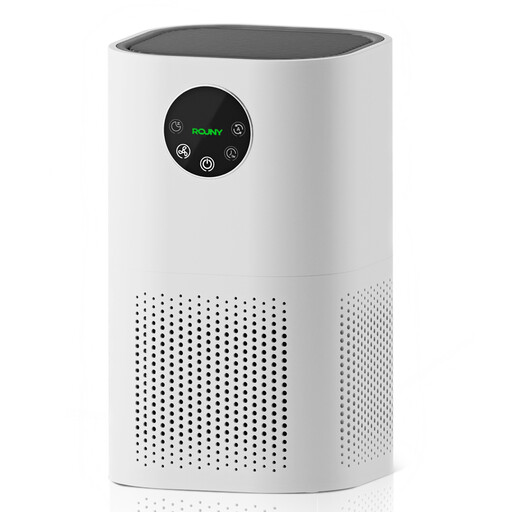
Why it suits this profile: With a CADR of 150 m³/h and stated coverage of 20–50 m², this is a straightforward choice for a bedroom, home office or compact living room. The four fan speeds and timer keep operation simple.
The product description lists both the CADR and noise levels: up to 52 dB and up to 25 dB in sleep mode. This makes it easier to compare the model than relying on general claims about quiet operation alone.
H13 HEPA filter, PM2.5 display, four speeds and a timer of 2, 4 or 8 hours.
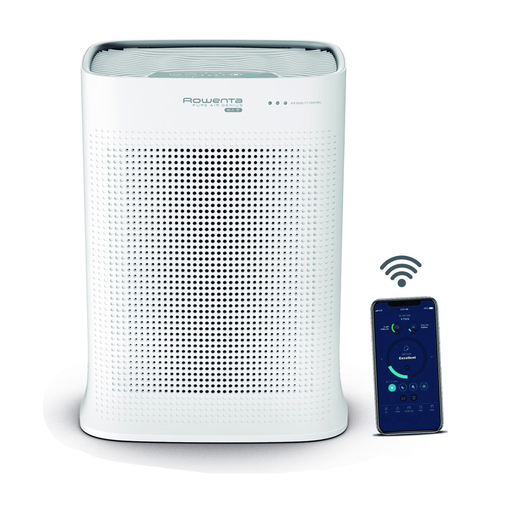
Why it suits this profile: According to the product information, this model is designed for larger spaces of up to 140 m². Its four-stage filtration, automatic mode and 360° air intake are well suited to households looking for a more comprehensive filtration system.
Alongside the room coverage, the product lists a CADR of 360 m³/h, five speeds and a filter indicator. According to Rowenta’s own research, the stated filter percentages apply under the conditions used in its own product tests.
Four-stage filtration with pre-filter, activated carbon, HEPA and formaldehyde filter; noise levels from 52 dB according to the specifications.
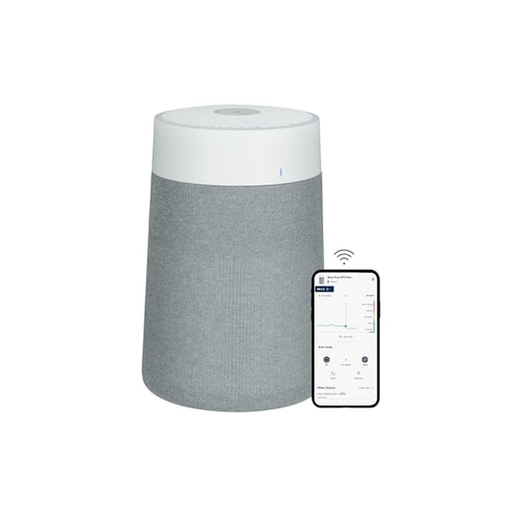
Why it suits this profile: This model combines a CADR of 212 m³/h with app control, scheduling and stated coverage of 43 m². That makes it suitable for users looking for a smart air purifier for a bedroom, home office or living room.
The product information lists both 19 dB on the lowest setting and 48 dB on the highest. This gives a more realistic picture than quoting only the lowest noise level.
App with air quality monitoring and scheduling; HEPASilent filter technology and child lock according to the product description.
Place the air purifier on a stable, level surface and leave around 30 cm of clearance on all sides. Do not put the appliance behind a curtain or directly next to furniture. Before using it for the first time, check that the plastic packaging around the filter has been removed. Without this step, airflow may be blocked.
Clean the pre-filter according to the instructions and replace the main filter when the indicator shows that it is due. Many models specify a period of around 6 to 12 months, but dust, smoke, pets and daily use can shorten this interval. An air purifier for pets particularly benefits from having hair regularly removed from the pre-filter.
We have put together a complete, up-to-date list of products that fully meet these strict selection criteria and the applicable European safety regulations.
According to the product description, a model with a suitable HEPA filter is designed to filter airborne particles such as pollen and dust. The appliance does not automatically remove dust that has already settled on furniture or the floor. Regular cleaning and ventilation are therefore still necessary.
The stated lifespan varies by model. Manufacturers often specify around 6 to 12 months. In particular, check the filter indicator and watch for reduced airflow. With a lot of smoke, pets or intensive use, the filter may need replacing sooner.
Energy consumption depends on the rated power, the selected fan speed and the number of hours it is used. A 20 to 35-watt model will generally use less electricity when operated continuously than a 60-watt appliance, but the actual cost depends on your electricity tariff. Before ordering, also factor in the price and availability of replacement filters.
