
For sports tops made from delicate fabrics
You want to dry sports tops, perhaps ones with printed designs, without applying extra heat unnecessarily. Check the garment's care label; Nike Netherlands recommends air-drying the jerseys discussed.


For a few sports tops, a compact unheated airer is a practical starting point if the care label allows air-drying. Only choose a heated airer if the garment is suitable for extra heat and you intend to use it. Also consider the usable hanging space, where the airer will stand and ventilation indoors: the stated wattage is no guarantee of a particular drying time. CE marking is required for electrically heated airers sold in the Netherlands as electrical consumer products, according to the NVWA; check the specific product for this marking.
You want to dry sports tops, perhaps ones with printed designs, without applying extra heat unnecessarily. Check the garment's care label; Nike Netherlands recommends air-drying the jerseys discussed.
You regularly hang up just a few items and are mainly looking for practical hanging space, rather than an airer with the largest possible capacity.
You need to find a spot where the airer fits and moist air can escape. Milieu Centraal points out that drying laundry indoors adds moisture to the air.
Choose this when: the care label allows air-drying and you don't want to use extra heat for small loads.
The trade-off: there's no heating function, so you'll need a suitable spot and enough time for your laundry to dry.
Choose this when: you want to use heat and both the garment's care label and the airer's instructions allow it.
The trade-off: it uses electricity and needs extra care with heat-sensitive or printed tops. Also check the CE marking on the specific product.
Choose this when: you want to keep floor space clear and ceiling mounting suits your home and the way you'll use it.
The trade-off: permanent installation takes more preparation than a portable airer and may be more than you need for just a few tops.
| What to consider | What to look for | Who it's important for |
|---|---|---|
| Care label and heat | Check the top's care label and the airer's instructions. Choose an unheated airer if heat isn't allowed or you're unsure. | I don't want to expose printed or heat-sensitive sports tops to unsuitable heat; around 33% of consumers put fabric care first. |
| Space for small loads | Check the spacing between the bars and how many tops you can hang without crowding them. | I often only hang up a few items and don't want to use more airer than I need; around 27% of consumers prioritise practical space for small loads. |
| Positioning and storage | Measure the space with the airer fully open, as well as the storage space available. For a wall- or ceiling-mounted model, check the installation requirements. | I need to store the airer without awkwardly blocking a walkway or taking up floor space; around 20% of consumers focus mainly on positioning and storage. |
| Electricity and ventilation | Compare the stated wattage with how long you expect to use it, and make sure moist indoor air can escape. | I want to know how heating will affect my electricity use and choose a spot where moisture can be removed; around 20% of consumers prioritise this consideration. |
The care label applies to the specific garment. A heated bar gives off localised heat, so advice about tumble-drying doesn't, by itself, tell you whether that bar is suitable.
Check both the garment's care label and the airer's instructions. If you're unsure whether the fabric can withstand heat, choose an unheated drying method.
The stated wattage doesn't tell you how long your sports tops will take to dry. How long you use a heated airer and your own electricity tariff both affect its electricity consumption.
Use the stated wattage and actual hours of use to work out the cost for yourself, then compare it with air-drying.
A heated airer also releases moisture from your laundry into the indoor air. Without enough ventilation, moisture can build up in the room.
Choose a spot where the air can circulate, whether you use a heated or unheated airer.
The DO7117DR is DOMO's compact heated airer, which the manufacturer says can be used freestanding or wall-mounted.
The HangOn 15 metre Matt Black is an unheated alternative with fold-out hanging space.
The Pegasus 150 Solid Slim, product number 87001, is a foldable unheated model for spaces where width matters.
The TopDry Pro – Black from Wasophoogte is an electric ceiling-mounted option for anyone who wants to keep floor space clear.
This selection is made up mainly of unheated airers for air-drying, plus one electric heated model. Before choosing, compare how well each one suits your space and the care label on your laundry.
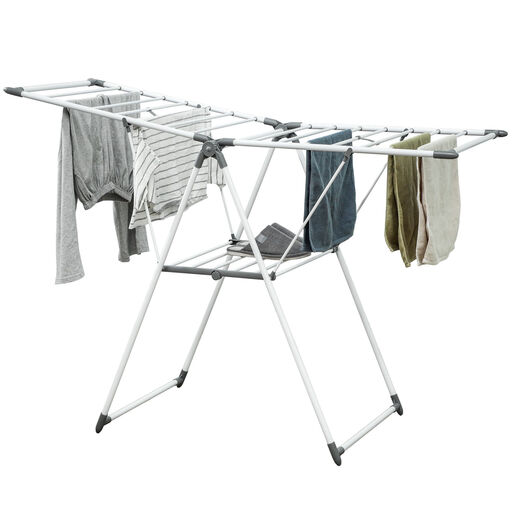 Image unavailable
An unheated option for air-drying a few sports tops at different heights.
Joybuy's product information lists dimensions of 156,5 × 61,5 × 97 cm and a folded depth of 8 cm. Check that the dimensions when open will fit your drying space.
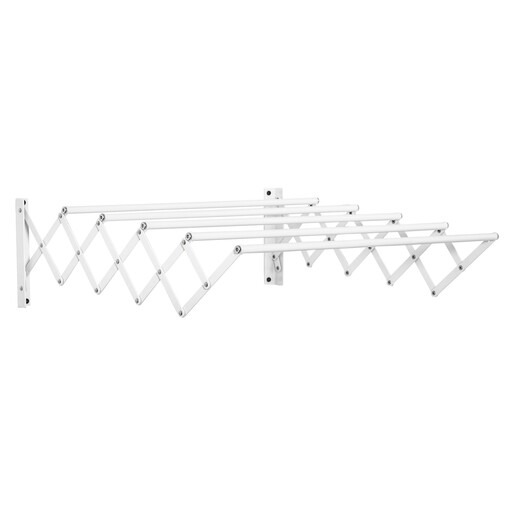 Image unavailable
An unheated airer for anyone who wants to air-dry clothes but has limited floor space.
Joybuy's product information lists dimensions of 63,5 × 60 × 20 cm, five rails and a total load capacity of 10 kg. Wall mounting is required, so check the fixing point beforehand.
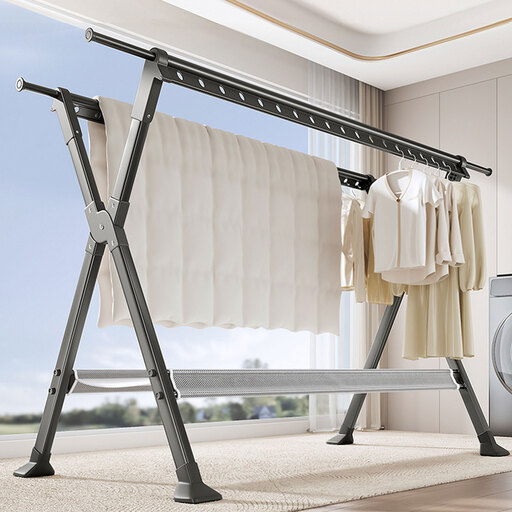 Image unavailable
An unheated option with hanging holes and a drying net for small items.
Joybuy's product information lists 42 hanging holes and an adjustable length of 53,5 to 90,6 inch. The airer can be stored flat; bear in mind how much space it needs when extended.
 Image unavailable
This model is for anyone who wants to use heat for small loads; first check that your sports tops' care labels allow it.
Joybuy's product information lists 230 W, dimensions of 144 × 53 × 91 cm and a heat range of 45–55 °C. It's described as suitable for indoor use on a stable, level surface, with ventilation and at least 31 cm clearance from walls. Check the CE marking on the specific product before buying; according to the NVWA, this is required for electrical consumer products sold in the Netherlands.
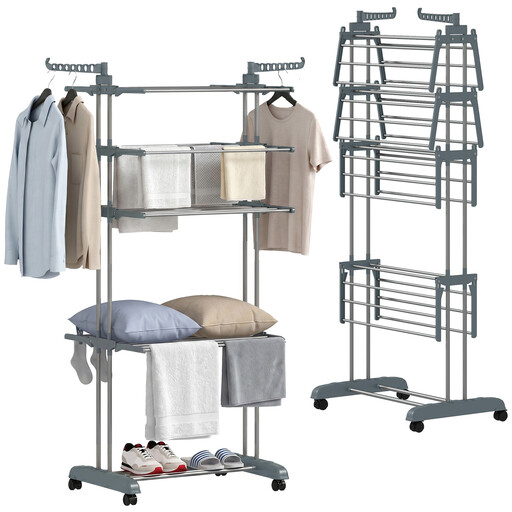 Image unavailable
An unheated tower-style option for anyone who wants to dry clothes across several levels.
Joybuy's product information lists dimensions of 73 × 64 × 172 cm, two side wings and four wheels, two of which are lockable. Check that the height and width will fit in your chosen spot.
No, you can't tell from the type of garment alone. Check the care label on the specific top and the airer's instructions. Nike Netherlands recommends air-drying the jerseys discussed; this isn't a universal temperature limit for all sportswear.
Follow the model's manual for positioning, connecting and cleaning it, and make sure moist air can escape. Milieu Centraal emphasises the importance of ventilation at home; heating doesn't replace it.
DOMO lists a power rating of 150 W, or 0,15 kW. If used continuously at its rated power for one hour, it uses 0,15 kWh; multiply this by your actual usage time and electricity tariff. This isn't a measured figure for each drying session.
According to the NVWA, CE marking is required for electrical consumer products sold in the Netherlands. Check the marking on the specific product; the general requirement doesn't confirm that a particular product carries it.
Contact the seller. According to the Dutch government, you're entitled to a product that works properly, and there is no fixed statutory guarantee period in the Netherlands. A manufacturer's guarantee doesn't replace your statutory rights.