
Anyone who wants to follow the drying instructions
Check the drying symbols first. If a cover needs to dry flat, look for a flat support that’s large enough; heated bars aren’t necessarily suitable.


Always check the cushion cover’s care label first, then choose an airer that can support it safely, either hanging or flat. A heated airer may suit you if you want extra warmth indoors and the cover’s care label and the instructions allow it; an unheated airer is an option if you don’t need heat. With either type, consider the moisture in the room. If you choose a heated model, check the relevant safety information.
Check the drying symbols first. If a cover needs to dry flat, look for a flat support that’s large enough; heated bars aren’t necessarily suitable.
Check the usable drying areas and the space between the covers. An airer’s overall dimensions don’t tell you how large each individual area is.
Compare the airer’s open and folded dimensions with the space you have available. Also consider ventilation when drying wet textiles indoors.
A good fit if: you want to spread out several covers and have room for the airer when it’s fully open.
Keep in mind: heating uses electricity and doesn’t remove moisture from the room. Also, the overall width doesn’t necessarily mean there’s one large drying area.
A good fit if: floor space is limited and the cover fits on the available bars or shelves.
Keep in mind: a compact airer won’t necessarily have enough space to lay a large cover flat.
A good fit if: the care label says to dry the cover flat, you don’t need extra heat or you want to avoid using electricity for the airer.
Keep in mind: moisture still needs to be removed from the room when drying indoors; check that the shelf or drying mesh is large enough.
Measure the cover and check the care label to see how it should be positioned for drying before choosing an airer. For electrical products within the applicable voltage limits, the Netherlands Food and Consumer Product Safety Authority sets out the relevant safety requirements and CE marking; check this information for the specific model.
| What to consider | What to look for | Who this matters to |
|---|---|---|
| Drying instructions | Read the care label and check that the airer supports the recommended drying position. | If your cover needs to dry flat, look for a suitable supporting surface rather than a few bars; around 33% of consumers say drying instructions are their main purchasing consideration. |
| Usable drying area | Measure the cover and compare it with the individual drying areas and the airer’s dimensions when open. | If you want to dry several or large covers with space between them, each usable area matters; around 27% of consumers prioritise having enough drying space. |
| Moisture indoors | Assess the room’s ventilation and leave space between the covers. | If moisture levels in the drying area are a concern, consider the air circulation too; around 20% of consumers say moisture control is their main need. |
| Storage and electricity use | Compare the open and folded dimensions, and check the stated power rating and how long you expect to use the airer. | If you want to put the airer away after the change of season or limit electricity use, factor this into your choice; around 20% of consumers prioritise storage and electricity use. |
Milieu Centraal notes that poor ventilation can allow moisture to build up in the home. Heated bars don’t remove moisture from the room, so treat ventilation as a separate consideration when drying indoors.
A cover may be larger than an individual drying area or side wing, even if the airer looks wide enough overall.
Compare the cover’s dimensions with each usable drying area, not just the overall dimensions of the airer when open.
When you dry clothes indoors, moisture is released into the air. A heated airer doesn’t automatically have a function that removes it.
Assess the room’s ventilation separately, and choose a heated airer only if it suits your drying method and space.
A similar name or photo doesn’t confirm that the plug, electrical specification, accessories and terms are the same.
Before buying, check the full model identity and the version you intend to use.
DOMO describes the DO7117DR as a slim heated airer that can be used freestanding or wall-mounted.
The ClassiDry is a foldable heated airer with bars.
The K120 is a heated airer marketed as a compact model.
Brabantia also describes unheated airers with shelves for delicate laundry that needs to dry flat.
Leifheit describes the Pegasus Ultra Mobile as having a drying mesh for flat drying.
Below you’ll find a heated winged airer and a range of unheated airers. Compare the usable drying area with your cover, and consider whether extra heat suits your drying method.
 No image available
The wings may suit you if you want to spread out several covers and have enough floor space. Before use, check the relevant safety information and guidance on contact with heated surfaces.
The airer folds away. Stated power rating: 230 W. Dimensions: 144 × 53 × 91 cm. Maximum recommended load: 10 kg. These are the airer’s overall dimensions, not the size of a single drying area.
Follow the instructions for positioning the airer and keep the specified distance from walls. Ventilate the room when drying indoors.
 No image available
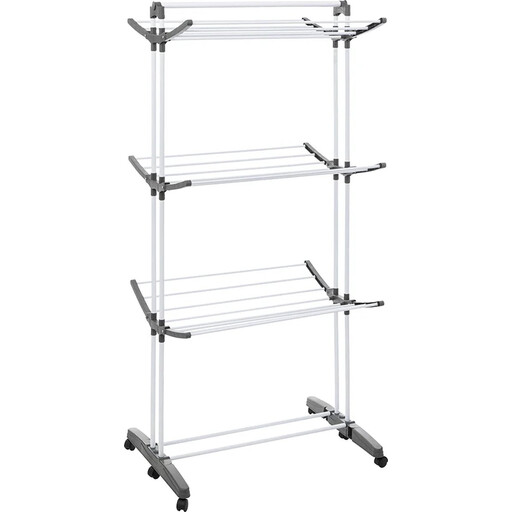
An unheated airer to consider if you don’t need extra heat; measure the individual drying area before laying a large cover on it.
Stated drying length: 24 m. Dimensions: 125 × 62 × 172 cm. The frame folds away, has wheels and requires self-assembly.
 No image available
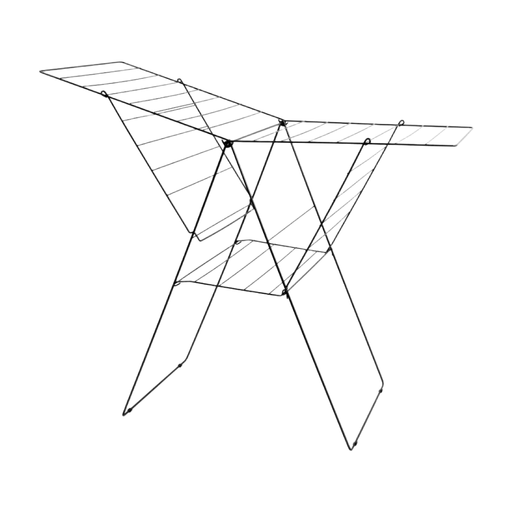
A freestanding, foldable airer to consider if you want to put it away after use; check that the cover fits on the available drying areas.
Stated drying length: 20 m. Dimensions when open: 95 × 128.5 × 59 cm. Fully open the airer on a level surface before use.
 No image available
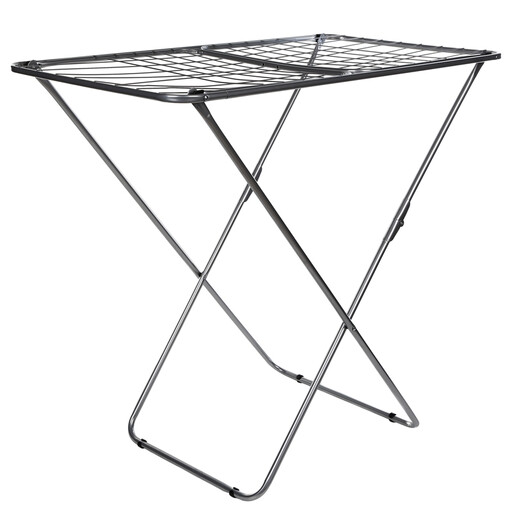
An unheated airer to consider if you’re looking for a foldable option; separately check that the cover will have enough support.
Stated drying length: 18 m. The product information describes a metal and plastic construction and assembly without tools.
 No image available
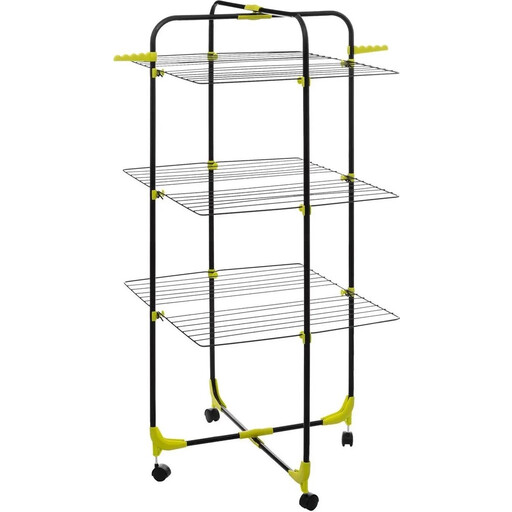
The multiple drying areas may be useful if you want to spread out different items of laundry; check that a cushion cover will actually fit on an individual area.
Stated drying length: 30 m. The product information specifies three overlapping drying areas, wheels and a maximum load of 15 kg. Self-assembly is required.
Don’t assume these drying methods are interchangeable. The drying symbol tells you how to position the cover. Choose a suitable supporting surface and check the cover’s and airer’s guidance on contact with heated surfaces too.
Yes. The airer’s heat doesn’t remove moisture from wet textiles from the room. Milieu Centraal notes that poor ventilation can allow moisture to build up in the home.
Follow the chosen model’s instructions on surfaces, clearance, connection, switching off and cleaning. The Netherlands Fire Service advises allowing electrical appliances to dissipate heat, so follow the model-specific positioning instructions.
Use the stated power rating and your actual usage time to calculate energy consumption; you’ll also need your own electricity tariff to work out the cost. For purchases made by consumers in the Netherlands, statutory consumer protection applies alongside any manufacturer’s guarantee. If a product doesn’t perform as you could reasonably expect under normal use, the seller must resolve the issue in line with the applicable terms.
According to the Netherlands Food and Consumer Product Safety Authority, electrical products within the applicable voltage limits must meet safety requirements and carry the required CE marking; CE marking isn’t proof of independent testing. For a standard online consumer purchase, there is generally a statutory cooling-off period of up to 14 days after delivery, subject to legal exceptions.