Who is this buying guide for?

Student dealing with airborne fluff

You want to tell the difference between fluff still floating in the air and fluff that has already settled on surfaces before buying a device. The US Environmental Protection Agency and the Consumers’ Association (Consumentenbond) offer background information to help you weigh up your options.

Light sleeper with a single room

You use the same room for studying and sleeping, so noise, indicator lights and cleaning at a usable setting all matter when choosing a device. The Consumers’ Association discusses what to consider when using one in a bedroom.

Student short on space and working to a budget

You’ll need to make room for the device and factor in the ongoing cost of a suitable replacement filter, not just the purchase price. The Consumers’ Association discusses room size and filter choice, and its bedroom advice also covers using an air purifier while you sleep.

What should you look for when buying?

What to consider What should you check? Who is this important for?
Capturing airborne fluff Check that the device has a particle filter and useful airflow. You’ll need to remove any fluff that has already settled separately. If my main aim is to reduce fluff that’s still airborne, and I don’t expect a device to replace cleaning, this is my first consideration. Around 33% of consumers say capturing fluff is their main buying concern.
Sleeping with the device on Compare the noise and lighting at the setting you plan to use while sleeping; a lower setting may move less air through the filter. If I use the same room for studying and sleeping, I’ll consider noise and light without losing sight of the level of filtration I want. Around 27% of consumers prioritise a good night’s sleep.
Capacity and placement Compare particle CADR in m³/h for the same room size, and check the dimensions and clearance around the air inlet and outlet. In a small room, I want enough airflow without losing a useful spot to an awkwardly placed device. Around 20% of consumers give room suitability top priority.
Ongoing use Check the exact replacement filter number and the stated power consumption for the way you plan to use the device. If I plan to use the device regularly, I want to know in advance which replacement filter it needs and how much power it uses. Around 20% of consumers put running costs first.

Common buying mistakes

  • Expecting an air purifier to remove visible fluff from everywhere

    A device treats the air that passes through it; larger particles may already have settled on bedding, clothes, the floor or furniture.

    Tackle the source in your textiles and remove settled fluff separately. Think of the air purifier as an extra measure only.

    You’ll still need to clean surfaces and tackle the source of the fluff.

  • Choosing based only on filter type or stated room size

    A fine filter alone doesn’t tell you how quickly the air in the room will be cleaned. Manufacturers may also use different assumptions when stating the room size a device can handle.

    Compare airflow or particle CADR, room size and noise at the setting you plan to use.

  • Checking replacement filters or ionisation only after buying

    A particle filter will eventually need replacing. With some ionisation systems, particles can settle on furniture instead of being caught in a filter; the Consumers’ Association discusses this point.

    Before buying, check the exact filter number and find out what any ionisation function does.

    Replacing filters can mean ongoing maintenance; some ionisation systems may also mean more surface cleaning.

Brands to compare

IKEA

IKEA says the UPPÅTVIND is ideal for 7 m² at five air changes per hour. For the FÖRNUFTIG, IKEA gives a maximum coverage of 8–10 m², depending on the fan setting.

  • The two models offer different placement options: according to IKEA, the FÖRNUFTIG can stand on the floor or be wall-mounted.
  • IKEA says the carbon filter for the FÖRNUFTIG is sold separately. Compare the stated coverage with the size of your room.

Xiaomi

Xiaomi lists a particle CADR of 230 m³/h, a fine-particle sensor and app control for the Smart Air Purifier 4 Compact. Xiaomi gives coverage of 48 m² based on two air changes per hour, as well as an effective coverage area of 16–27 m².

  • The stated capacity and app control give you concrete points to compare with your room size and needs.
  • The two coverage figures use different definitions, so don’t treat them as directly comparable room-size claims.

WINIX

WINIX lists a CADR of 250 m³/h, a pre-filter and a combined filter set for the ZERO Compact.

  • A pre-filter and the stated capacity are useful points to consider when comparing models.
  • The model also has PlasmaWave ionisation. Consider this feature separately: the Consumers’ Association explains that, with some ionisation systems, particles can settle on furniture.

Philips

For the refurbished PureProtect Mini AC0921/14R1, Philips lists a CADR of 250 m³/h, a sleep mode and replacement filter FY0900/30.

  • The stated sleep mode and specific filter number are useful points of comparison.
  • The AC0921/14R1 is a refurbished model. Don’t assume it’s the same as the new AC0921/14 without checking.

Air purifiers at Joybuy

These models are for anyone looking to filter particles from the air as well as tackle the source and clean surfaces. Compare the stated airflow and sleep mode with your room and how you plan to use the device. For the exact model, also check the CE marking and EU Declaration of Conformity.
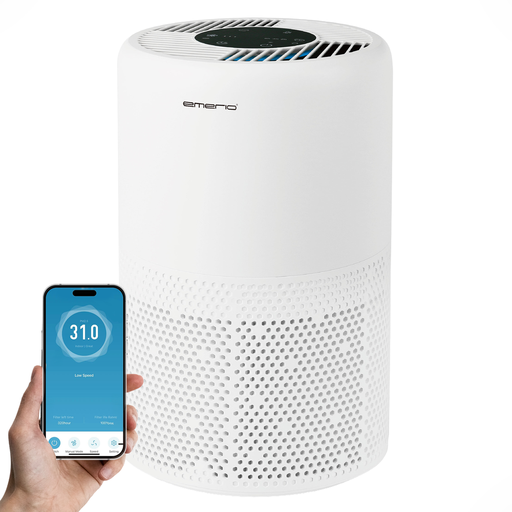
Emerio AP-132324 air purifier

Emerio AP-132324 air purifier

Worth comparing if you’re looking for a particle filter and a stated sleep mode for a room where you also sleep.

HEPA 13 and carbon filters; airflow up to 221 m³/h; 26 dB sleep mode; app control; stated coverage of 25 m². The main filters are recommended for replacement approximately every 6–8 months.

View at Joybuy
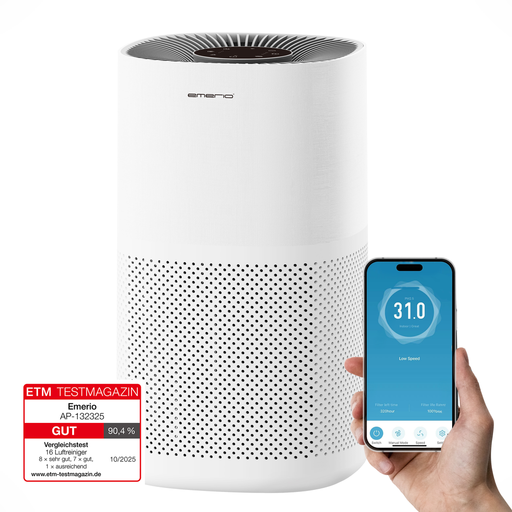
Emerio AP-132325 air purifier

Emerio AP-132325 air purifier

Worth comparing if higher stated airflow, a sleep mode and a dimmed display are important to you.

HEPA 13 and carbon filters; airflow up to 374 m³/h; PM2.5 sensor; 26 dB sleep mode; app control; stated coverage of 45 m². The description recommends replacing the filters every 6–8 months.

View at Joybuy

Philips PureProtect Mini 900 Series AC0921/14

Philips PureProtect Mini 900 Series AC0921/14

Worth comparing if you’re looking for a stated particle CADR and a sleep mode for use beside your bed.

Particle CADR 250 m³/h; two-layer HEPA filtration system; 20.5 dB(A) sleep mode; dimmed indicator lights and filter replacement indicator.

View at Joybuy
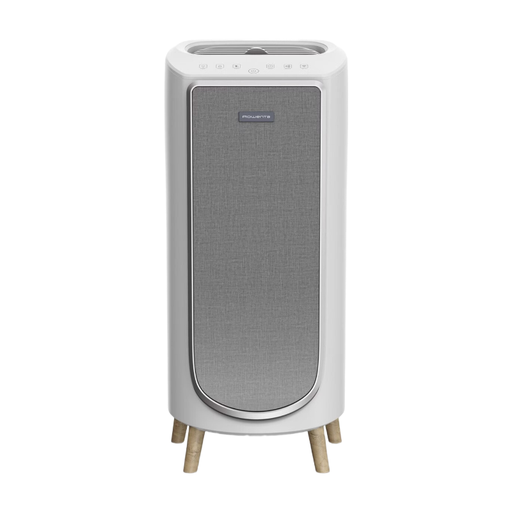
Rowenta PU6180 Intense Pure Air Home air purifier

Rowenta PU6180 Intense Pure Air Home

Worth comparing if you want to weigh a stated particle CADR and several filter types against your room and how you’ll use the device.

Particle CADR 360 m³/h; HEPA, carbon and nano filters; night and quiet modes; 32 dB(A) on the lowest setting.

View at Joybuy
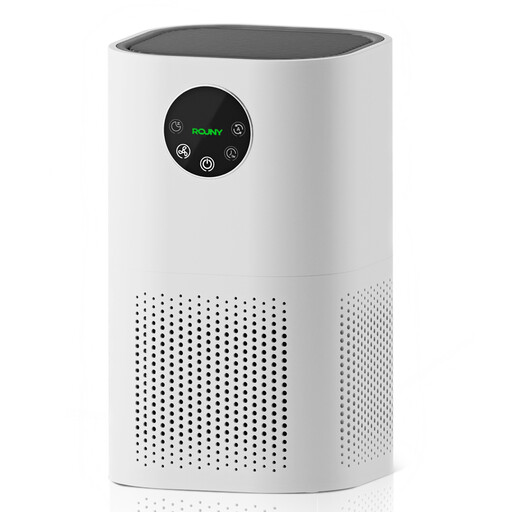
ROUNY AP-T1 air purifier

ROUNY AP-T1 air purifier

Worth comparing if you’re looking for a stated sleep mode and four fan speeds.

HEPA H13 filter; CADR 150 m³/h; four fan speeds; sleep mode up to 25 dB; stated coverage of 20–50 m². The description recommends replacing the filter every 6–8 months.

View at Joybuy

Frequently asked questions

Can an air purifier help with fluff that has already settled on furniture?

No. An air purifier processes the air that passes through it, so you’ll need to remove fluff that has already settled separately. Don’t expect filtration to replace cleaning.

Where should you put an air purifier in a small room?

Position the device so the air inlet and outlet aren’t blocked, and follow the instructions for your model. The Consumers’ Association advises against putting an air purifier in a corner and recommends leaving at least 20 cm of clearance around it, unless the instructions say otherwise.

Can you clean a particle filter instead of replacing it?

Follow the instructions for the exact filter. The Consumers’ Association points out that particle and carbon filters eventually need replacing. IKEA separately states that the pre-filter for the UPPÅTVIND can be cleaned with a vacuum cleaner.

What product safety rules apply to an electric air purifier in the Netherlands?

According to the Dutch Ondernemersplein business information service, electrical appliances must meet the relevant European requirements. After carrying out a conformity assessment, the manufacturer applies a CE marking and draws up an EU Declaration of Conformity. Check this for the exact model you plan to buy.

Is an ozone generator an alternative to a filter?

No. An ozone generator isn’t a suitable solution for fluff in an occupied student room: the US Environmental Protection Agency explains that ozone generators deliberately produce ozone. An ionisation function isn’t the same as an ozone generator; check what the feature does to particles and bear in mind the points raised by the Consumers’ Association.
