
Someone with pollen symptoms in one room
Primarily wants to filter airborne particles in the room where they spend a lot of time. The room’s size and the purifier’s airflow are important factors to consider.


Start by choosing the room you want to treat, then compare the stated airflow, the noise level on the setting you plan to use and the space needed for placement. A compact model may suit one very small room; for a larger room, it may be worth comparing a model with a higher stated capacity. Filtration is an addition to ventilation and is not proven to guarantee fewer hay fever symptoms, according to the Consumers’ Association.
Primarily wants to filter airborne particles in the room where they spend a lot of time. The room’s size and the purifier’s airflow are important factors to consider.
Wants to filter the bedroom without disruptive noise or light, so considers how well the purifier cleans the air on a setting that’s also suitable for use at night.
Is looking for a purifier that fits in one small room and also wants to know which replacement filter is needed and what that means in terms of running costs.
Suitable if: you mainly want to treat one small room and have limited space. IKEA states that the FÖRNUFTIG covers up to 8–10 m², depending on the fan speed.
Keep in mind: this stated room size does not automatically apply to the whole flat and also depends on the setting you choose.
Suitable if: you want to compare options for a larger room based on their stated capacity. WINIX lists 250 m³/hour for the ZERO Compact; Philips lists 300 m³/hour for the AC1715/11.
Keep in mind: these are manufacturer figures; they don’t show how quiet a purifier will be in your room or how much it may reduce pollen symptoms.
Suitable if: you want to address existing ventilation and potential sources of pollen before choosing a purifier.
Keep in mind: filtration does not replace the supply of fresh air from outside; at most, think of an air purifier as an addition for one chosen room.
The Consumers’ Association warns that stated room sizes can be difficult to compare. Measure your room and consider capacity, noise and placement together.
| Factor to consider | What to look for | Who is this important for? |
|---|---|---|
| Filtration in your chosen room | Measure the room and compare particle CADR in m³/hour; keep manufacturer figures separate from independently measured performance. | If I mainly want to filter pollen in the room where I spend a lot of time, I want to be able to assess the capacity for that space. Around 40% of consumers prioritise adequate filtration there. |
| Comfort while sleeping | Compare noise and airflow on the same operating setting, and check whether the lights can be switched off or dimmed. | If you want to run the purifier in your bedroom at night, pay particular attention to noise and light without overlooking which setting is suitable for use. Around 30% of consumers prioritise sleeping comfort. |
| Placement | Check the dimensions, the clearance around the purifier and the stated room size for each setting. | If I have limited floor space, I want to know whether the purifier will fit where I want to put it and whether it’s suitable for that room. Around 20% of consumers give placement the highest priority. |
| Replacement filters | Look up the exact filter part for the full model number and check the replacement instructions. | If you plan to use a purifier regularly, you’ll want to know in advance which replacement filter you need and how often the instructions say to replace it. Around 10% of consumers prioritise ongoing filter costs. |
Air has to pass through the purifier. Filter efficiency alone doesn’t tell you how much air in your room will be treated.
Measure the room and compare the stated particle CADR and, where available, independently measured performance.
A lower fan speed may provide a different airflow from the setting used to calculate a capacity claim.
Compare the noise level and airflow on the setting you actually plan to use.
A replacement filter is part of maintenance, and electricity use also affects running costs.
Before buying, look up the exact replacement filter and the instructions for your specific model.
Filtration doesn’t remove every substance from indoor air or replace the supply of fresh air from outside.
Keep ventilating and, if needed, use filtration as an addition in the room you’ve chosen.
The FÖRNUFTIG is a compact particle-filter model for one very small room. For the Dutch version, IKEA states a coverage area of up to 8–10 m², depending on fan speed.
For the ZERO Compact, the manufacturer lists a HEPA filter, a CADR of 250 m³/hour and coverage of up to 50 m².
For the 1000i Series AC1715/11, Philips states a CADR of 300 m³/hour.
These products are options to compare for particle filtration in one chosen room. Assess the stated capacity for the room itself; a stated room size does not mean coverage of the whole flat.
 No image available
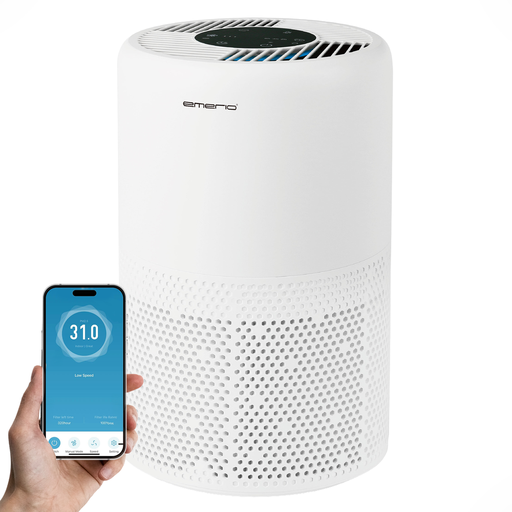
Worth comparing if you want to weigh up a stated room size and airflow for one room.
The product information lists HEPA 13, an airflow of 221 m³/h, three fan speeds and a stated room size of up to 25 m².
The stated noise level ranges from 26–52 dB; compare this with the fan speed you want to use at night.
 No image available
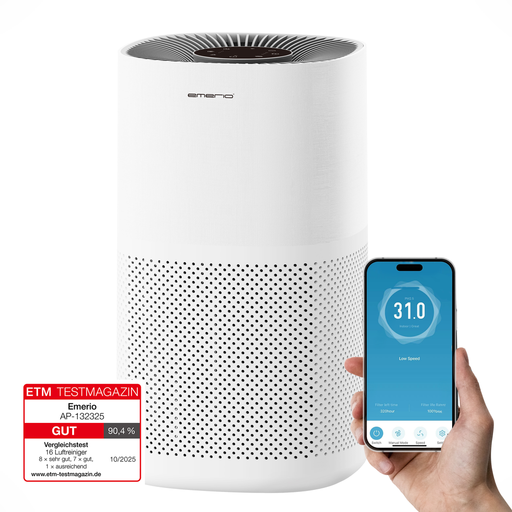
Worth comparing if you want to match the stated capacity to the airflow and a sleep setting for your chosen room.
The product information lists HEPA 13, an airflow of 374 m³/h, four fan speeds and a stated room size of up to 45 m².
The stated noise level in sleep mode is 26 dB. Filter replacement is described as approximately every 6–8 months, depending on use.
 No image available
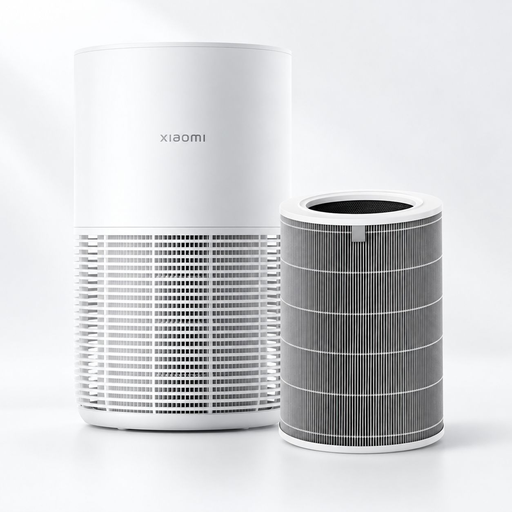
Worth comparing if you want to weigh up the stated CADR and coverage for the room you want to filter.
The product information lists a three-layer filter with HEPA and carbon, a CADR of 230 m³/h and stated coverage of 16–27 m².
Assess the stated coverage for your own room, not as coverage for the whole flat.
 No image available
Worth comparing if you want to weigh up capacity and noise levels for filtration in one chosen room.
The product information lists a two-layer HEPA filter, a PM2.5 sensor and a CADR of 250 m³/h.
It measures 23,8 × 24 × 36,4 cm and has a noise range of 20,5–49 dB(A). Filter replacement is generally recommended after approximately 12 months, depending on use.
 No image available
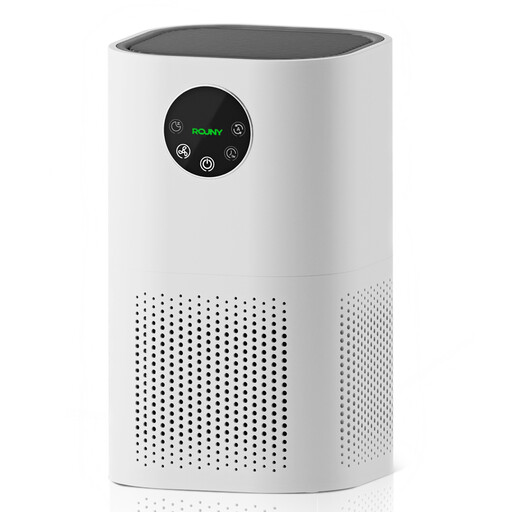
Worth comparing if you want to consider the stated airflow and a sleep setting for a chosen room.
The product information lists an H13 True HEPA filter, a CADR of 150 m³/h, four fan speeds and a stated range of 20–50 m².
The stated noise level in sleep mode is a maximum of 25 dB; assess the stated range for your own room, not the whole flat.
Don’t assume it can: portable air purifiers are designed for one room or space, according to the US Environmental Protection Agency. Choose the area where filtration matters most to you and assess the capacity for that room.
No, a reduction in hay fever symptoms isn’t guaranteed. The Consumers’ Association says there is no scientific evidence that air purifiers help with hay fever; a panel’s reported experience of relief does not prove a causal effect.
Follow the instructions for your specific model regarding the clearance around the air inlet and outlet. Check which replacement filter matches the full model number and replace it according to the instructions; don’t assume a particle filter is washable.
The relevant European safety requirements apply to electrical equipment sold in the Netherlands. According to Business.gov.nl, manufacturers must draw up an EU declaration of conformity and affix the CE marking to equipment that meets the applicable requirements. CE is not an independent assessment of pollen filtration.
You can expect a product to do what you could reasonably expect of it when used normally. ACM ConsuWijzer says that if a product is faulty, the seller is responsible for providing an appropriate free solution, such as a repair, replacement or refund; this is not simply a fixed two-year period.