What should you look for when buying?
The US Environmental Protection Agency advises choosing a CADR suited to the room size. The Consumers’ Association notes that manufacturers’ maximum room-size claims can be difficult to compare like for like.
| What to consider |
What should you check? |
Which consumers? |
| Capacity for your living room |
Compare the particle CADR in m³/h with the actual size of your room and check the placement instructions. |
If I want to purify the air in one large living room, I look for a capacity suited to that space. Around 36% of consumers say living-room capacity is their top priority. |
| Capturing airborne pollen |
Check whether the model has a particle filter and compare its CADR with any claims about filter efficiency. |
If filtering pollen from the air is my priority, I look at both the filtration and how quickly the appliance cleans the air. Around 29% of consumers say pollen filtration is their top priority. |
| Noise during use |
Check the noise level at the stated fan setting and consider which setting you would want to use every day. |
If I want to leave the air purifier running while I’m in the living room, I want to know how noisy the required setting is. Around 21% of consumers say noise during use is their top priority. |
| Replacement filters and maintenance |
Check the exact filter model, the recommended replacement interval and whether the right filter is available. |
If I want to keep filter maintenance simple, I check in advance which filter fits the appliance. Around 14% of consumers say maintenance is their top priority. |
Air purifiers at Joybuy
These product options are relevant to filtering pollen in living spaces. Compare the stated CADR, filter type and usage features for each model; a stated floor area is not automatically directly comparable with that of another model.
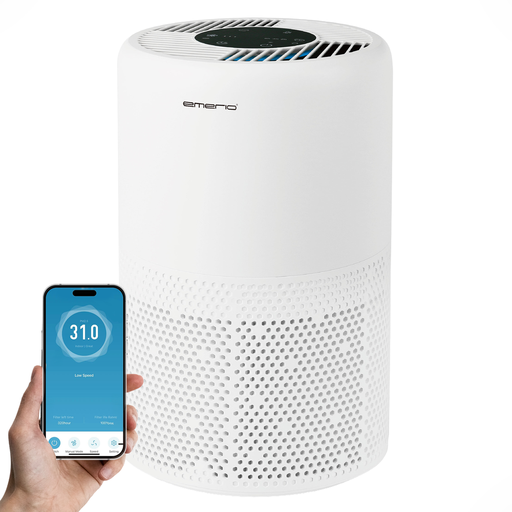 Image unavailable
Emerio AP-132324 air purifier
Could suit anyone looking to filter pollen who also wants app control and a choice of fan settings; check that the stated room capacity is right for your living room.
The Joybuy product description lists a HEPA 13 filter, a carbon filter and use in rooms up to 45 m². The stated airflow is 374 m³/h and is not a CADR.
The description also mentions four fan speeds, a sleep mode and filter replacement advice. An ioniser is listed; assess this feature separately, as the general EPA warning about ionisers does not establish that this model emits ozone.
View on Joybuy
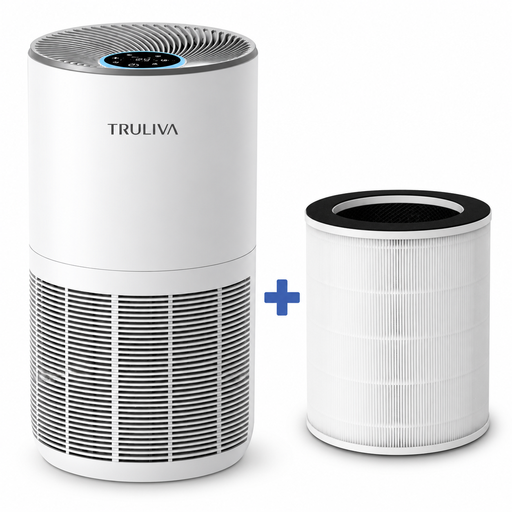 Image unavailable
TRULIVA air purifier, 450 m³/h CADR
An option to compare if a stated CADR and an extra replacement filter are important to you; compare the stated room size with the dimensions of your living room.
The Joybuy product listing gives a CADR of 450 m³/h, an H13 True HEPA filter and one extra replacement filter. The description says it is suitable for rooms of 32–55 m².
The product title also mentions a three-stage filtration system, a PM2.5 display, a timer and a sleep mode.
View on Joybuy
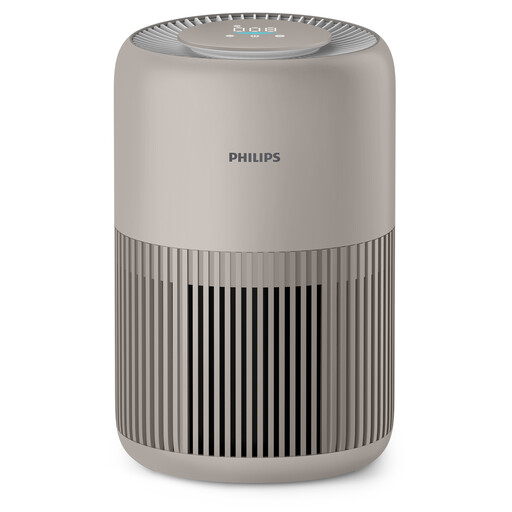 Image unavailable
Philips PureProtect Mini 900 Series AC0921/14
Could be worth considering if you’re looking for a compact model with a sleep mode; compare its CADR with the needs of your large living room before relying on a room-size claim.
The Joybuy product title lists a CADR of 250 m³/h and a two-layer HEPA filter. The product description states a maximum room size of 65 m², and mentions a PM2.5 sensor and automatic mode.
The description gives a noise level from 20.5 dB(A) in sleep mode and says to replace the filter when prompted by an indicator.
View on Joybuy
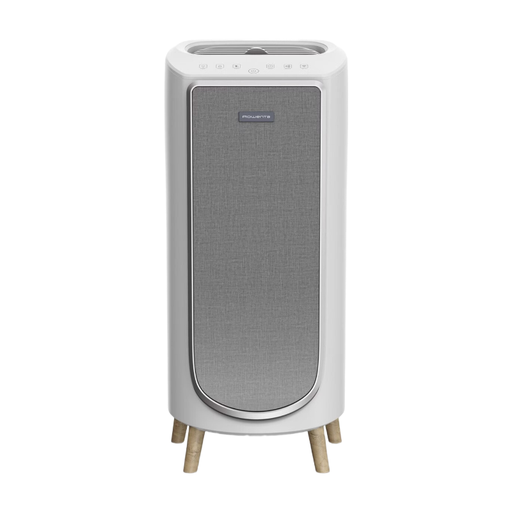 Image unavailable
Rowenta PU6180 Intense Pure Air Home
A model to include in your comparison if HEPA filtration and automatic adjustment to pollution levels match what you’re looking for.
The Joybuy product description lists a CADR of 360 m³/h, four settings and the ability to clean a 20 m² room in 8 minutes.
The description gives a noise level from 32 dB(A) on quiet mode and says the purifier can be controlled via Wi-Fi and an app. Check that the stated noise level suits how you plan to use it.
View on Joybuy
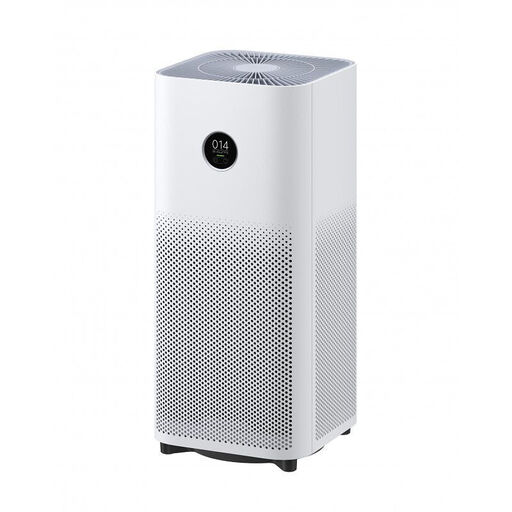 Image unavailable
Xiaomi Smart Air Purifier 4 Pro
An option to compare if a higher stated particle CADR and air-quality information are important to you; also check the noise level at the setting you plan to use.
Xiaomi Netherlands lists a maximum particle CADR of 500 m³/h for this model. The Joybuy product description mentions a three-stage filtration system, automatic mode and an OLED display.
The Joybuy product description also mentions Wi-Fi and app control, as well as air-quality information. Xiaomi describes a compatible replacement filter for this model.
View on Joybuy
Frequently asked questions
Do I still need to ventilate when using an air purifier?
Yes. The RIVM describes ventilation as replacing indoor air with outdoor air; an air purifier does not do this. When pollen levels are high, you can take Thuisarts’ advice about opening windows on sunny, windy days into account without stopping necessary ventilation.
How do I choose the right capacity for a large living room?
Compare the particle CADR in m³/h with the dimensions of your living room and check which fan setting is needed. The US Environmental Protection Agency advises matching the CADR to the room size; according to the Consumers’ Association, maximum room-size claims from different manufacturers are not always easy to compare.
Where should I put an air purifier in the living room?
Follow the clearance requirements in the manual for your chosen model. The Consumers’ Association advises against placing the appliance in a corner and recommends leaving at least 20 cm of clear space around it, unless the manual says otherwise.
What should I look for in replacement filters?
Check the exact filter model and the recommended replacement interval for your air purifier in advance. Xiaomi lists a compatible filter for the Smart Air Purifier 4 Pro and recommends replacing it every 6–12 months, depending on use; this interval does not automatically apply to other models.
Is an ozone generator a suitable alternative for filtering pollen?
An ozone generator is not an equivalent replacement for a particle-filtering air purifier. The US Environmental Protection Agency warns that ozone generators deliberately produce ozone and describes ozone as irritating to the lungs; this safety information does not address Dutch legal requirements for selling these products.


