
Vandaag of morgen in huis

Kwaliteit gegarandeerd

Welkomstaanbiedingen ontgrendelen: GRATIS bezorging | Tot 80% korting | Gratis 30 dagen JoyPlus-proefperiode
Download de app
An air purifier for large rooms needs to do more than simply move air around. In a spacious living room, open-plan kitchen or dusty bedroom, the key things to consider are the room size, airflow, filter and noise level. If you go by claims such as ‘large capacity’ or ‘HEPA filter’ alone, you could end up with a unit that treats too little air per hour in practice, or becomes expensive to maintain.
These points will help you assess marketing claims and choose a model that suits your home.
A stated room size tells you little without information about the number of air changes per hour. For example, a unit might be described as suitable for a large room based on one air change per hour, while a smaller room may need several air changes to make a noticeable difference to air circulation.
So always check the CADR rating: the amount of filtered air the unit delivers in a given time. Also check whether the manufacturer uses square feet or square metres. 1190 ft² is about 110 m², but that doesn’t automatically mean the air is cleaned five times an hour.
According to its product specifications, an air purifier with a HEPA H13 filter can filter very small particles from the air. This makes the filter grade relevant for dust and pollen. However, performance in the home also depends on airflow, how well-sealed the room is and replacing the filter on time.
Before you buy, check:
The Jafanda model lists a filter lifespan of 3000 hours. According to the product information, the composite filter must not be washed or reused.
A ‘quiet air purifier’ is often judged by its lowest noise level. At the highest setting, the noise level may be considerably higher. So check the full range, especially if you plan to use the unit in a bedroom or home office.
The Jafanda JF260S lists 20 dB at low speed, 23 dB in sleep mode and a maximum of 53 dB. This gives you a more realistic picture than the lowest figure alone.
For a large room, CADR is a useful place to start. According to its product specifications, the Jafanda has a CADR of 260 m³/h. Its stated coverage is:
For a Dutch living room of, say, 40 to 60 m², it’s worth checking which air-change rate applies. An open-plan kitchen, high ceilings or lots of furniture can also affect air circulation.
An air purifier with activated carbon is particularly useful if you want to reduce smoke, cooking smells or other odours. Activated carbon works differently from a particle filter. The carbon layer becomes saturated over time, so it needs to be replaced along with the filter.
According to Jafanda’s product information, the unit uses a three-stage filter system with an H13 filter and a layer of 300 grams of activated carbon. Treat this as a product specification, not a guarantee that every odour will disappear completely.
An air purifier with a PM2.5 monitor displays the measured concentration of fine particles in your indoor air. This can help you track changes after cooking, vacuuming or airing out the room. However, a sensor measures the air where the unit is positioned, so its reading won’t necessarily represent every room in your home.
According to the product description, the Jafanda has a built-in PM2.5 sensor, an automatic mode and five fan speeds. The manufacturer says you can use the app to monitor air quality and set schedules. The product specifications also state that it works with Alexa and Google Assistant.
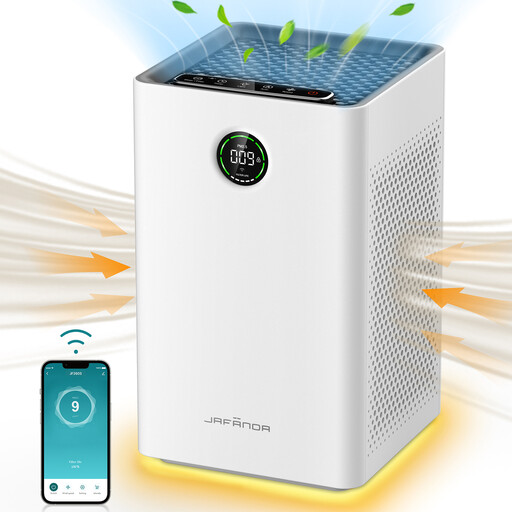
Why it suits this profile: This model combines a clear CADR specification with an automatic mode, a PM2.5 display and app control. That makes it a straightforward choice if you’re buying an air purifier for the first time.
The product specifications give both the CADR and different air-change rates. This makes it easier to check whether the capacity suits your room.
CADR of 260 m³/h; five speeds; PM2.5 monitor; stated filter lifespan of 3000 hours.
Why it suits this profile: The combination of filter information, automatic control, smart features and sleep mode makes it a good fit for households looking for several features in one unit.
The stated figures make it clear that 1190 ft² corresponds to one air change per hour. This helps you avoid relying on the largest figure without context.
According to Jafanda’s own product information: H13 composite filter, 300 grams of activated carbon, Wi-Fi app, Alexa and Google Assistant control.
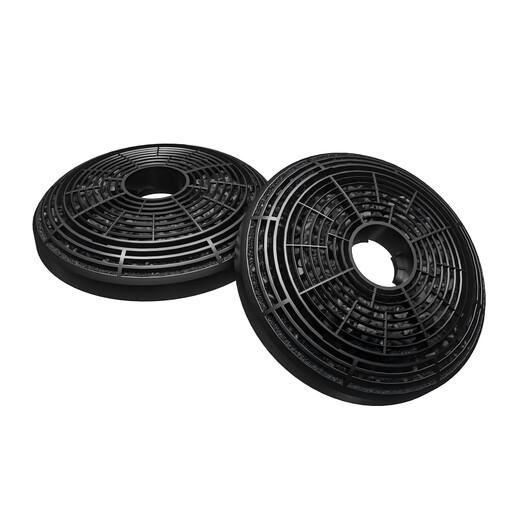
Why it suits this profile: This isn’t a replacement for an air purifier, but it’s an additional option for anyone looking to tackle cooking smells and smoke in the kitchen with a suitable cooker hood.
Compatibility is specified for certain Ciarra cooker hoods. Check your model before ordering.
Activated carbon filter; dimensions 11 × 11 × 4 cm; tool-free replacement according to the product information.
We’ve put together a complete, up-to-date list of products that meet these strict selection criteria and the applicable European safety regulations.
Don’t just look at the number of square metres. Focus on the combination of CADR and the air-change rate you need. Use the stated capacity at one, two or five air changes as a comparison point. A higher airflow may be more practical in an open-plan living room with a kitchen than in an enclosed room.
That depends on how often you use the unit, the amount of dust in the air and the product specifications. Jafanda lists a filter lifespan of 3000 hours, but this is a stated guideline. Check the filter regularly and follow the instructions. A saturated activated-carbon layer may be less effective at tackling odours.
Energy use depends on the power rating and the speed you choose. Jafanda lists a rated power of 32 watts and standby consumption of less than 0,5 watts. Remember to factor in the cost of replacement filters too. A unit that uses little electricity but has expensive or hard-to-find filters may be less practical in the long run.
