
Vandaag of morgen in huis

Kwaliteit gegarandeerd

Welkomstaanbiedingen ontgrendelen: GRATIS bezorging | Tot 80% korting | Gratis 30 dagen JoyPlus-proefperiode
Download de app
A stuffy living room in summer, the sniffles from hay fever in spring, or simply the desire for fresh, clean air all year round. The quest for a comfortable indoor climate quickly leads to an air purifier fan. These 2-in-1 devices promise both cooling and pure air, but the market is saturated with models that overpromise and underdeliver.
As a Product Recommendation Officer at Joybuy, I see the challenges consumers face every day. Many devices become a source of irritation rather than comfort after just a few months. Before you make a choice, it's crucial to recognise the common pitfalls.
This guide will help you cut through the marketing jargon and choose a model that truly makes a difference in your living environment.
To avoid a bad purchase, there are a few technical specifications you can't ignore. These determine whether a device does its job effectively or just becomes an expensive dust collector.
This is arguably the most important metric for anyone looking for an air purifier for allergies. The CADR is expressed in cubic metres per hour (m?/h) and indicates how much clean air the device can produce per hour. A higher CADR means the room is purified of pollen, fine particulate matter (PM2.5), pet dander, and other pollutants more quickly. For an average living room or bedroom, a CADR of 200 m?/h or higher is a good benchmark. Without a decent CADR rating, an air purifier is really just a fan that circulates polluted air, which can actually worsen symptoms like hay fever.
A standard fan oscillates from left to right. A modern air circulator does more. Models with advanced oscillation, like a 360-degree fan, create a three-dimensional airflow. They can pivot both horizontally and vertically, ensuring the cooled and purified air reaches the entire room. This prevents "dead spots" of stagnant, stuffy air and ensures a uniform temperature and air quality. This is especially useful in combination with an air conditioner or heater to distribute the treated air efficiently.
For use in the bedroom, a quiet fan is essential. Manufacturers often advertise low decibel ratings, but always check if this applies to the sleep or night mode. A noise level of 25 to 30 dB in this mode is generally considered very quiet, comparable to a whisper. A device quieter than 30 dB provides cooling and purification without disturbing your sleep.
Based on the criteria above, we've identified which products are a smart choice for different users. Below is a model that aligns well with specific needs.
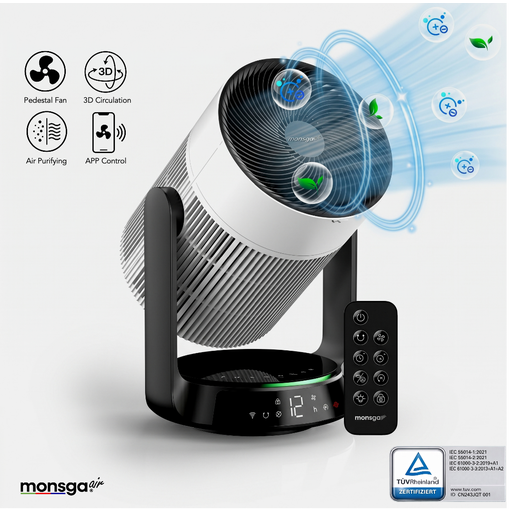
Why This Fits Their Persona: Ideal for apartments where pollen, fine dust, and pet dander accumulate. This device combines powerful purification with air circulation, saving space and proving useful all year round.
This model tackles the 'pointless airflow' pitfall. Its specified CADR of 280 m?/h ensures the air is actually filtered, not just blown around.
The high CADR rating makes it an effective air purifier for allergies and fine dust. The HEPA filter captures the particles that cause symptoms.
Why This Fits Their Persona: For those who want a cool, clean, and above all, quiet bedroom. This device is designed to provide comfort without disrupting sleep.
This model debunks the 'silent' myth. According to the manufacturer, its sleep mode produces a noise level of just 25 dB. This is a verifiable specification, not a vague claim.
The combination of a very low noise level and continuous air purification makes this an excellent quiet fan for the bedroom.
Why This Fits Their Persona: For those who want convenience, control, and advanced features that genuinely improve comfort. A smart fan that's more than just a gadget.
This is no 'smart' gimmick. The control via the Tuya app-enabled fan is functional, and the unique 360-degree fan oscillation is a practical innovation.
Full control via app and remote, combined with a unique 3D airflow for whole-room comfort. The smart features are practical, not superfluous.
We have compiled a complete, real-time list of products that fully satisfy these strict selection criteria and UK safety regulations.
A filter's lifespan depends on usage and the air quality in your home. Generally, it's recommended to replace the HEPA filter every 6 to 12 months. Many smart models, like the Monsga AP200, indicate when it's time for a replacement via an indicator light or a notification in the app.
No, it is not an air conditioner. An air circulator doesn't actively cool the air but improves the perceived temperature through air movement. It is, however, an excellent partner for your AC. By distributing the cool air more quickly and evenly throughout the room, the air conditioner can run on a lower setting, which helps save on energy costs.
For whole-room air circulation, yes. A regular fan primarily blows air in one direction. A 360-degree fan creates a more complex airflow that moves the air throughout the entire space. This prevents stagnant air and ensures a more uniform temperature and air quality, which significantly increases comfort.
