What should you look for when choosing one?
First, decide which room you want to use the appliance in. Then compare its cleaning performance on your preferred setting, the space it needs and the filter maintenance involved.
| What to consider |
What should you check? |
Who should pay particular attention? |
| Cleaning performance for the room |
Compare particle CADR or measured cleaning speed, and check how it was measured. Don’t look only at the stated number of m². |
If I mainly want to reduce airborne dust in the living room, I want to know whether the cleaning performance suits that room; around 33% of consumers put room cleaning first. |
| Noise and light while you sleep |
Check the sleep setting, light controls and cleaning capacity on the setting you plan to use at night. |
I need an air purifier that I can use in a small bedroom without unnecessary disturbance; around 27% of consumers give sleep comfort top priority. |
| Replacement filters and running costs |
Look up the exact filter number and replacement instructions. Also check energy consumption on the setting and for the length of time you expect to use it. |
I want to know in advance which filter fits my model and how to maintain it; around 20% of consumers put filter maintenance first. |
| Positioning in a small space |
Check the dimensions, the position of the air openings and the required clearance from walls and furniture. |
With limited free space, I want to place the appliance without blocking the airflow; around 20% of consumers choose mainly based on finding a suitable place for it. |
Air purifiers at Joybuy
This selection includes freestanding air purifiers described as filtering particles in a room. Compare the stated cleaning performance with the space where you plan to use the appliance, and check noise levels, clearance and filter maintenance.
 No image available
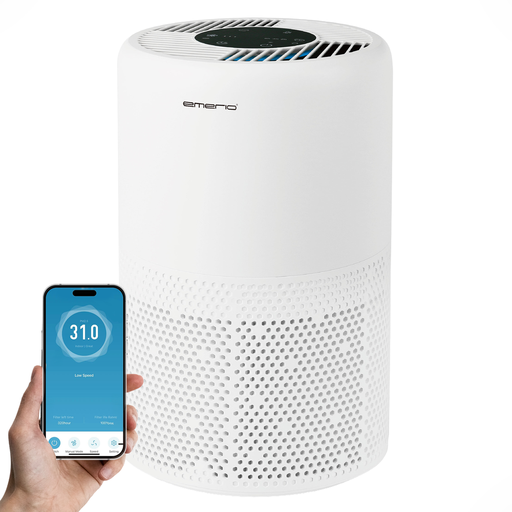
Emerio AP-132324 air purifier, HEPA 13 and carbon filter
Could be a good option if you want to compare filtration and app control for a room.
The product information lists HEPA 13 and carbon filtration, an airflow rate of 221 m³/h, use in rooms up to 25 m² and a noise range of 26–52 dB.
This model has a built-in ioniser, so take that into account if you want to avoid ionisation. The product information also specifies at least 30 cm of clearance all around.
View at Joybuy
 No image available
Philips PureProtect Mini 900 Series AC0921/14
Could be a good choice if you’re looking for a compact appliance to use in a bedroom as well.
The product information lists a CADR of 250 m³/h, a HEPA filter system and a sleep setting from 20.5 dB(A).
The instructions specify at least 30 cm of clearance on all sides.
View at Joybuy
 No image available
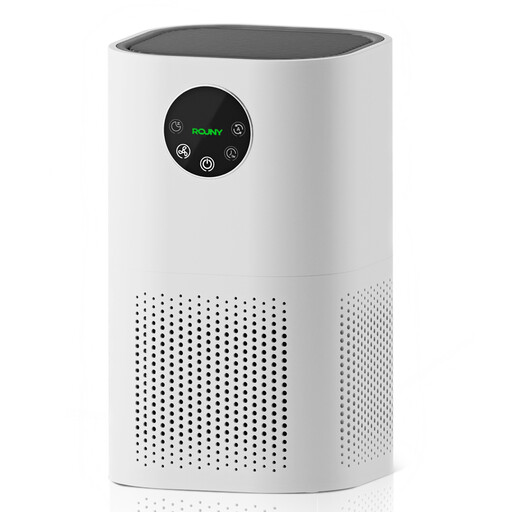
ROUNY AP-T1 air purifier, H13 HEPA, CADR 150 m³/h
Could be a good option if you want to weigh up the stated particle cleaning performance and a sleep setting for a room.
The product information lists a CADR of 150 m³/h, an H13 HEPA filter and a sleep setting of up to 25 dB.
According to the product information, the recommended filter replacement frequency is every 6–8 months, depending on use and air quality.
View at Joybuy
 No image available
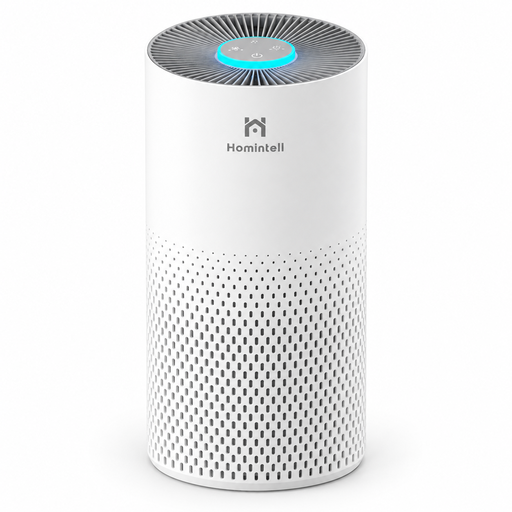
Homintell air purifier, CADR 150 m³/h, 18 m²
Could be a good choice if the stated room size and automatic control suit the way you plan to use it.
The product information lists HEPA and carbon filters, a CADR of 150 m³/h, a recommended room size of 18 m², an automatic setting and a timer.
The instructions specify using original filters only and not washing or reusing the filter.
View at Joybuy
 No image available
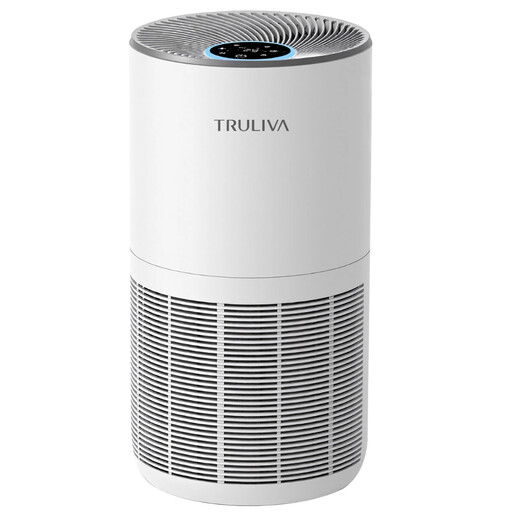
TRULIVA H13 HEPA air purifier, CADR 450 m³/h, 24-hour timer
Could be a good option if you want to compare the stated CADR and timer controls for your room.
The product information lists an H13 HEPA filter, a CADR of 450 m³/h and a 24-hour timer.
View at Joybuy
Frequently asked questions
Does an air purifier remove dust from furniture and floors too?
No. A portable air purifier filters the air that passes through it and doesn’t replace regular cleaning. So don’t expect surfaces to stay dust-free; tackle sources of dust as well.
Where should I put an air purifier in a small bedroom?
Place the appliance where air can circulate freely and follow the clearance specified in the manual. If no distance is given, the Consumentenbond recommends at least 20 cm from walls or furniture as a practical guideline.
Do I still need to ventilate when using an air purifier?
Yes, ventilation is still necessary: according to Milieu Centraal, it removes polluted air and brings in fresh air. An air purifier can complement filtration, but it doesn’t replace ventilation.
What product safety information should I check before buying?
Electrical appliances sold on the Dutch market must meet the applicable European requirements. Ondernemersplein, a Dutch government service, describes CE marking and the EU declaration of conformity as the manufacturer’s responsibilities. Check the documentation for the specific model, as a brand name doesn’t prove that an individual appliance meets the requirements.
What can I do if my air purifier develops a fault?
If the product is faulty, contact the seller. According to the Dutch government, the seller must provide a solution and can’t simply refer you to the manufacturer. Regular filter replacement is different: check the instructions for the exact model.


