
Vandaag of morgen in huis

Kwaliteit gegarandeerd

Welkomstaanbiedingen ontgrendelen: GRATIS bezorging | Tot 80% korting | Gratis 30 dagen JoyPlus-proefperiode
Download de app
An air purifier can help reduce airborne particles and odours in your home. However, it’s not wise to rely solely on terms such as “HEPA”, “large room” or “smart sensor”. Performance depends largely on the CADR rating, the type of filter and the room where you use the appliance.
A bedroom also has different requirements from a living room, home office or a home with pets. Read on to find out which features matter, which marketing claims to treat with caution and which models suit different needs.
Manufacturers sometimes state a maximum room capacity, but this figure may be based on just one air change per hour. That’s not always comparable with a smaller room where the air is cleaned several times an hour.
So pay particular attention to the CADR, or Clean Air Delivery Rate. This tells you how much purified air the appliance circulates per hour. A higher CADR is generally more practical for a larger room or if you want results more quickly.
A HEPA air purifier may be suitable for dust, pollen and other fine particles, but check exactly which filter is specified. H13, H11, “True HEPA” and brand-specific technologies aren’t directly comparable.
Also look at the rest of the filtration system. A pre-filter traps larger particles such as hairs. A HEPA filter is designed for finer particles. An activated carbon filter is intended, according to the product description, to tackle odours and certain gases. Without a carbon layer, an appliance is less suitable if your main concern is cooking smells, smoke or pet odours.
A bedroom air purifier needs to do more than clean the air – it should also be comfortable to use while you sleep. Check the noise level on the low or sleep setting, as well as at higher fan speeds.
Filters are consumables. Before buying, check:
Use the stated room capacity as a guide, not as a guarantee of the same performance in every home. For example, an open-plan living room with high ceilings needs more air circulation than an enclosed bedroom with the same floor area.
For an air purifier for large rooms, models with a higher CADR, such as 360 m³/h or more, are a more logical choice. A lower CADR may be enough for a bedroom or office, as long as the appliance isn’t too small for the room.
For dust, pollen and pet allergens, a combination of pre-filter and HEPA filter is a practical choice. If you also want to tackle smoke or odours, look for an air purifier with a carbon filter.
Bear in mind that claims about removal rates come from the product information. For example, according to its own product description, Blueair states that it removes at least 99.97% of certain airborne particles. This figure relates to a specific test or product condition and isn’t a guarantee for every home.
An air purifier with a PM2.5 sensor can display the measured fine-particle level and adjust the fan speed in automatic mode. This makes it easier to use the appliance day to day without having to choose a setting manually each time.
An air purifier with an app or a smart air purifier is particularly useful if you want to switch it on or off remotely, set schedules or check air quality information. Do check that the app and any voice controls are compatible with your Wi-Fi and smart home system.
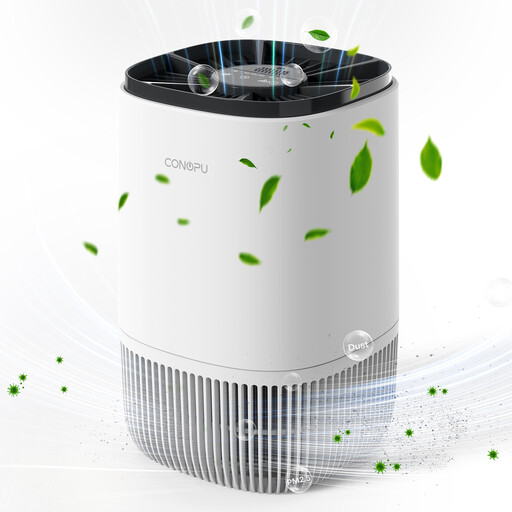
Why it suits this profile: This compact model has three settings, a 24-hour timer and a combination of pre-filter, HEPA filter and activated carbon layer. It’s straightforward to use in a bedroom, office or smaller living room.
The product information specifies an H13 filter, a replaceable filter and low power consumption of 5 W. Do check the available filter size and replacement costs in advance.
H13 filter, three settings, timer and portable design.
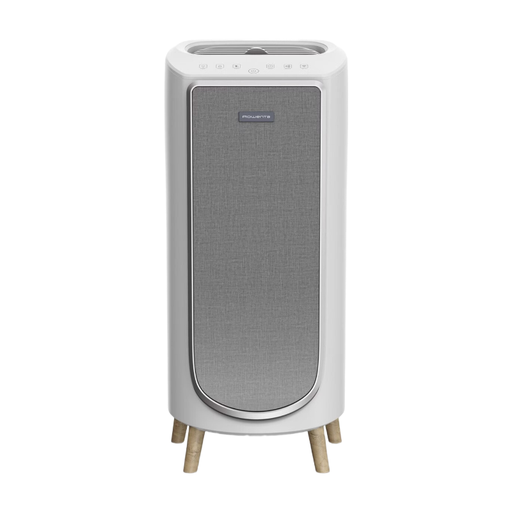
Why it suits this profile: This model combines a CADR of 360 m³/h with Wi-Fi controls, automatic detection and several modes. It’s a good fit for households that value easy controls, monitoring and higher air circulation.
The product description lists separate HEPA, carbon and nano-filters. The stated noise level of 32 dB applies at the lowest speed; higher settings may be noticeably louder.
360 m³/h CADR, Wi-Fi app, automatic mode and night mode.
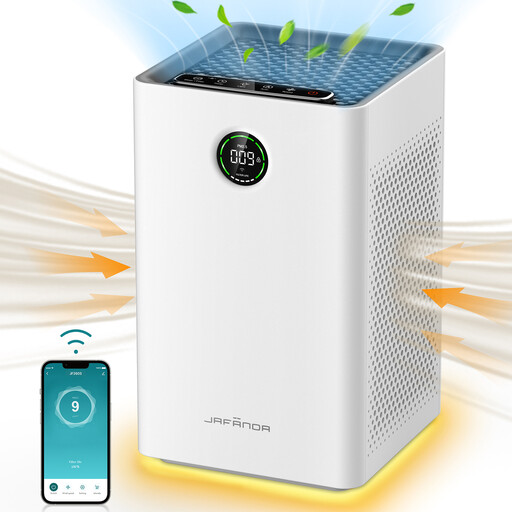
Why it suits this profile: The manufacturer specifies a CADR of 260 m³/h, control via an app and voice assistants, and coverage of up to 1190 ft² at one air change per hour. This makes it an interesting option for larger living spaces.
The specifications give several room sizes and air change rates, rather than a single maximum figure. According to the product information, sleep mode is 23 dB; 53 dB is specified at high speed.
H13 True HEPA, 300 grams of activated carbon, PM2.5 sensor and app controls.

Why it suits this profile: According to the product information, this model is designed for households with pets. It features a three-layer filtration system, app and voice controls, a PM2.5 sensor and a stated coverage area of 16 to 27 m².
The stated room capacity is specific and limited. This makes it clearer when one appliance may not be enough for a large, open-plan living room.
230 m³/h CADR, activated carbon, PM2.5 sensor, child lock and tool-free filter replacement.
We’ve put together a complete, up-to-date list of products that meet these strict selection criteria and current European safety regulations.
Place your air purifier on a flat, stable surface with enough clear space around it. Keep the air inlet and outlet clear of curtains, furniture and other obstructions. Don’t place the appliance in the bathroom, close to a heat source or in a very humid environment.
In a bedroom, use sleep mode where possible and check whether you can dim the lights. In a living room, automatic mode can be useful. Clean the pre-filter regularly and replace disposable filters according to the manual or filter indicator.
According to product descriptions, a model with a pre-filter and HEPA filter is designed to capture airborne particles such as dust and pollen. An activated carbon filter is relevant for smoke and odours. Actual performance depends on the amount of pollution, the room, ventilation and how you use the appliance.
It varies by model and use. Product information for various appliances gives an approximate filter life of six to twelve months. In a home with pets, lots of dust or smoke, you may need to replace the filter sooner. Always follow the filter indicator and the manual.
Power consumption depends on the appliance’s wattage and the fan speed you choose. According to the stated specifications, many models use around 20 to 60 watts. Automatic or low mode generally uses less power than running the appliance continuously at high speed. Check the rated power before buying.
