
Vandaag of morgen in huis

Kwaliteit gegarandeerd

Welkomstaanbiedingen ontgrendelen: GRATIS bezorging | Tot 80% korting | Gratis 30 dagen JoyPlus-proefperiode
Download de app
An air purifier can help reduce airborne particles, dust and unpleasant odours in your home. However, not every model is suitable for every room. A compact air purifier for the bedroom needs different features from an air purifier for large rooms or a home with pets.
The biggest buying mistakes usually stem from three marketing claims:
If you only look at a brand name or a claim such as “99.97% filtration”, you could end up buying a device that moves too little air in practice, makes too much noise or requires expensive filters. Below, you’ll find the specifications you should compare.
CADR, or Clean Air Delivery Rate, indicates how much filtered air a device can deliver per hour. The figure is usually given in m³/h. A higher CADR is particularly relevant in a large living room, open-plan kitchen or office.
A manufacturer’s statement such as “suitable for 50 m²” may be based on one air change per hour. For faster filtration, a smaller area may be more realistic. Therefore, compare:
An air purifier for a bedroom measuring 12 to 20 m² does not need the same capacity as a model for a 60 m² living room. For larger rooms, models offering around 360 to 700 m³/h are more practical than compact tabletop models.
A HEPA air purifier often consists of several filter layers. A pre-filter captures larger particles such as hair and dust. A HEPA filter is designed for smaller airborne particles. An activated carbon filter is used for certain odours and gaseous substances.
Pay attention to the exact description:
According to a brand’s own research or measurements, certain filtration rates may be achieved under specific conditions. Treat these figures as product specifications, therefore, rather than as a guarantee of the same results in every home in the Netherlands.
For a bedroom air purifier, the noise level on the lowest setting is more important than maximum power alone. Also check whether the lights can be dimmed and whether the device automatically switches to night mode.
An air purifier with a PM2.5 sensor can show changes in fine-particle levels and adjust the fan speed automatically. This is useful when cooking, vacuuming or dealing with smoke indoors. However, a sensor only measures the air where the device is positioned.
A smart air purifier, or an air purifier with an app, can offer additional features such as scheduling, filter replacement notifications and remote control. Check in advance:
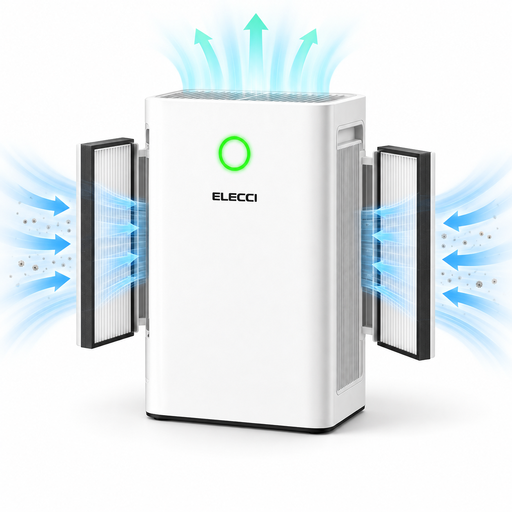
Why it suits this profile: This model combines a CADR of 550 m³/h with a stated coverage of up to 48 m², making it suitable for anyone looking for one device for a bedroom, home office or medium-sized living room.
The product information states both the CADR and the noise level: 24 dB in sleep mode and 69 dB as the general stated figure. This allows you to assess the quiet and maximum settings separately.
CADR of 550 m³/h, dual-HEPA system, washable pre-filter, air-quality indicator and timer of up to 8 hours.

Why it suits this profile: This compact model is well suited to a bedroom, study or child’s room where space is limited and a low noise level matters.
The specifications state a CADR of 250 m³/h alongside maximum coverage of 65 m². This means you can match the capacity to the room more realistically than by relying on the marketed area alone.
Noise level from 20.5 dB(A), PM2.5 sensor, automatic mode, maximum power of 21 W and a stated filter life of approximately 12 months.

Why it suits this profile: The combination of a high stated CADR, app control and odour filtration is well suited to large living spaces, households with pets and intensive daily use.
Alongside stated coverage of 154 m², a CADR of more than 700 m³/h is specified. Filter notifications and an automatic mode are also available, so maintenance does not rely on guesswork alone.
App and voice control, automatic air-quality monitoring, seven filter stages according to the product description and a design intended for large living spaces.
We’ve put together a complete, up-to-date list of products that fully meet these strict selection criteria and the applicable European safety regulations.
Place an air purifier on a level surface with at least 30 cm of clear space around the air inlet and outlet. Do not place the device behind a curtain, directly next to a radiator or in a damp bathroom. In a bedroom, a low setting will often run for longer and more consistently than short periods at maximum speed.
Before first use, check that the plastic packaging has been removed from the filter. A packaged filter blocks the airflow and can put strain on the motor. Clean the pre-filter according to the instructions and replace the main filter as soon as the indicator shows that it is needed. The stated interval varies by model from approximately 6 to 12 months and depends on usage, smoke, pets and local air quality.
An air purifier for pollen and dust is not a substitute for ventilation or regular cleaning. For smoke and odours, an activated carbon filter is relevant, but its capacity decreases as it becomes saturated.
A pre-filter can capture larger particles such as hair. According to the product description, a HEPA filter is designed for smaller airborne particles, including dust and pollen. The effectiveness depends on the CADR, the room, the positioning and how long the device runs. No model can prevent new particles from entering the room again.
This varies by model. Manufacturers often state a period of approximately 6 to 12 months. In a home with pets, a lot of dust or smoke, the filter may need replacing sooner. Check the filter indicator and, before buying, find out whether replacement filters are readily available.
Energy costs depend on the power rating, the setting selected and the number of hours it runs. A 20 W model running 24 hours a day uses less electricity than a 60 W device on its maximum setting. You should also factor in the cost of replacement filters. A quiet automatic mode can help limit consumption when the measured air quality is good.
