Choose a roll labelled ‘wholemeal’ if getting wholegrain is your priority; according to the Netherlands Nutrition Centre, wholemeal bread is made from 100% wholemeal flour. If your child prefers white bread, a multigrain or brown roll can be a stepping stone, but it isn’t automatically wholemeal. Check the current label on the specific roll and, if you plan to bake it, follow the preparation instructions.
Who is this choice relevant to?
Parents who prioritise wholemeal
You’re looking for an after-school roll that’s genuinely wholemeal, rather than one that just looks dark. Look for the ‘wholemeal’ label and compare the fibre per 100 g on specific products. The Netherlands Nutrition Centre explains what the wholemeal label means.
Parents of fussy eaters
You want to try a different roll without risking your child leaving their snack uneaten. A brown or multigrain roll can be a stepping stone; check the ingredients to see whether it contains wholemeal flour and how much.
Parents who shop quickly and keep allergies in mind
You want to know whether a roll needs baking and which allergens are listed on the current packaging. If it’s going to be eaten at school or childcare, check their rules too.
What should you look for when choosing?
First decide whether a fully wholemeal roll, a stepping stone or a white roll is right for what your child will eat. Then compare the labels and preparation instructions for the products you’re considering.
Wholemeal roll
A good fit if: you want a fully wholemeal grain ingredient and your child will eat this roll.
The trade-off: the flavour or texture may put off a child who’s used to white bread.
Brown or multigrain
A good fit if: you want to try something other than white without insisting on a fully wholemeal roll.
The trade-off: the name ‘multigrain’ alone doesn’t mean the grain ingredient is fully wholemeal.
White roll
A good fit if: a familiar white roll is the practical choice for a fussy eater.
The trade-off: white bread isn’t a substitute for a roll specifically labelled as wholemeal.
| What to consider |
What to check when buying |
Who does this matter to? |
| Wholemeal and fibre |
Look for the ‘wholemeal’ label and compare the fibre per 100 g on the labels of specific products. |
If I want to give my child a fully wholemeal roll, I don’t want to judge by colour alone. For around 36% of consumers, choosing wholemeal comes first. |
| Appeal to fussy eaters |
For brown or multigrain rolls, check which types of flour are listed in the ingredients; the product name alone doesn’t tell you everything. |
An after-school roll isn’t much use if my child leaves it uneaten. That’s why around 29% of consumers put how well it’s received first. |
| Preparation and storage |
Check whether baking is needed and follow the preparation and storage instructions for the product you choose. |
On a busy afternoon, I want to know in advance whether I’ll need the oven. This is the biggest consideration for around 21% of consumers. |
| Availability and packaging |
Check how many rolls are in the pack and whether your chosen product is available from your retailer. |
If I’m buying rolls for several afternoons, I want to be able to find a pack that suits my needs. This is the main consideration for around 14% of consumers. |
Common mistakes
-
Mistaking brown or multigrain for wholemeal
A dark colour, grains or seeds don’t prove that the grain ingredient is fully wholemeal. The roll may not be what you thought you were choosing.
If you need a fully wholemeal roll, look for the ‘wholemeal’ label. Otherwise, check the ingredients to see which types of flour have been used.
-
Relying on an allergen list you read earlier
Ingredients and allergen information can change. If you have a relevant allergy, check the information on the packaging of the roll you’ve bought.
Before serving, check the allergen information and any warnings about possible cross-contamination. If the roll will be eaten at school or childcare, ask about their policies too.
-
Leaving baking until after school
A part-baked roll takes time and the right appliance to prepare before you can serve it. Instructions vary from product to product.
Choose a roll that suits when you want to serve it, and read the preparation and storage instructions in advance.
Brands compared
Albert Heijn
Compare a white and a wholemeal roll from the same product range.
- Albert Heijn states that its wholemeal roll is made with 100% wholemeal flour and contains 7,1 g of fibre per 100 g; its white roll contains 2,8 g of fibre per 100 g. These figures apply to those two products.
- Albert Heijn warns that product information can change. Check the packaging of the roll you buy for ingredients, nutritional values and allergens.
Jumbo
Explore different types of rolls, including white, brown and multigrain.
- Jumbo’s roll range includes different types of bread and preparation methods.
- Check the current availability and preparation instructions for each product you choose.
PLUS
Compare white and multigrain part-baked rolls by product.
- For one multigrain roll, PLUS lists ingredients including 56% wholemeal wheat flour and 3% wholemeal rye flour; for a white version, it lists wheat flour as an ingredient.
- These ingredients apply to the versions mentioned. Check the current allergen and preparation information on your pack too.
Dirk
Compare white and multigrain part-baked rolls in packs of four.
- Dirk lists both versions as separate products, so you can choose the type of roll you want.
- For the multigrain version, check the current ingredients and nutritional information if the amount of wholemeal flour or fibre matters to your choice.
ALDI
Explore a single white roll from the bakery section.
- ALDI describes its individual roll as a white bread roll.
- Check the ingredients and allergens for the specific roll before giving it to your child.
Lidl
Explore a white wheat roll available to buy in store.
- Lidl describes its white roll as a wheat roll that’s only available in store.
- Check the current product information when you buy it, especially if ingredients or allergens are important to you.
Rolls for those who prefer white
This Joybuy product is a white roll for anyone considering a white option. If you’re looking for a fully wholemeal or multigrain version instead, check the label of a suitable product before deciding.
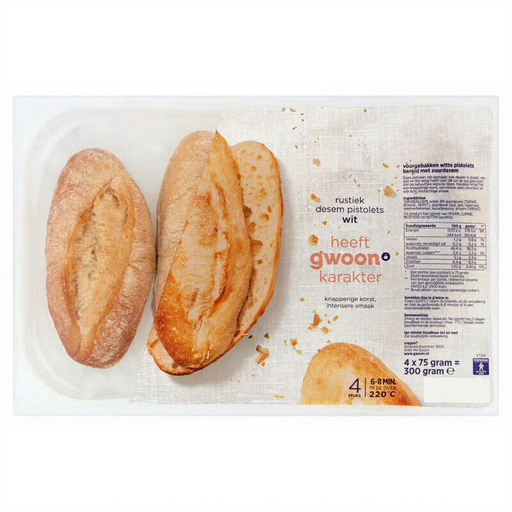 Image unavailable
g'woon white rustic rolls, 4 pieces
An option if you’re choosing a white roll. For a quick after-school snack, check whether it needs to be prepared first.
Pack: 4 pieces. If you have a relevant allergy, check the current label and, if necessary, ask about the school or childcare policies.
View at Joybuy
Frequently asked questions
Is a multigrain roll the same as a wholemeal roll?
No. ‘Multigrain’ doesn’t automatically mean that the grain ingredient is fully wholemeal. According to the Netherlands Nutrition Centre, wholemeal bread is made from 100% wholemeal flour; check the ingredients of a multigrain roll to see which types of flour it contains.
Can I give my child a white roll as an after-school snack?
Yes, a white roll can be a practical choice if your child will eat it. The Netherlands Nutrition Centre also suggests wholemeal bread as a snack for children and recommends wholemeal and brown bread for their fibre; compare the labels if that’s important to you.
What should I check if a child has an allergy?
Check the allergens on the current label of the roll you’ve chosen, including any warnings about possible cross-contamination. The Netherlands Food and Consumer Product Safety Authority says that allergens must be listed on the label. If the child will eat the roll at school or childcare, ask about their policies too.
Can I prepare part-baked rolls in advance for after school?
That depends on the product’s preparation and storage instructions. PLUS gives oven or air fryer instructions for some rolls; check how to prepare and store the rolls on your pack.


